Wen Cai, Junqing Wang, Chengchao Chu, Wei Chen, Chunsheng Wu, Gang Liu
{"title":"Metal–Organic Framework-Based Stimuli-Responsive Systems for Drug Delivery","authors":"Wen Cai, Junqing Wang, Chengchao Chu, Wei Chen, Chunsheng Wu, Gang Liu","doi":"10.1002/advs.201801526","DOIUrl":null,"url":null,"abstract":"<p>With the rapid development of nanotechnology, stimuli-responsive nanomaterials have provided an alternative for designing controllable drug delivery systems due to their spatiotemporally controllable properties. As a new type of porous material, metal–organic frameworks (MOFs) have been widely used in biomedical applications, especially drug delivery systems, owing to their tunable pore size, high surface area and pore volume, and easy surface modification. Here, recent progress in MOF-based stimuli-responsive systems is presented, including pH-, magnetic-, ion-, temperature-, pressure-, light-, humidity-, redox-, and multiple stimuli-responsive systems for the delivery of anticancer drugs. The remaining challenges and suggestions for future directions for the rational design of MOF-based nanomedicines are also discussed.</p>","PeriodicalId":117,"journal":{"name":"Advanced Science","volume":"6 1","pages":""},"PeriodicalIF":14.1000,"publicationDate":"2018-11-20","publicationTypes":"Journal Article","fieldsOfStudy":null,"isOpenAccess":false,"openAccessPdf":"https://sci-hub-pdf.com/10.1002/advs.201801526","citationCount":"410","resultStr":null,"platform":"Semanticscholar","paperid":null,"PeriodicalName":"Advanced Science","FirstCategoryId":"88","ListUrlMain":"https://onlinelibrary.wiley.com/doi/10.1002/advs.201801526","RegionNum":1,"RegionCategory":"材料科学","ArticlePicture":[],"TitleCN":null,"AbstractTextCN":null,"PMCID":null,"EPubDate":"","PubModel":"","JCR":"Q1","JCRName":"CHEMISTRY, MULTIDISCIPLINARY","Score":null,"Total":0}
引用次数: 410
Abstract
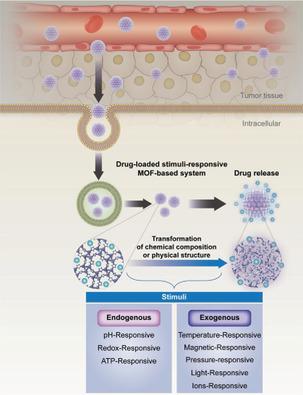
With the rapid development of nanotechnology, stimuli-responsive nanomaterials have provided an alternative for designing controllable drug delivery systems due to their spatiotemporally controllable properties. As a new type of porous material, metal–organic frameworks (MOFs) have been widely used in biomedical applications, especially drug delivery systems, owing to their tunable pore size, high surface area and pore volume, and easy surface modification. Here, recent progress in MOF-based stimuli-responsive systems is presented, including pH-, magnetic-, ion-, temperature-, pressure-, light-, humidity-, redox-, and multiple stimuli-responsive systems for the delivery of anticancer drugs. The remaining challenges and suggestions for future directions for the rational design of MOF-based nanomedicines are also discussed.
期刊介绍:
Advanced Science is a prestigious open access journal that focuses on interdisciplinary research in materials science, physics, chemistry, medical and life sciences, and engineering. The journal aims to promote cutting-edge research by employing a rigorous and impartial review process. It is committed to presenting research articles with the highest quality production standards, ensuring maximum accessibility of top scientific findings. With its vibrant and innovative publication platform, Advanced Science seeks to revolutionize the dissemination and organization of scientific knowledge.



 京公网安备 11010802042870号
京ICP备2023020795号-1
京公网安备 11010802042870号
京ICP备2023020795号-1

 分享
分享
 求助内容:
求助内容: 应助结果提醒方式:
 扫码关注我们
