Dongqin Yu, Haochen Zhang, Zhenqi Liu, Chun Liu, Dr. Xiubo Du, Prof. Jinsong Ren, Prof. Xiaogang Qu
{"title":"Hydrogen-Bonded Organic Framework (HOF)-Based Single-Neural Stem Cell Encapsulation and Transplantation to Remodel Impaired Neural Networks","authors":"Dongqin Yu, Haochen Zhang, Zhenqi Liu, Chun Liu, Dr. Xiubo Du, Prof. Jinsong Ren, Prof. Xiaogang Qu","doi":"10.1002/anie.202201485","DOIUrl":null,"url":null,"abstract":"<p>Herein we present a new way to encapsulate neural stem cells (NSCs) by using hydrogen-bonded organic frameworks (HOFs) to overcome the common causes of low therapeutic efficacy during NSC transplantation: 1) loss of fundamental stem cell properties, “stemness”, before transplantation, 2) cytomembrane damage during transplantation, and 3) apoptosis due to oxidative stress after transplantation. Porous carbon nanospheres (PCNs) are doped into the HOF shell during the process of mineralization to endow the cellular exoskeletons with hierarchical hydrogen bonds, and the ability to resist oxidative stress due to the catalase and superoxide dismutase-like activities of PCN. Under NIR-II irradiation, thermal-responsive hydrogen bonds dissociate to release NSCs. Stereotactic transplanting encapsulated NSC into the brain of an Alzheimer's disease (AD) mouse model further verifies that our design can enhance NSC viability, promote neurogenesis, and ameliorate cognitive impairment. As the first example of using HOFs to encapsulate NSCs, this work may inspire the design of HOF-based exoskeletons to ameliorate neurogenesis and cognitive behavioral symptoms associated with AD.</p>","PeriodicalId":125,"journal":{"name":"Angewandte Chemie International Edition","volume":"61 28","pages":""},"PeriodicalIF":16.9000,"publicationDate":"2022-04-06","publicationTypes":"Journal Article","fieldsOfStudy":null,"isOpenAccess":false,"openAccessPdf":"","citationCount":"22","resultStr":null,"platform":"Semanticscholar","paperid":null,"PeriodicalName":"Angewandte Chemie International Edition","FirstCategoryId":"92","ListUrlMain":"https://onlinelibrary.wiley.com/doi/10.1002/anie.202201485","RegionNum":1,"RegionCategory":"化学","ArticlePicture":[],"TitleCN":null,"AbstractTextCN":null,"PMCID":null,"EPubDate":"","PubModel":"","JCR":"Q1","JCRName":"CHEMISTRY, MULTIDISCIPLINARY","Score":null,"Total":0}
引用次数: 22
Abstract
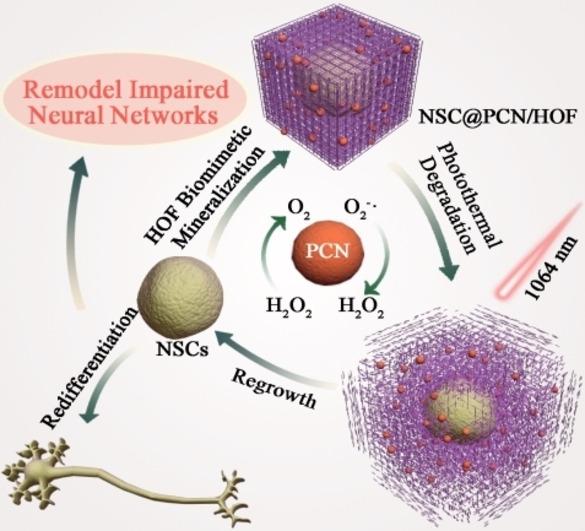
Herein we present a new way to encapsulate neural stem cells (NSCs) by using hydrogen-bonded organic frameworks (HOFs) to overcome the common causes of low therapeutic efficacy during NSC transplantation: 1) loss of fundamental stem cell properties, “stemness”, before transplantation, 2) cytomembrane damage during transplantation, and 3) apoptosis due to oxidative stress after transplantation. Porous carbon nanospheres (PCNs) are doped into the HOF shell during the process of mineralization to endow the cellular exoskeletons with hierarchical hydrogen bonds, and the ability to resist oxidative stress due to the catalase and superoxide dismutase-like activities of PCN. Under NIR-II irradiation, thermal-responsive hydrogen bonds dissociate to release NSCs. Stereotactic transplanting encapsulated NSC into the brain of an Alzheimer's disease (AD) mouse model further verifies that our design can enhance NSC viability, promote neurogenesis, and ameliorate cognitive impairment. As the first example of using HOFs to encapsulate NSCs, this work may inspire the design of HOF-based exoskeletons to ameliorate neurogenesis and cognitive behavioral symptoms associated with AD.
期刊介绍:
Angewandte Chemie, a journal of the German Chemical Society (GDCh), maintains a leading position among scholarly journals in general chemistry with an impressive Impact Factor of 16.6 (2022 Journal Citation Reports, Clarivate, 2023). Published weekly in a reader-friendly format, it features new articles almost every day. Established in 1887, Angewandte Chemie is a prominent chemistry journal, offering a dynamic blend of Review-type articles, Highlights, Communications, and Research Articles on a weekly basis, making it unique in the field.



 京公网安备 11010802042870号
京ICP备2023020795号-1
京公网安备 11010802042870号
京ICP备2023020795号-1

 分享
分享
 求助内容:
求助内容: 应助结果提醒方式:
 扫码关注我们
