{"title":"Shaping-Power-Constrained Transceiver Designs for MIMO AF Relaying Systems With Direct Link","authors":"Han-Bae Kong;Changick Song;Haewook Park;Inkyu Lee","doi":"10.1109/TWC.2014.2342223","DOIUrl":null,"url":null,"abstract":"In this paper, we propose new relay transceiver designs based on the minimum mean square error (MMSE) criterion for amplify-and-forward multiple-input-multiple-output (MIMO) relaying systems with direct link. Since each antenna element is equipped with its own power amplifier, a norm power constraint, which restricts the transmit power with the expected norm of the transmit signal vector, is not suitable for practical systems. Therefore, we consider a shaping constraint (SC), which imposes a limit on the shape of the transmit covariance matrix. The SC includes several power constraints such as the peak power constraint and the per-antenna power constraint as special cases. To this end, we first derive the optimal structure of the MMSE relay transceiver under the SC. Then, by introducing an upper bound of the mean square error, we provide closed-form relay transceiver solutions. Due to limited bandwidth of the feedback channel, perfect channel knowledge at the transmitter may not be feasible. Thus, we also propose a quantized relay transceiver design based on Grassmannian codebooks for a limited-feedback scenario. From simulation results, it is confirmed that the proposed relay transceiver techniques demonstrate a significant performance improvement compared with conventional schemes.","PeriodicalId":13431,"journal":{"name":"IEEE Transactions on Wireless Communications","volume":"14 1","pages":"294-304"},"PeriodicalIF":10.7000,"publicationDate":"2014-07-23","publicationTypes":"Journal Article","fieldsOfStudy":null,"isOpenAccess":false,"openAccessPdf":"https://sci-hub-pdf.com/10.1109/TWC.2014.2342223","citationCount":"7","resultStr":null,"platform":"Semanticscholar","paperid":null,"PeriodicalName":"IEEE Transactions on Wireless Communications","FirstCategoryId":"94","ListUrlMain":"https://ieeexplore.ieee.org/document/6862926/","RegionNum":1,"RegionCategory":"计算机科学","ArticlePicture":[],"TitleCN":null,"AbstractTextCN":null,"PMCID":null,"EPubDate":"","PubModel":"","JCR":"Q1","JCRName":"ENGINEERING, ELECTRICAL & ELECTRONIC","Score":null,"Total":0}
引用次数: 7
Abstract
In this paper, we propose new relay transceiver designs based on the minimum mean square error (MMSE) criterion for amplify-and-forward multiple-input-multiple-output (MIMO) relaying systems with direct link. Since each antenna element is equipped with its own power amplifier, a norm power constraint, which restricts the transmit power with the expected norm of the transmit signal vector, is not suitable for practical systems. Therefore, we consider a shaping constraint (SC), which imposes a limit on the shape of the transmit covariance matrix. The SC includes several power constraints such as the peak power constraint and the per-antenna power constraint as special cases. To this end, we first derive the optimal structure of the MMSE relay transceiver under the SC. Then, by introducing an upper bound of the mean square error, we provide closed-form relay transceiver solutions. Due to limited bandwidth of the feedback channel, perfect channel knowledge at the transmitter may not be feasible. Thus, we also propose a quantized relay transceiver design based on Grassmannian codebooks for a limited-feedback scenario. From simulation results, it is confirmed that the proposed relay transceiver techniques demonstrate a significant performance improvement compared with conventional schemes.
期刊介绍:
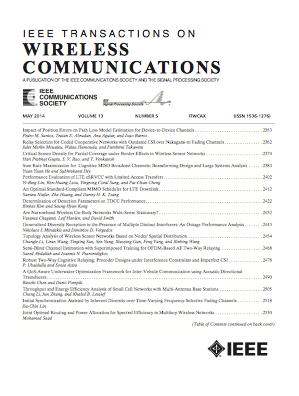
The IEEE Transactions on Wireless Communications is a prestigious publication that showcases cutting-edge advancements in wireless communications. It welcomes both theoretical and practical contributions in various areas. The scope of the Transactions encompasses a wide range of topics, including modulation and coding, detection and estimation, propagation and channel characterization, and diversity techniques. The journal also emphasizes the physical and link layer communication aspects of network architectures and protocols.
The journal is open to papers on specific topics or non-traditional topics related to specific application areas. This includes simulation tools and methodologies, orthogonal frequency division multiplexing, MIMO systems, and wireless over optical technologies.
Overall, the IEEE Transactions on Wireless Communications serves as a platform for high-quality manuscripts that push the boundaries of wireless communications and contribute to advancements in the field.



 京公网安备 11010802042870号
京ICP备2023020795号-1
京公网安备 11010802042870号
京ICP备2023020795号-1

 分享
分享
 求助内容:
求助内容: 应助结果提醒方式:
 扫码关注我们
