{"title":"Association of Balance Impairment with Risk of Incident Dementia among Older Adults.","authors":"H J Kim, S Jeong, Y H Oh, M J Suh","doi":"10.14283/jpad.2023.79","DOIUrl":null,"url":null,"abstract":"<p><strong>Background: </strong>A growing body of data suggests that balance impairment may be linked to the onset of dementia.</p><p><strong>Objectives: </strong>However, a large-scale epidemiologic investigation is needed to clarify its association in older adults.</p><p><strong>Design: </strong>A retrospective-prospective hybrid database.</p><p><strong>Setting: </strong>Cox proportional hazards regression model was used to assess the relationship between balance impairment and the risk of incident dementia, and the results were provided as adjusted hazard ratios (aHR) with 95% confidence intervals (CI). All participants were tracked until the date of incident dementia, death, or 31 December 2019 whichever came first.</p><p><strong>Participants: </strong>We analyzed 143,788 older adults who had at least one health screening between 2009 and 2019 from the Korea National Health Insurance Service-Senior Cohort.</p><p><strong>Measurements: </strong>A total of 3,774 cases of dementia were discovered throughout 850,425 person-years of follow-up investigation. Balance impairment was associated with a risk of dementia compared to those without balance impairment (adjusted hazard ratio [aHR] 1.83; 95% CI, 1.69-2.00; P value <0.001).</p><p><strong>Results: </strong>Risks of the Alzheimer's disease (aHR, 1.80; 95% CI, 1.65-1.96; P for trend <0.001) and the vascular dementia (aHR, 2.94; 95% CI, 1.89-4.58; P for trend <0.001) showed comparable trends and findings.</p><p><strong>Conclusions: </strong>Balance impairment was found to be independently associated with an increased risk of dementia in older adults.</p>","PeriodicalId":16235,"journal":{"name":"Journal of Mechanical Science and Technology","volume":"31 1","pages":"130-137"},"PeriodicalIF":1.7000,"publicationDate":"2024-01-01","publicationTypes":"Journal Article","fieldsOfStudy":null,"isOpenAccess":false,"openAccessPdf":"","citationCount":"0","resultStr":null,"platform":"Semanticscholar","paperid":null,"PeriodicalName":"Journal of Mechanical Science and Technology","FirstCategoryId":"3","ListUrlMain":"https://doi.org/10.14283/jpad.2023.79","RegionNum":4,"RegionCategory":"工程技术","ArticlePicture":[],"TitleCN":null,"AbstractTextCN":null,"PMCID":null,"EPubDate":"","PubModel":"","JCR":"Q3","JCRName":"ENGINEERING, MECHANICAL","Score":null,"Total":0}
引用次数: 0
Abstract
Background: A growing body of data suggests that balance impairment may be linked to the onset of dementia.
Objectives: However, a large-scale epidemiologic investigation is needed to clarify its association in older adults.
Design: A retrospective-prospective hybrid database.
Setting: Cox proportional hazards regression model was used to assess the relationship between balance impairment and the risk of incident dementia, and the results were provided as adjusted hazard ratios (aHR) with 95% confidence intervals (CI). All participants were tracked until the date of incident dementia, death, or 31 December 2019 whichever came first.
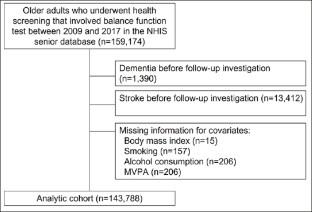
Participants: We analyzed 143,788 older adults who had at least one health screening between 2009 and 2019 from the Korea National Health Insurance Service-Senior Cohort.
Measurements: A total of 3,774 cases of dementia were discovered throughout 850,425 person-years of follow-up investigation. Balance impairment was associated with a risk of dementia compared to those without balance impairment (adjusted hazard ratio [aHR] 1.83; 95% CI, 1.69-2.00; P value <0.001).
Results: Risks of the Alzheimer's disease (aHR, 1.80; 95% CI, 1.65-1.96; P for trend <0.001) and the vascular dementia (aHR, 2.94; 95% CI, 1.89-4.58; P for trend <0.001) showed comparable trends and findings.
Conclusions: Balance impairment was found to be independently associated with an increased risk of dementia in older adults.
期刊介绍:
The aim of the Journal of Mechanical Science and Technology is to provide an international forum for the publication and dissemination of original work that contributes to the understanding of the main and related disciplines of mechanical engineering, either empirical or theoretical. The Journal covers the whole spectrum of mechanical engineering, which includes, but is not limited to, Materials and Design Engineering, Production Engineering and Fusion Technology, Dynamics, Vibration and Control, Thermal Engineering and Fluids Engineering.
Manuscripts may fall into several categories including full articles, solicited reviews or commentary, and unsolicited reviews or commentary related to the core of mechanical engineering.



 京公网安备 11010802042870号
京ICP备2023020795号-1
京公网安备 11010802042870号
京ICP备2023020795号-1

 分享
分享
 求助内容:
求助内容: 应助结果提醒方式:
 扫码关注我们
