{"title":"Secure and efficient implementation of facial emotion detection for smart patient monitoring system.","authors":"Kh Shahriya Zaman, Md Mamun Bin Ibne Reaz","doi":"10.15302/J-QB-022-0312","DOIUrl":null,"url":null,"abstract":"<p><strong>Background: </strong>Machine learning has enabled the automatic detection of facial expressions, which is particularly beneficial in smart monitoring and understanding the mental state of medical and psychological patients. Most algorithms that attain high emotion classification accuracy require extensive computational resources, which either require bulky and inefficient devices or require the sensor data to be processed on cloud servers. However, there is always the risk of privacy invasion, data misuse, and data manipulation when the raw images are transferred to cloud servers for processing facical emotion recognition (FER) data. One possible solution to this problem is to minimize the movement of such private data.</p><p><strong>Methods: </strong>In this research, we propose an efficient implementation of a convolutional neural network (CNN) based algorithm for on-device FER on a low-power field programmable gate array (FPGA) platform. This is done by encoding the CNN weights to approximated signed digits, which reduces the number of partial sums to be computed for multiply-accumulate (MAC) operations. This is advantageous for portable devices that lack full-fledged resource-intensive multipliers.</p><p><strong>Results: </strong>We applied our approximation method on MobileNet-v2 and ResNet18 models, which were pretrained with the FER2013 dataset. Our implementations and simulations reduce the FPGA resource requirement by at least 22% compared to models with integer weight, with negligible loss in classification accuracy.</p><p><strong>Conclusions: </strong>The outcome of this research will help in the development of secure and low-power systems for FER and other biomedical applications. The approximation methods used in this research can also be extended to other image-based biomedical research fields.</p>","PeriodicalId":45660,"journal":{"name":"Quantitative Biology","volume":"15 1 1","pages":"175-182"},"PeriodicalIF":1.4000,"publicationDate":"2023-06-01","publicationTypes":"Journal Article","fieldsOfStudy":null,"isOpenAccess":false,"openAccessPdf":"https://www.ncbi.nlm.nih.gov/pmc/articles/PMC12807348/pdf/","citationCount":"0","resultStr":null,"platform":"Semanticscholar","paperid":null,"PeriodicalName":"Quantitative Biology","FirstCategoryId":"99","ListUrlMain":"https://doi.org/10.15302/J-QB-022-0312","RegionNum":4,"RegionCategory":"生物学","ArticlePicture":[],"TitleCN":null,"AbstractTextCN":null,"PMCID":null,"EPubDate":"","PubModel":"","JCR":"Q4","JCRName":"MATHEMATICAL & COMPUTATIONAL BIOLOGY","Score":null,"Total":0}
引用次数: 0
Abstract
Background: Machine learning has enabled the automatic detection of facial expressions, which is particularly beneficial in smart monitoring and understanding the mental state of medical and psychological patients. Most algorithms that attain high emotion classification accuracy require extensive computational resources, which either require bulky and inefficient devices or require the sensor data to be processed on cloud servers. However, there is always the risk of privacy invasion, data misuse, and data manipulation when the raw images are transferred to cloud servers for processing facical emotion recognition (FER) data. One possible solution to this problem is to minimize the movement of such private data.
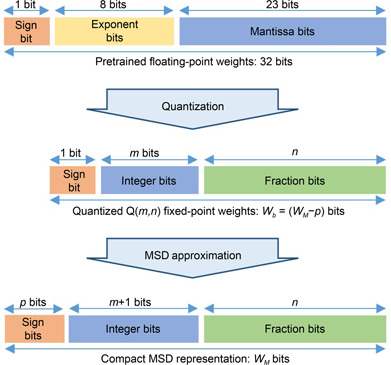
Methods: In this research, we propose an efficient implementation of a convolutional neural network (CNN) based algorithm for on-device FER on a low-power field programmable gate array (FPGA) platform. This is done by encoding the CNN weights to approximated signed digits, which reduces the number of partial sums to be computed for multiply-accumulate (MAC) operations. This is advantageous for portable devices that lack full-fledged resource-intensive multipliers.
Results: We applied our approximation method on MobileNet-v2 and ResNet18 models, which were pretrained with the FER2013 dataset. Our implementations and simulations reduce the FPGA resource requirement by at least 22% compared to models with integer weight, with negligible loss in classification accuracy.
Conclusions: The outcome of this research will help in the development of secure and low-power systems for FER and other biomedical applications. The approximation methods used in this research can also be extended to other image-based biomedical research fields.
期刊介绍:
Quantitative Biology is an interdisciplinary journal that focuses on original research that uses quantitative approaches and technologies to analyze and integrate biological systems, construct and model engineered life systems, and gain a deeper understanding of the life sciences. It aims to provide a platform for not only the analysis but also the integration and construction of biological systems. It is a quarterly journal seeking to provide an inter- and multi-disciplinary forum for a broad blend of peer-reviewed academic papers in order to promote rapid communication and exchange between scientists in the East and the West. The content of Quantitative Biology will mainly focus on the two broad and related areas: ·bioinformatics and computational biology, which focuses on dealing with information technologies and computational methodologies that can efficiently and accurately manipulate –omics data and transform molecular information into biological knowledge. ·systems and synthetic biology, which focuses on complex interactions in biological systems and the emergent functional properties, and on the design and construction of new biological functions and systems. Its goal is to reflect the significant advances made in quantitatively investigating and modeling both natural and engineered life systems at the molecular and higher levels. The journal particularly encourages original papers that link novel theory with cutting-edge experiments, especially in the newly emerging and multi-disciplinary areas of research. The journal also welcomes high-quality reviews and perspective articles.





 京公网安备 11010802042870号
京ICP备2023020795号-1
京公网安备 11010802042870号
京ICP备2023020795号-1

 分享
分享
 求助内容:
求助内容: 应助结果提醒方式:
 扫码关注我们
