{"title":"Prediction of chromatin looping using deep hybrid learning (DHL).","authors":"Mateusz Chiliński, Anup Kumar Halder, Dariusz Plewczynski","doi":"10.15302/J-QB-022-0315","DOIUrl":null,"url":null,"abstract":"<p><strong>Background: </strong>With the development of rapid and cheap sequencing techniques, the cost of whole-genome sequencing (WGS) has dropped significantly. However, the complexity of the human genome is not limited to the pure sequence-and additional experiments are required to learn the human genome's influence on complex traits. One of the most exciting aspects for scientists nowadays is the spatial organisation of the genome, which can be discovered using spatial experiments ( <i><b>e.g.</b></i> , Hi-C, ChIA-PET). The information about the spatial contacts helps in the analysis and brings new insights into our understanding of the disease developments.</p><p><strong>Methods: </strong>We have used an ensemble of deep learning with classical machine learning algorithms. The deep learning network we used was DNABERT, which utilises the BERT language model (based on transformers) for the genomic function. The classical machine learning models included support vector machines (SVMs), random forests (RFs), and K-nearest neighbor (KNN). The whole approach was wrapped together as deep hybrid learning (DHL).</p><p><strong>Results: </strong>We found that the DNABERT can be used to predict the ChIA-PET experiments with high precision. Additionally, the DHL approach has increased the metrics on CTCF and RNAPII sets.</p><p><strong>Conclusions: </strong>DHL approach should be taken into consideration for the models utilising the power of deep learning. While straightforward in the concept, it can improve the results significantly.</p>","PeriodicalId":45660,"journal":{"name":"Quantitative Biology","volume":"1 1","pages":"155-162"},"PeriodicalIF":1.4000,"publicationDate":"2023-06-01","publicationTypes":"Journal Article","fieldsOfStudy":null,"isOpenAccess":false,"openAccessPdf":"https://www.ncbi.nlm.nih.gov/pmc/articles/PMC12806927/pdf/","citationCount":"0","resultStr":null,"platform":"Semanticscholar","paperid":null,"PeriodicalName":"Quantitative Biology","FirstCategoryId":"99","ListUrlMain":"https://doi.org/10.15302/J-QB-022-0315","RegionNum":4,"RegionCategory":"生物学","ArticlePicture":[],"TitleCN":null,"AbstractTextCN":null,"PMCID":null,"EPubDate":"","PubModel":"","JCR":"Q4","JCRName":"MATHEMATICAL & COMPUTATIONAL BIOLOGY","Score":null,"Total":0}
引用次数: 0
Abstract
Background: With the development of rapid and cheap sequencing techniques, the cost of whole-genome sequencing (WGS) has dropped significantly. However, the complexity of the human genome is not limited to the pure sequence-and additional experiments are required to learn the human genome's influence on complex traits. One of the most exciting aspects for scientists nowadays is the spatial organisation of the genome, which can be discovered using spatial experiments ( e.g. , Hi-C, ChIA-PET). The information about the spatial contacts helps in the analysis and brings new insights into our understanding of the disease developments.
Methods: We have used an ensemble of deep learning with classical machine learning algorithms. The deep learning network we used was DNABERT, which utilises the BERT language model (based on transformers) for the genomic function. The classical machine learning models included support vector machines (SVMs), random forests (RFs), and K-nearest neighbor (KNN). The whole approach was wrapped together as deep hybrid learning (DHL).
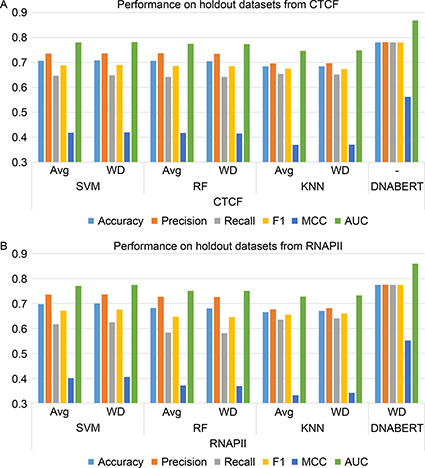
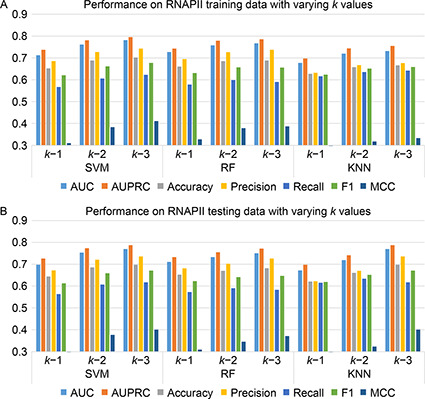
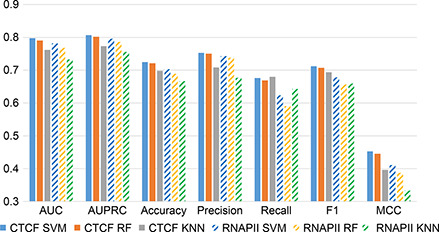
Results: We found that the DNABERT can be used to predict the ChIA-PET experiments with high precision. Additionally, the DHL approach has increased the metrics on CTCF and RNAPII sets.
Conclusions: DHL approach should be taken into consideration for the models utilising the power of deep learning. While straightforward in the concept, it can improve the results significantly.
期刊介绍:
Quantitative Biology is an interdisciplinary journal that focuses on original research that uses quantitative approaches and technologies to analyze and integrate biological systems, construct and model engineered life systems, and gain a deeper understanding of the life sciences. It aims to provide a platform for not only the analysis but also the integration and construction of biological systems. It is a quarterly journal seeking to provide an inter- and multi-disciplinary forum for a broad blend of peer-reviewed academic papers in order to promote rapid communication and exchange between scientists in the East and the West. The content of Quantitative Biology will mainly focus on the two broad and related areas: ·bioinformatics and computational biology, which focuses on dealing with information technologies and computational methodologies that can efficiently and accurately manipulate –omics data and transform molecular information into biological knowledge. ·systems and synthetic biology, which focuses on complex interactions in biological systems and the emergent functional properties, and on the design and construction of new biological functions and systems. Its goal is to reflect the significant advances made in quantitatively investigating and modeling both natural and engineered life systems at the molecular and higher levels. The journal particularly encourages original papers that link novel theory with cutting-edge experiments, especially in the newly emerging and multi-disciplinary areas of research. The journal also welcomes high-quality reviews and perspective articles.



 京公网安备 11010802042870号
京ICP备2023020795号-1
京公网安备 11010802042870号
京ICP备2023020795号-1

 分享
分享
 求助内容:
求助内容: 应助结果提醒方式:
 扫码关注我们
