{"title":"3D genomic organization in cancers.","authors":"Junting Wang, Huan Tao, Hao Li, Xiaochen Bo, Hebing Chen","doi":"10.15302/J-QB-022-0317","DOIUrl":null,"url":null,"abstract":"<p><strong>Background: </strong>The hierarchical three-dimensional (3D) architectures of chromatin play an important role in fundamental biological processes, such as cell differentiation, cellular senescence, and transcriptional regulation. Aberrant chromatin 3D structural alterations often present in human diseases and even cancers, but their underlying mechanisms remain unclear.</p><p><strong>Results: </strong>3D chromatin structures (chromatin compartment A/B, topologically associated domains, and enhancer-promoter interactions) play key roles in cancer development, metastasis, and drug resistance. Bioinformatics techniques based on machine learning and deep learning have shown great potential in the study of 3D cancer genome.</p><p><strong>Conclusion: </strong>Current advances in the study of the 3D cancer genome have expanded our understanding of the mechanisms underlying tumorigenesis and development. It will provide new insights into precise diagnosis and personalized treatment for cancers.</p>","PeriodicalId":45660,"journal":{"name":"Quantitative Biology","volume":"1 1","pages":"109-121"},"PeriodicalIF":1.4000,"publicationDate":"2023-06-01","publicationTypes":"Journal Article","fieldsOfStudy":null,"isOpenAccess":false,"openAccessPdf":"https://www.ncbi.nlm.nih.gov/pmc/articles/PMC12807217/pdf/","citationCount":"0","resultStr":null,"platform":"Semanticscholar","paperid":null,"PeriodicalName":"Quantitative Biology","FirstCategoryId":"99","ListUrlMain":"https://doi.org/10.15302/J-QB-022-0317","RegionNum":4,"RegionCategory":"生物学","ArticlePicture":[],"TitleCN":null,"AbstractTextCN":null,"PMCID":null,"EPubDate":"","PubModel":"","JCR":"Q4","JCRName":"MATHEMATICAL & COMPUTATIONAL BIOLOGY","Score":null,"Total":0}
引用次数: 0
Abstract
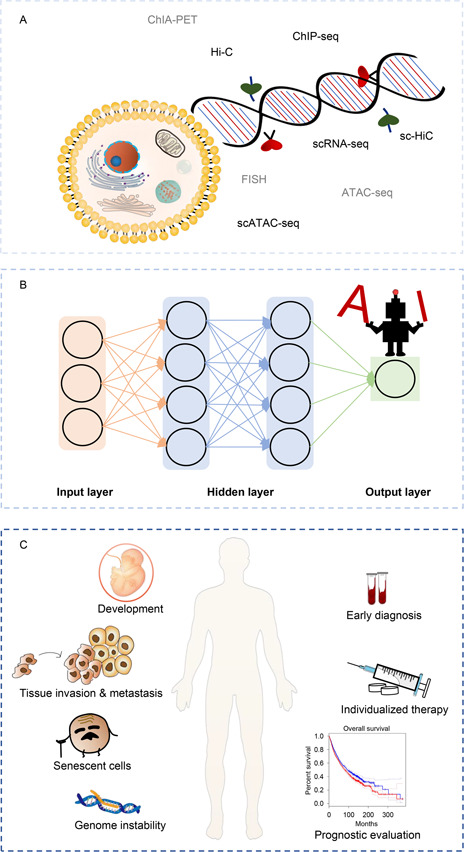
Background: The hierarchical three-dimensional (3D) architectures of chromatin play an important role in fundamental biological processes, such as cell differentiation, cellular senescence, and transcriptional regulation. Aberrant chromatin 3D structural alterations often present in human diseases and even cancers, but their underlying mechanisms remain unclear.
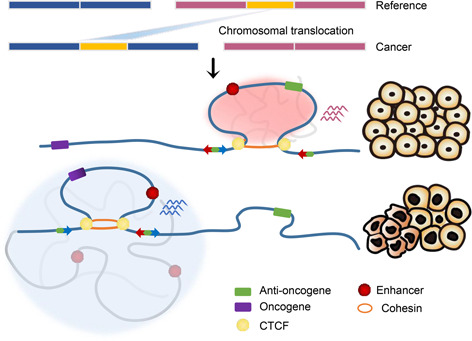
Results: 3D chromatin structures (chromatin compartment A/B, topologically associated domains, and enhancer-promoter interactions) play key roles in cancer development, metastasis, and drug resistance. Bioinformatics techniques based on machine learning and deep learning have shown great potential in the study of 3D cancer genome.
Conclusion: Current advances in the study of the 3D cancer genome have expanded our understanding of the mechanisms underlying tumorigenesis and development. It will provide new insights into precise diagnosis and personalized treatment for cancers.
期刊介绍:
Quantitative Biology is an interdisciplinary journal that focuses on original research that uses quantitative approaches and technologies to analyze and integrate biological systems, construct and model engineered life systems, and gain a deeper understanding of the life sciences. It aims to provide a platform for not only the analysis but also the integration and construction of biological systems. It is a quarterly journal seeking to provide an inter- and multi-disciplinary forum for a broad blend of peer-reviewed academic papers in order to promote rapid communication and exchange between scientists in the East and the West. The content of Quantitative Biology will mainly focus on the two broad and related areas: ·bioinformatics and computational biology, which focuses on dealing with information technologies and computational methodologies that can efficiently and accurately manipulate –omics data and transform molecular information into biological knowledge. ·systems and synthetic biology, which focuses on complex interactions in biological systems and the emergent functional properties, and on the design and construction of new biological functions and systems. Its goal is to reflect the significant advances made in quantitatively investigating and modeling both natural and engineered life systems at the molecular and higher levels. The journal particularly encourages original papers that link novel theory with cutting-edge experiments, especially in the newly emerging and multi-disciplinary areas of research. The journal also welcomes high-quality reviews and perspective articles.




 京公网安备 11010802042870号
京ICP备2023020795号-1
京公网安备 11010802042870号
京ICP备2023020795号-1

 分享
分享
 求助内容:
求助内容: 应助结果提醒方式:
 扫码关注我们
