Jwa Hoon Kim, Shinkyo Yoon, Dae Ho Lee, Se Jin Jang, Sung-Min Chun, Sang-We Kim
{"title":"Real-world utility of next-generation sequencing for targeted gene analysis and its application to treatment in lung adenocarcinoma","authors":"Jwa Hoon Kim, Shinkyo Yoon, Dae Ho Lee, Se Jin Jang, Sung-Min Chun, Sang-We Kim","doi":"10.1002/cam4.3874","DOIUrl":null,"url":null,"abstract":"<div>\n \n \n <section>\n \n <h3> Purpose</h3>\n \n <p>This study investigated the clinical utility of next-generation sequencing (NGS) for detection of genetic alterations and its implications on treatment of lung adenocarcinoma in real-world practice.</p>\n </section>\n \n <section>\n \n <h3> Patients and Methods</h3>\n \n <p>Data were reviewed for 391 patients with lung adenocarcinoma who underwent NGS between March 2017 and October 2018. Formalin-fixed, paraffin-embedded archival samples were used for performing NGS targeting 382 genes, including all exons of 199 genes, 184 hotspots, and the partial introns of 8 genes often rearranged in cancer. Survival analysis was performed for stage IV disease.</p>\n </section>\n \n <section>\n \n <h3> Results</h3>\n \n <p>Among the 391 patients, at least one actionable mutation was identified in 294 patients (75.2%). The most commonly mutated gene was <i>EGFR</i> (<i>n</i> = 130, 33.2%), involving <i>EGFR</i> exon 19 deletion (<i>n</i> = 48, 12.3%), L858R (<i>n</i> = 47, 12%), and others (<i>n</i> = 35, 9%), followed by <i>KRAS</i> (<i>n</i> = 48, 12.3%), <i>ALK</i> (<i>n</i> = 40, 10.2%), <i>RET</i> (6%), <i>MET</i> (3%), <i>ROS</i>-<i>1</i> (3%), and <i>BRAF</i> (2%) mutations. <i>TP53</i> (46.9%) and <i>CDKN2A</i> (12.6%) mutations were common co-mutations in patients with AMs. With a median follow-up duration of 16.8 months, median overall survival was 36.8 months in patients with stage IV disease. Patients treated with the corresponding targeted therapy for AMs based on NGS reports lived significantly longer than those not treated with such therapy (<i>p</i> < 0.001). After multivariate analysis, targeted therapy for AM was a significantly favorable factor for survival (AM without targeted therapy vs. AM with targeted therapy, hazard ratio 2.58, 95% confidence interval 1.57–4.25; <i>p</i> < 0.001).</p>\n </section>\n \n <section>\n \n <h3> Conclusion</h3>\n \n <p>This study revealed that AMs could be comparably detected using NGS. Based on these NGS results, a suitable targeted therapy can be selected, which may improve survival in patients with lung adenocarcinoma. This NGS-based approach is useful in real-world practice to provide guidance when selecting targeted therapy.</p>\n </section>\n </div>","PeriodicalId":139,"journal":{"name":"Cancer Medicine","volume":"10 10","pages":"3197-3204"},"PeriodicalIF":3.1000,"publicationDate":"2021-05-07","publicationTypes":"Journal Article","fieldsOfStudy":null,"isOpenAccess":false,"openAccessPdf":"https://sci-hub-pdf.com/10.1002/cam4.3874","citationCount":"8","resultStr":null,"platform":"Semanticscholar","paperid":null,"PeriodicalName":"Cancer Medicine","FirstCategoryId":"3","ListUrlMain":"https://onlinelibrary.wiley.com/doi/10.1002/cam4.3874","RegionNum":2,"RegionCategory":"医学","ArticlePicture":[],"TitleCN":null,"AbstractTextCN":null,"PMCID":null,"EPubDate":"","PubModel":"","JCR":"Q2","JCRName":"ONCOLOGY","Score":null,"Total":0}
引用次数: 8
Abstract
Purpose
This study investigated the clinical utility of next-generation sequencing (NGS) for detection of genetic alterations and its implications on treatment of lung adenocarcinoma in real-world practice.
Patients and Methods
Data were reviewed for 391 patients with lung adenocarcinoma who underwent NGS between March 2017 and October 2018. Formalin-fixed, paraffin-embedded archival samples were used for performing NGS targeting 382 genes, including all exons of 199 genes, 184 hotspots, and the partial introns of 8 genes often rearranged in cancer. Survival analysis was performed for stage IV disease.
Results
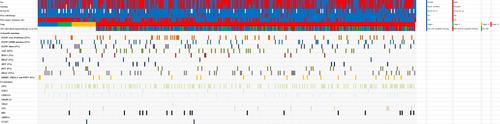
Among the 391 patients, at least one actionable mutation was identified in 294 patients (75.2%). The most commonly mutated gene was EGFR (n = 130, 33.2%), involving EGFR exon 19 deletion (n = 48, 12.3%), L858R (n = 47, 12%), and others (n = 35, 9%), followed by KRAS (n = 48, 12.3%), ALK (n = 40, 10.2%), RET (6%), MET (3%), ROS-1 (3%), and BRAF (2%) mutations. TP53 (46.9%) and CDKN2A (12.6%) mutations were common co-mutations in patients with AMs. With a median follow-up duration of 16.8 months, median overall survival was 36.8 months in patients with stage IV disease. Patients treated with the corresponding targeted therapy for AMs based on NGS reports lived significantly longer than those not treated with such therapy (p < 0.001). After multivariate analysis, targeted therapy for AM was a significantly favorable factor for survival (AM without targeted therapy vs. AM with targeted therapy, hazard ratio 2.58, 95% confidence interval 1.57–4.25; p < 0.001).
Conclusion
This study revealed that AMs could be comparably detected using NGS. Based on these NGS results, a suitable targeted therapy can be selected, which may improve survival in patients with lung adenocarcinoma. This NGS-based approach is useful in real-world practice to provide guidance when selecting targeted therapy.
期刊介绍:
Cancer Medicine is a peer-reviewed, open access, interdisciplinary journal providing rapid publication of research from global biomedical researchers across the cancer sciences. The journal will consider submissions from all oncologic specialties, including, but not limited to, the following areas:
Clinical Cancer Research
Translational research ∙ clinical trials ∙ chemotherapy ∙ radiation therapy ∙ surgical therapy ∙ clinical observations ∙ clinical guidelines ∙ genetic consultation ∙ ethical considerations
Cancer Biology:
Molecular biology ∙ cellular biology ∙ molecular genetics ∙ genomics ∙ immunology ∙ epigenetics ∙ metabolic studies ∙ proteomics ∙ cytopathology ∙ carcinogenesis ∙ drug discovery and delivery.
Cancer Prevention:
Behavioral science ∙ psychosocial studies ∙ screening ∙ nutrition ∙ epidemiology and prevention ∙ community outreach.
Bioinformatics:
Gene expressions profiles ∙ gene regulation networks ∙ genome bioinformatics ∙ pathwayanalysis ∙ prognostic biomarkers.
Cancer Medicine publishes original research articles, systematic reviews, meta-analyses, and research methods papers, along with invited editorials and commentaries. Original research papers must report well-conducted research with conclusions supported by the data presented in the paper.



 京公网安备 11010802042870号
京ICP备2023020795号-1
京公网安备 11010802042870号
京ICP备2023020795号-1

 分享
分享
 求助内容:
求助内容: 应助结果提醒方式:
 扫码关注我们
