Xiaomin Ma, Yan Cheng, Hui Jian, Yanlin Feng, Yun Chang, Runxiao Zheng, Xiaqing Wu, Li Wang, Xi Li, Haiyuan Zhang
{"title":"Hollow, Rough, and Nitric Oxide-Releasing Cerium Oxide Nanoparticles for Promoting Multiple Stages of Wound Healing","authors":"Xiaomin Ma, Yan Cheng, Hui Jian, Yanlin Feng, Yun Chang, Runxiao Zheng, Xiaqing Wu, Li Wang, Xi Li, Haiyuan Zhang","doi":"10.1002/adhm.201900256","DOIUrl":null,"url":null,"abstract":"<p>Wound healing is a complex and sequential biological process that involves multiple stages. Although various nanomaterials are applied to accelerate the wound healing process, only a single stage is promoted during the process, lacking hierarchical stimulation. Herein, hollow CeO<sub>2</sub> nanoparticles (NPs) with rough surface and <span>l</span>-arginine inside (<sub>Ah</sub>CeO<sub>2</sub> NPs) are developed as a compact and programmable nanosystem for sequentially promoting the hemostasis, inflammation, and proliferation stages. The rough surface of <sub>Ah</sub>CeO<sub>2</sub> NPs works as a nanobridge to rapidly closure the wounds, promoting the hemostasis stage. The hollow structure of <sub>Ah</sub>CeO<sub>2</sub> NPs enables the multireflection of light inside particles, significantly enhancing the light harvest efficiency and electron–hole pair abundance. Simultaneously, the porous shell of <sub>Ah</sub>CeO<sub>2</sub> NPs facilitates the electron–hole separation and reactive oxygen species production, preventing wound infection and promotion wound healing during the inflammation stage. The enzyme mimicking property of <sub>Ah</sub>CeO<sub>2</sub> NPs can alleviate the oxidative injury in the wound, and the released <span>l</span>-arginine can be converted into nitric oxide (NO) under the catalysis of inducible NO synthase, both of which promote the proliferation stage. A series of in vitro and in vitro biological assessments corroborate the effectiveness of <sub>Ah</sub>CeO<sub>2</sub> NPs in the wound healing process.</p>","PeriodicalId":113,"journal":{"name":"Advanced Healthcare Materials","volume":"8 16","pages":""},"PeriodicalIF":9.6000,"publicationDate":"2019-07-10","publicationTypes":"Journal Article","fieldsOfStudy":null,"isOpenAccess":false,"openAccessPdf":"https://sci-hub-pdf.com/10.1002/adhm.201900256","citationCount":"62","resultStr":null,"platform":"Semanticscholar","paperid":null,"PeriodicalName":"Advanced Healthcare Materials","FirstCategoryId":"5","ListUrlMain":"https://onlinelibrary.wiley.com/doi/10.1002/adhm.201900256","RegionNum":2,"RegionCategory":"医学","ArticlePicture":[],"TitleCN":null,"AbstractTextCN":null,"PMCID":null,"EPubDate":"","PubModel":"","JCR":"Q1","JCRName":"ENGINEERING, BIOMEDICAL","Score":null,"Total":0}
引用次数: 62
Abstract
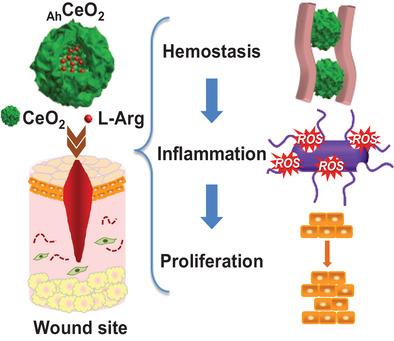
Wound healing is a complex and sequential biological process that involves multiple stages. Although various nanomaterials are applied to accelerate the wound healing process, only a single stage is promoted during the process, lacking hierarchical stimulation. Herein, hollow CeO2 nanoparticles (NPs) with rough surface and l-arginine inside (AhCeO2 NPs) are developed as a compact and programmable nanosystem for sequentially promoting the hemostasis, inflammation, and proliferation stages. The rough surface of AhCeO2 NPs works as a nanobridge to rapidly closure the wounds, promoting the hemostasis stage. The hollow structure of AhCeO2 NPs enables the multireflection of light inside particles, significantly enhancing the light harvest efficiency and electron–hole pair abundance. Simultaneously, the porous shell of AhCeO2 NPs facilitates the electron–hole separation and reactive oxygen species production, preventing wound infection and promotion wound healing during the inflammation stage. The enzyme mimicking property of AhCeO2 NPs can alleviate the oxidative injury in the wound, and the released l-arginine can be converted into nitric oxide (NO) under the catalysis of inducible NO synthase, both of which promote the proliferation stage. A series of in vitro and in vitro biological assessments corroborate the effectiveness of AhCeO2 NPs in the wound healing process.
期刊介绍:
Advanced Healthcare Materials, a distinguished member of the esteemed Advanced portfolio, has been dedicated to disseminating cutting-edge research on materials, devices, and technologies for enhancing human well-being for over ten years. As a comprehensive journal, it encompasses a wide range of disciplines such as biomaterials, biointerfaces, nanomedicine and nanotechnology, tissue engineering, and regenerative medicine.



 京公网安备 11010802042870号
京ICP备2023020795号-1
京公网安备 11010802042870号
京ICP备2023020795号-1

 分享
分享
 求助内容:
求助内容: 应助结果提醒方式:
 扫码关注我们
