Dr. Xiaoxia Chang, Prof.?Dr. Tuo Wang, Dr. Zhi-Jian Zhao, Piaoping Yang, Prof.?Dr. Jeffrey Greeley, Dr. Rentao Mu, Gong Zhang, Zhongmiao Gong, Dr. Zhibin Luo, Dr. Jun Chen, Dr. Yi Cui, Prof.?Dr. Geoffrey A. Ozin, Prof.?Dr. Jinlong Gong
{"title":"Tuning Cu/Cu2O Interfaces for the Reduction of Carbon Dioxide to Methanol in Aqueous Solutions","authors":"Dr. Xiaoxia Chang, Prof.?Dr. Tuo Wang, Dr. Zhi-Jian Zhao, Piaoping Yang, Prof.?Dr. Jeffrey Greeley, Dr. Rentao Mu, Gong Zhang, Zhongmiao Gong, Dr. Zhibin Luo, Dr. Jun Chen, Dr. Yi Cui, Prof.?Dr. Geoffrey A. Ozin, Prof.?Dr. Jinlong Gong","doi":"10.1002/anie.201805256","DOIUrl":null,"url":null,"abstract":"<p>Artificial photosynthesis can be used to store solar energy and reduce CO<sub>2</sub> into fuels to potentially alleviate global warming and the energy crisis. Compared to the generation of gaseous products, it remains a great challenge to tune the product distribution of artificial photosynthesis to liquid fuels, such as CH<sub>3</sub>OH, which are suitable for storage and transport. Herein, we describe the introduction of metallic Cu nanoparticles (NPs) on Cu<sub>2</sub>O films to change the product distribution from gaseous products on bare Cu<sub>2</sub>O to predominantly CH<sub>3</sub>OH by CO<sub>2</sub> reduction in aqueous solutions. The specifically designed Cu/Cu<sub>2</sub>O interfaces balance the binding strengths of H* and CO* intermediates, which play critical roles in CH<sub>3</sub>OH production. With a TiO<sub>2</sub> model photoanode to construct a photoelectrochemical cell, a Cu/Cu<sub>2</sub>O dark cathode exhibited a Faradaic efficiency of up to 53.6 % for CH<sub>3</sub>OH production. This work demonstrates the feasibility and mechanism of interface engineering to enhance the CH<sub>3</sub>OH production from CO<sub>2</sub> reduction in aqueous electrolytes.</p>","PeriodicalId":125,"journal":{"name":"Angewandte Chemie International Edition","volume":"57 47","pages":"15415-15419"},"PeriodicalIF":16.9000,"publicationDate":"2018-10-17","publicationTypes":"Journal Article","fieldsOfStudy":null,"isOpenAccess":false,"openAccessPdf":"https://sci-hub-pdf.com/10.1002/anie.201805256","citationCount":"143","resultStr":null,"platform":"Semanticscholar","paperid":null,"PeriodicalName":"Angewandte Chemie International Edition","FirstCategoryId":"92","ListUrlMain":"https://onlinelibrary.wiley.com/doi/10.1002/anie.201805256","RegionNum":1,"RegionCategory":"化学","ArticlePicture":[],"TitleCN":null,"AbstractTextCN":null,"PMCID":null,"EPubDate":"","PubModel":"","JCR":"Q1","JCRName":"CHEMISTRY, MULTIDISCIPLINARY","Score":null,"Total":0}
引用次数: 143
Abstract
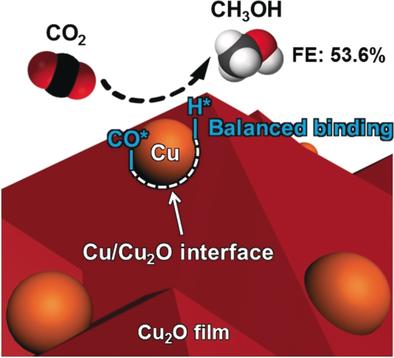
Artificial photosynthesis can be used to store solar energy and reduce CO2 into fuels to potentially alleviate global warming and the energy crisis. Compared to the generation of gaseous products, it remains a great challenge to tune the product distribution of artificial photosynthesis to liquid fuels, such as CH3OH, which are suitable for storage and transport. Herein, we describe the introduction of metallic Cu nanoparticles (NPs) on Cu2O films to change the product distribution from gaseous products on bare Cu2O to predominantly CH3OH by CO2 reduction in aqueous solutions. The specifically designed Cu/Cu2O interfaces balance the binding strengths of H* and CO* intermediates, which play critical roles in CH3OH production. With a TiO2 model photoanode to construct a photoelectrochemical cell, a Cu/Cu2O dark cathode exhibited a Faradaic efficiency of up to 53.6 % for CH3OH production. This work demonstrates the feasibility and mechanism of interface engineering to enhance the CH3OH production from CO2 reduction in aqueous electrolytes.
期刊介绍:
Angewandte Chemie, a journal of the German Chemical Society (GDCh), maintains a leading position among scholarly journals in general chemistry with an impressive Impact Factor of 16.6 (2022 Journal Citation Reports, Clarivate, 2023). Published weekly in a reader-friendly format, it features new articles almost every day. Established in 1887, Angewandte Chemie is a prominent chemistry journal, offering a dynamic blend of Review-type articles, Highlights, Communications, and Research Articles on a weekly basis, making it unique in the field.



 京公网安备 11010802042870号
京ICP备2023020795号-1
京公网安备 11010802042870号
京ICP备2023020795号-1

 分享
分享
 求助内容:
求助内容: 应助结果提醒方式:
 扫码关注我们
