Panchao Yin, Dr. Chullikkattil P. Pradeep, Baofang Zhang, Dr. Feng-Yan Li, Claire Lydon, Dr. Mali H. Rosnes, Dong Li, Emily Bitterlich, Prof.?Dr. Lin Xu, Prof.?Dr. Leroy Cronin, Prof.?Dr. Tianbo Liu
{"title":"Controllable Self-Assembly of Organic–Inorganic Amphiphiles Containing Dawson Polyoxometalate Clusters","authors":"Panchao Yin, Dr. Chullikkattil P. Pradeep, Baofang Zhang, Dr. Feng-Yan Li, Claire Lydon, Dr. Mali H. Rosnes, Dong Li, Emily Bitterlich, Prof.?Dr. Lin Xu, Prof.?Dr. Leroy Cronin, Prof.?Dr. Tianbo Liu","doi":"10.1002/chem.201200362","DOIUrl":null,"url":null,"abstract":"<p>An organic–inorganic molecular hybrid containing the Dawson polyoxometalate, ((C<sub>4</sub>H<sub>9</sub>)<sub>4</sub>N)<sub>5</sub>H- [P<sub>2</sub>V<sub>3</sub>W<sub>15</sub>O<sub>59</sub>(OCH<sub>2</sub>)<sub>3</sub>CNHCOC<sub>15</sub>H<sub>31</sub>], was synthesized and its surfactant-like amphiphilic properties, represented by the formation of bilayer vesicles, were studied in polar solvents. The vesicle size decreases with both decreasing hybrid concentration and with increasing polarity of the solvent, independently. The self-assembly behavior of this hybrid can be controlled by introducing different counterions into the acetonitrile solutions. The addition of ZnCl<sub>2</sub> and NaI can cause a gradual decrease and increase of vesicular sizes, respectively. Tetraalkylammonium bromide is found to disassemble the vesicle assemblies. Moreover, the original counterions of the hybrid can be replaced with protons, resulting in pH-dependent formation of vesicles in aqueous solutions. The hybrid surfactant can further form micro-needle structures in aqueous solutions upon addition of Ca<sup>2+</sup> ions.</p>","PeriodicalId":144,"journal":{"name":"Chemistry - A European Journal","volume":"18 26","pages":"8157-8162"},"PeriodicalIF":3.7000,"publicationDate":"2012-05-22","publicationTypes":"Journal Article","fieldsOfStudy":null,"isOpenAccess":false,"openAccessPdf":"https://sci-hub-pdf.com/10.1002/chem.201200362","citationCount":"70","resultStr":null,"platform":"Semanticscholar","paperid":null,"PeriodicalName":"Chemistry - A European Journal","FirstCategoryId":"92","ListUrlMain":"https://onlinelibrary.wiley.com/doi/10.1002/chem.201200362","RegionNum":2,"RegionCategory":"化学","ArticlePicture":[],"TitleCN":null,"AbstractTextCN":null,"PMCID":null,"EPubDate":"","PubModel":"","JCR":"Q2","JCRName":"CHEMISTRY, MULTIDISCIPLINARY","Score":null,"Total":0}
引用次数: 70
Abstract
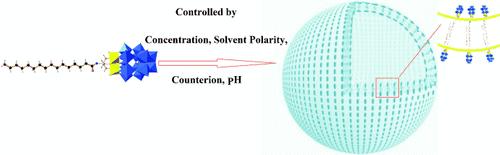
An organic–inorganic molecular hybrid containing the Dawson polyoxometalate, ((C4H9)4N)5H- [P2V3W15O59(OCH2)3CNHCOC15H31], was synthesized and its surfactant-like amphiphilic properties, represented by the formation of bilayer vesicles, were studied in polar solvents. The vesicle size decreases with both decreasing hybrid concentration and with increasing polarity of the solvent, independently. The self-assembly behavior of this hybrid can be controlled by introducing different counterions into the acetonitrile solutions. The addition of ZnCl2 and NaI can cause a gradual decrease and increase of vesicular sizes, respectively. Tetraalkylammonium bromide is found to disassemble the vesicle assemblies. Moreover, the original counterions of the hybrid can be replaced with protons, resulting in pH-dependent formation of vesicles in aqueous solutions. The hybrid surfactant can further form micro-needle structures in aqueous solutions upon addition of Ca2+ ions.
期刊介绍:
Chemistry—A European Journal is a truly international journal with top quality contributions (2018 ISI Impact Factor: 5.16). It publishes a wide range of outstanding Reviews, Minireviews, Concepts, Full Papers, and Communications from all areas of chemistry and related fields.
Based in Europe Chemistry—A European Journal provides an excellent platform for increasing the visibility of European chemistry as well as for featuring the best research from authors from around the world.
All manuscripts are peer-reviewed, and electronic processing ensures accurate reproduction of text and data, plus short publication times.
The Concepts section provides nonspecialist readers with a useful conceptual guide to unfamiliar areas and experts with new angles on familiar problems.
Chemistry—A European Journal is published on behalf of ChemPubSoc Europe, a group of 16 national chemical societies from within Europe, and supported by the Asian Chemical Editorial Societies. The ChemPubSoc Europe family comprises: Angewandte Chemie, Chemistry—A European Journal, European Journal of Organic Chemistry, European Journal of Inorganic Chemistry, ChemPhysChem, ChemBioChem, ChemMedChem, ChemCatChem, ChemSusChem, ChemPlusChem, ChemElectroChem, and ChemistryOpen.



 京公网安备 11010802042870号
京ICP备2023020795号-1
京公网安备 11010802042870号
京ICP备2023020795号-1

 分享
分享
 求助内容:
求助内容: 应助结果提醒方式:
 扫码关注我们
