Application of the Steady-State Variable Nutation Angle Method for Faster Determinations of Long T 1s-An Approach Useful for the Design of Hyperpolarized MR Molecular Probes.
Marc Jupin, Ayelet Gamliel, Yonatan Hovav, Jacob Sosna, J Moshe Gomori, Rachel Katz-Brull
{"title":"Application of the Steady-State Variable Nutation Angle Method for Faster Determinations of Long T 1s-An Approach Useful for the Design of Hyperpolarized MR Molecular Probes.","authors":"Marc Jupin, Ayelet Gamliel, Yonatan Hovav, Jacob Sosna, J Moshe Gomori, Rachel Katz-Brull","doi":"10.4137/MRI.S29358","DOIUrl":null,"url":null,"abstract":"<p><p>In the dissolution-dynamic nuclear polarization technique, molecular probes with long T 1s are preferred. 13C nuclei of small molecules with no directly bonded protons or sp(3 13)C nuclei with proton positions substituted by deuterons may fulfill this requirement. The T 1 determination of such new molecular probes is crucial for the success of the hyperpolarized observation. Although the inversion-recovery approach remained by and large the standard for T 1 measurements, we show here that the steady-state variable nutation angle approach is faster and may be better suited for the determination of relatively long T 1s in thermal equilibrium. Specifically, the T 1 of a new molecular probe, [uniformly labeled (UL)-13C6, UL-2H8]2-deoxy-d-glucose, is determined here and compared to that of [UL-13C6, UL-2H7]d-glucose. </p>","PeriodicalId":74096,"journal":{"name":"Magnetic resonance insights","volume":"8 1","pages":"41-7"},"PeriodicalIF":0.0000,"publicationDate":"2015-10-29","publicationTypes":"Journal Article","fieldsOfStudy":null,"isOpenAccess":false,"openAccessPdf":"https://www.ncbi.nlm.nih.gov/pmc/articles/PMC4629631/pdf/","citationCount":"0","resultStr":null,"platform":"Semanticscholar","paperid":null,"PeriodicalName":"Magnetic resonance insights","FirstCategoryId":"1085","ListUrlMain":"https://doi.org/10.4137/MRI.S29358","RegionNum":0,"RegionCategory":null,"ArticlePicture":[],"TitleCN":null,"AbstractTextCN":null,"PMCID":null,"EPubDate":"2015/1/1 0:00:00","PubModel":"eCollection","JCR":"","JCRName":"","Score":null,"Total":0}
引用次数: 0
Abstract
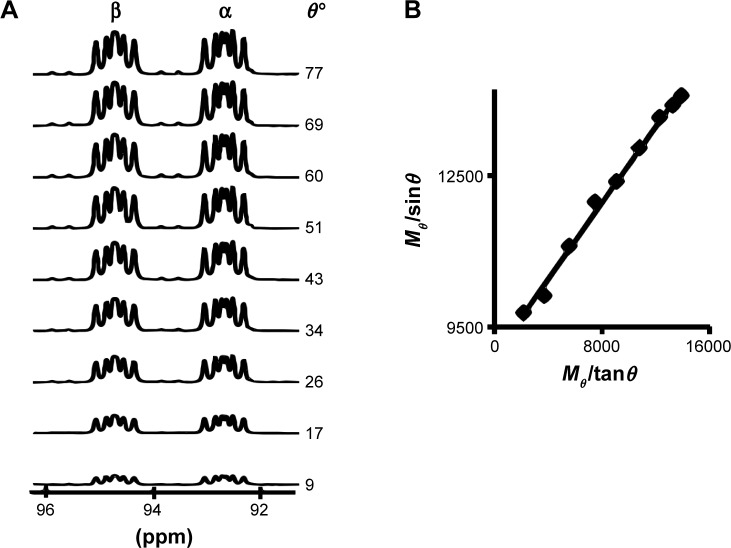
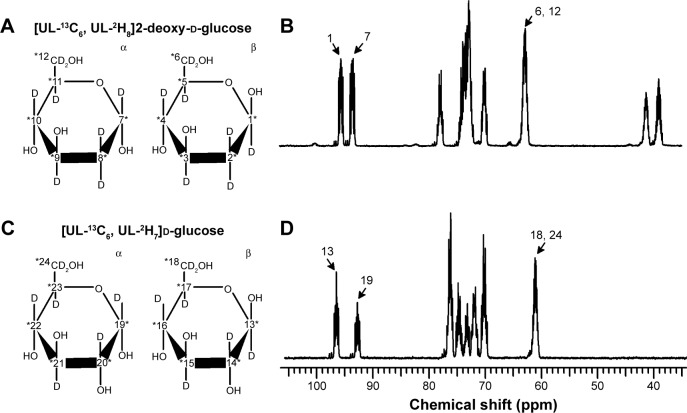
In the dissolution-dynamic nuclear polarization technique, molecular probes with long T 1s are preferred. 13C nuclei of small molecules with no directly bonded protons or sp(3 13)C nuclei with proton positions substituted by deuterons may fulfill this requirement. The T 1 determination of such new molecular probes is crucial for the success of the hyperpolarized observation. Although the inversion-recovery approach remained by and large the standard for T 1 measurements, we show here that the steady-state variable nutation angle approach is faster and may be better suited for the determination of relatively long T 1s in thermal equilibrium. Specifically, the T 1 of a new molecular probe, [uniformly labeled (UL)-13C6, UL-2H8]2-deoxy-d-glucose, is determined here and compared to that of [UL-13C6, UL-2H7]d-glucose.



 京公网安备 11010802042870号
京ICP备2023020795号-1
京公网安备 11010802042870号
京ICP备2023020795号-1

 分享
分享

 求助内容:
求助内容: 应助结果提醒方式:
 扫码关注我们
