Gyo-Bin Lee, Ki Deok Kim, Weon-Dae Cho, Wan-Gyu Kim
{"title":"<i>Didymella acutilobae</i> sp. nov. Causing Leaf Spot and Stem Rot in <i>Angelica acutiloba</i>.","authors":"Gyo-Bin Lee, Ki Deok Kim, Weon-Dae Cho, Wan-Gyu Kim","doi":"10.1080/12298093.2023.2254052","DOIUrl":null,"url":null,"abstract":"<p><p>During disease surveys of <i>Angelica acutiloba</i> plants in Korea, leaf spot symptoms were observed in a field in Andong in July 2019, and stem rot symptoms in vinyl greenhouses in Yangpyeong in April 2020. Incidence of leaf spot and stem rot of the plants ranged from 10 to 20% and 5 to 30%, respectively. Morphological and cultural characteristics of fungal isolates from the leaf spot and stem rot symptoms fitted into those of the genus <i>Phoma</i>. Molecular phylogenetic analyses of two single-spore isolates from the symptoms using concatenated sequences of LSU, ITS, TUB2, and RPB2 genes authenticated an independent cluster from other <i>Didymella</i> (anamorph: <i>Phoma</i>) species. Moreover, the isolates showed different morphological and cultural characteristics in comparison to closely related <i>Didymella</i> species. These discoveries confirmed the novelty of the isolates. Pathogenicity of the novel <i>Didymella</i> species isolates was substantiated on leaves and stems of <i>A. acutiloba</i> through artificial inoculation. Thus, this study reveals that <i>Didymella acutilobae</i> sp. nov. causes leaf spot and stem rot in <i>Angelica acutiloba.</i></p>","PeriodicalId":18825,"journal":{"name":"Mycobiology","volume":"51 5","pages":"313-319"},"PeriodicalIF":2.0000,"publicationDate":"2023-10-12","publicationTypes":"Journal Article","fieldsOfStudy":null,"isOpenAccess":false,"openAccessPdf":"https://www.ncbi.nlm.nih.gov/pmc/articles/PMC10621254/pdf/","citationCount":"0","resultStr":null,"platform":"Semanticscholar","paperid":null,"PeriodicalName":"Mycobiology","FirstCategoryId":"99","ListUrlMain":"https://doi.org/10.1080/12298093.2023.2254052","RegionNum":4,"RegionCategory":"生物学","ArticlePicture":[],"TitleCN":null,"AbstractTextCN":null,"PMCID":null,"EPubDate":"2023/1/1 0:00:00","PubModel":"eCollection","JCR":"Q2","JCRName":"AGRONOMY","Score":null,"Total":0}
引用次数: 0
Abstract
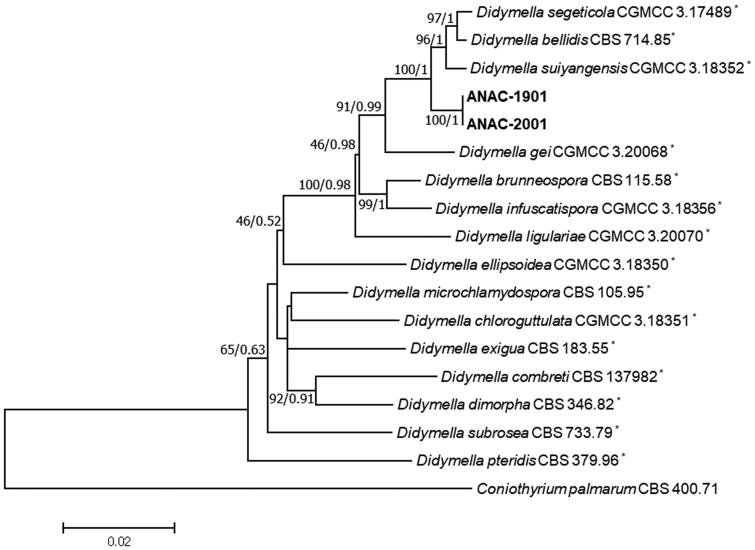
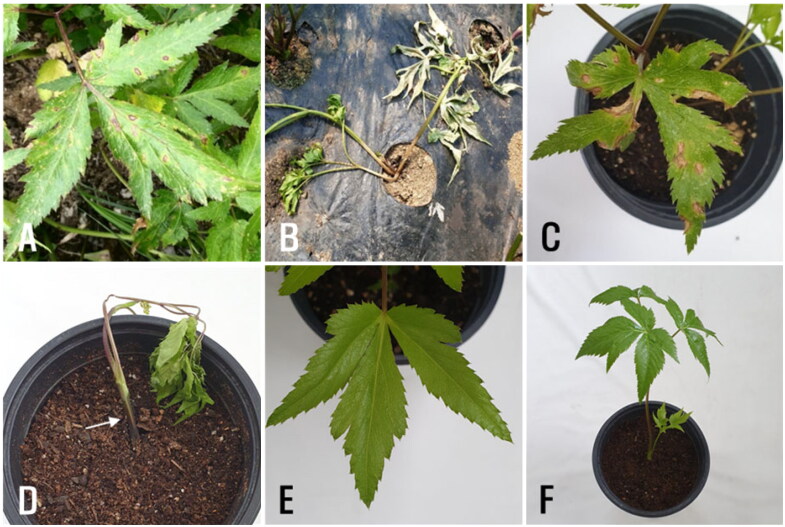
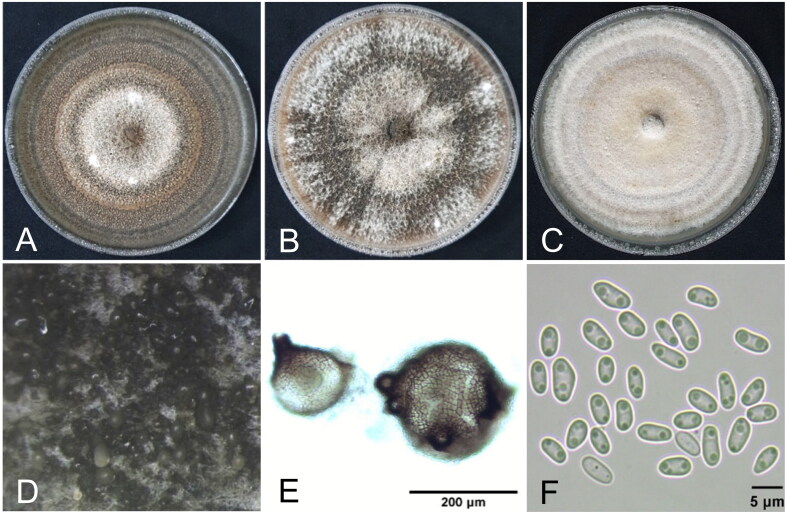
During disease surveys of Angelica acutiloba plants in Korea, leaf spot symptoms were observed in a field in Andong in July 2019, and stem rot symptoms in vinyl greenhouses in Yangpyeong in April 2020. Incidence of leaf spot and stem rot of the plants ranged from 10 to 20% and 5 to 30%, respectively. Morphological and cultural characteristics of fungal isolates from the leaf spot and stem rot symptoms fitted into those of the genus Phoma. Molecular phylogenetic analyses of two single-spore isolates from the symptoms using concatenated sequences of LSU, ITS, TUB2, and RPB2 genes authenticated an independent cluster from other Didymella (anamorph: Phoma) species. Moreover, the isolates showed different morphological and cultural characteristics in comparison to closely related Didymella species. These discoveries confirmed the novelty of the isolates. Pathogenicity of the novel Didymella species isolates was substantiated on leaves and stems of A. acutiloba through artificial inoculation. Thus, this study reveals that Didymella acutilobae sp. nov. causes leaf spot and stem rot in Angelica acutiloba.
期刊介绍:
Mycobiology is an international journal devoted to the publication of fundamental and applied investigations on all aspects of mycology and their traditional allies. It is published quarterly and is the official publication of the Korean Society of Mycology. Mycobiology publishes reports of basic research on fungi and fungus-like organisms, including yeasts, filamentous fungi, lichen fungi, oomycetes, moulds, and mushroom. Topics also include molecular and cellular biology, biochemistry, metabolism, developmental biology, environmental mycology, evolution, ecology, taxonomy and systematics, genetics/genomics, fungal pathogen and disease control, physiology, and industrial biotechnology using fungi.



 京公网安备 11010802042870号
京ICP备2023020795号-1
京公网安备 11010802042870号
京ICP备2023020795号-1

 分享
分享
 求助内容:
求助内容: 应助结果提醒方式:
 扫码关注我们
