{"title":"Disputes over provisioned resources are no more intense between groups than within groups in free-ranging Sapajus libidinosus.","authors":"Túlio Costa Lousa, Francisco D C Mendes","doi":"10.1007/s10329-023-01105-5","DOIUrl":null,"url":null,"abstract":"<p><p>Socioecological models predict that disputes between primate groups will be more intense than those within groups, given that the systematic loss of contests over a given resource will restrict the access of all of the members of that group to that resource. Higher levels of aggression are also expected for provisioned resources that have a more lucrative cost:benefit ratio. The levels of aggression in and between two free-ranging tufted capuchin monkey (Sapajus libidinosus) groups in the context of daily provisioning with bananas were evaluated. The aim of a complementary analysis was to identify possible predictors of the frequency of disputes at the site of the provisioned resource. The disputes were recorded using all-events sampling, while the social behaviour of the study groups was recorded by instantaneous scan sampling. The data were analysed using t-test, Mann-Whitney's U, and generalised linear modelling. Between-group disputes were no more intense than within-group events, and did not involve more individuals, or more adult females. The frequency of disputes increased as the number of individuals eating bananas increased. No evidence was found that disputes between groups were any more intense than those within groups. Dominance patterns may have affected these findings, by mediating intergroup disputes. An increase in the number of competitors affected the frequency of disputes at the site of the provisioned resource.</p>","PeriodicalId":20468,"journal":{"name":"Primates","volume":" ","pages":"61-68"},"PeriodicalIF":1.5000,"publicationDate":"2024-01-01","publicationTypes":"Journal Article","fieldsOfStudy":null,"isOpenAccess":false,"openAccessPdf":"","citationCount":"0","resultStr":null,"platform":"Semanticscholar","paperid":null,"PeriodicalName":"Primates","FirstCategoryId":"99","ListUrlMain":"https://doi.org/10.1007/s10329-023-01105-5","RegionNum":4,"RegionCategory":"生物学","ArticlePicture":[],"TitleCN":null,"AbstractTextCN":null,"PMCID":null,"EPubDate":"2023/11/8 0:00:00","PubModel":"Epub","JCR":"Q2","JCRName":"ZOOLOGY","Score":null,"Total":0}
引用次数: 0
Abstract
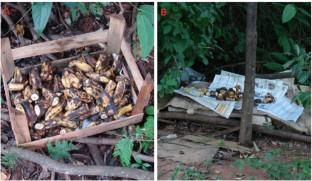
Socioecological models predict that disputes between primate groups will be more intense than those within groups, given that the systematic loss of contests over a given resource will restrict the access of all of the members of that group to that resource. Higher levels of aggression are also expected for provisioned resources that have a more lucrative cost:benefit ratio. The levels of aggression in and between two free-ranging tufted capuchin monkey (Sapajus libidinosus) groups in the context of daily provisioning with bananas were evaluated. The aim of a complementary analysis was to identify possible predictors of the frequency of disputes at the site of the provisioned resource. The disputes were recorded using all-events sampling, while the social behaviour of the study groups was recorded by instantaneous scan sampling. The data were analysed using t-test, Mann-Whitney's U, and generalised linear modelling. Between-group disputes were no more intense than within-group events, and did not involve more individuals, or more adult females. The frequency of disputes increased as the number of individuals eating bananas increased. No evidence was found that disputes between groups were any more intense than those within groups. Dominance patterns may have affected these findings, by mediating intergroup disputes. An increase in the number of competitors affected the frequency of disputes at the site of the provisioned resource.
期刊介绍:
Primates is an international journal of primatology whose aim is to provide a forum for the elucidation of all aspects of primates. The oldest primatological journal, Primates publishes original papers that advance the scientific study of primates, and its scope embraces work in diverse fields covering biological bases of behavior, socio-ecology, learning and cognition, social processes, systematics, evolution, and medicine. Contributions relevant to conservation of natural populations and welfare of captive primates are welcome. Studies focusing on nonprimate species may be considered if their relevance to primatology is clear. Original Articles as well as Review Articles, News and Perspectives, and Book Reviews are included. All manuscripts received are initially screened for suitability by members of the Editorial Board, taking into account style and ethical issues, leading to a swift decision about whether to send the manuscript for external review.



 京公网安备 11010802042870号
京ICP备2023020795号-1
京公网安备 11010802042870号
京ICP备2023020795号-1

 分享
分享
 求助内容:
求助内容: 应助结果提醒方式:
 扫码关注我们
