{"title":"Inhibition of GPR17/ID2 Axis Improve Remyelination and Cognitive Recovery after SAH by Mediating OPC Differentiation in Rat Model.","authors":"Yingwen Wang, Anan Jiang, Jin Yan, Daochen Wen, Nina Gu, Zhao Li, Xiaochuan Sun, Yue Wu, Zongduo Guo","doi":"10.1007/s12975-023-01201-0","DOIUrl":null,"url":null,"abstract":"<p><p>Myelin sheath injury contributes to cognitive deficits following subarachnoid hemorrhage (SAH). G protein-coupled receptor 17 (GPR17), a membrane receptor, negatively regulates oligodendrocyte precursor cell (OPC) differentiation in both developmental and pathological contexts. Nonetheless, GPR17's role in modulating OPC differentiation, facilitating remyelination post SAH, and its interaction with downstream molecules remain elusive. In a rat SAH model induced by arterial puncture, OPCs expressing GPR17 proliferated prominently by day 14 post-onset, coinciding with compromised myelin sheath integrity and cognitive deficits. Selective Gpr17 knockdown in oligodendrocytes (OLs) via adeno-associated virus (AAV) administration revealed that reduced GPR17 levels promoted OPC differentiation, restored myelin sheath integrity, and improved cognitive deficits by day 14 post-SAH. Moreover, GPR17 knockdown attenuated the elevated expression of the inhibitor of DNA binding 2 (ID2) post-SAH, suggesting a GPR17-ID2 regulatory axis. Bi-directional modulation of ID2 expression in OLs using AAV unveiled that elevated ID2 counteracted the restorative effects of GPR17 knockdown. This resulted in hindered differentiation, exacerbated myelin sheath impairment, and worsened cognitive deficits. These findings highlight the pivotal roles of GPR17 and ID2 in governing OPC differentiation and axonal remyelination post-SAH. This study positions GPR17 as a potential therapeutic target for SAH intervention. The interplay between GPR17 and ID2 introduces a novel avenue for ameliorating cognitive deficits post-SAH.</p>","PeriodicalId":23237,"journal":{"name":"Translational Stroke Research","volume":" ","pages":"178-193"},"PeriodicalIF":4.3000,"publicationDate":"2025-04-01","publicationTypes":"Journal Article","fieldsOfStudy":null,"isOpenAccess":false,"openAccessPdf":"","citationCount":"0","resultStr":null,"platform":"Semanticscholar","paperid":null,"PeriodicalName":"Translational Stroke Research","FirstCategoryId":"3","ListUrlMain":"https://doi.org/10.1007/s12975-023-01201-0","RegionNum":2,"RegionCategory":"医学","ArticlePicture":[],"TitleCN":null,"AbstractTextCN":null,"PMCID":null,"EPubDate":"2023/11/7 0:00:00","PubModel":"Epub","JCR":"Q1","JCRName":"CLINICAL NEUROLOGY","Score":null,"Total":0}
引用次数: 0
Abstract
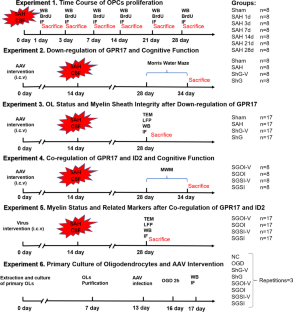
Myelin sheath injury contributes to cognitive deficits following subarachnoid hemorrhage (SAH). G protein-coupled receptor 17 (GPR17), a membrane receptor, negatively regulates oligodendrocyte precursor cell (OPC) differentiation in both developmental and pathological contexts. Nonetheless, GPR17's role in modulating OPC differentiation, facilitating remyelination post SAH, and its interaction with downstream molecules remain elusive. In a rat SAH model induced by arterial puncture, OPCs expressing GPR17 proliferated prominently by day 14 post-onset, coinciding with compromised myelin sheath integrity and cognitive deficits. Selective Gpr17 knockdown in oligodendrocytes (OLs) via adeno-associated virus (AAV) administration revealed that reduced GPR17 levels promoted OPC differentiation, restored myelin sheath integrity, and improved cognitive deficits by day 14 post-SAH. Moreover, GPR17 knockdown attenuated the elevated expression of the inhibitor of DNA binding 2 (ID2) post-SAH, suggesting a GPR17-ID2 regulatory axis. Bi-directional modulation of ID2 expression in OLs using AAV unveiled that elevated ID2 counteracted the restorative effects of GPR17 knockdown. This resulted in hindered differentiation, exacerbated myelin sheath impairment, and worsened cognitive deficits. These findings highlight the pivotal roles of GPR17 and ID2 in governing OPC differentiation and axonal remyelination post-SAH. This study positions GPR17 as a potential therapeutic target for SAH intervention. The interplay between GPR17 and ID2 introduces a novel avenue for ameliorating cognitive deficits post-SAH.
期刊介绍:
Translational Stroke Research covers basic, translational, and clinical studies. The Journal emphasizes novel approaches to help both to understand clinical phenomenon through basic science tools, and to translate basic science discoveries into the development of new strategies for the prevention, assessment, treatment, and enhancement of central nervous system repair after stroke and other forms of neurotrauma.
Translational Stroke Research focuses on translational research and is relevant to both basic scientists and physicians, including but not restricted to neuroscientists, vascular biologists, neurologists, neuroimagers, and neurosurgeons.



 京公网安备 11010802042870号
京ICP备2023020795号-1
京公网安备 11010802042870号
京ICP备2023020795号-1

 分享
分享
 求助内容:
求助内容: 应助结果提醒方式:
 扫码关注我们
