Rahul K Chattopadhyay, Mrinal Thakur, Rucchira Wickramasinghe, Julie Hayes, Panagiota A Chousou, Vassilios S Vassiliou, Peter J Pugh
{"title":"Exploring the Temporal Patterns of Right Ventricular Pacing Burden.","authors":"Rahul K Chattopadhyay, Mrinal Thakur, Rucchira Wickramasinghe, Julie Hayes, Panagiota A Chousou, Vassilios S Vassiliou, Peter J Pugh","doi":"10.19102/icrm.2023.14104","DOIUrl":null,"url":null,"abstract":"<p><p>Elevated right ventricular pacing (RVP) burdens are associated with the development of pacing-induced cardiomyopathy. This association is alluded to in the recent European and American pacing guidelines where anticipated pacing burden forms part of the indications for conduction system pacing. Understanding the temporal pattern of RVP burden is important with respect to anticipating future burden and ensuring that the most appropriate pacing modality is selected for patients. To the best of our knowledge, this is the first study to assess how RVP burden changes over time in different pacing indications. A retrospective, single-center, observational study was performed. RVP burdens from pacing checks were extracted and plotted against 6-month time \"bins.\" Graphical plots of RVP burdens for different pacing indications were produced. There was no significant change in the RVP burden across time, independent of the initial pacing indication. Individuals with sinus node disease (SND) and a P-R interval of >250 ms had increased RVP burden. Other than patients with SND and a P-R interval of <250 ms, individuals had pacing burdens higher than those proposed in both the European and American pacing guidelines for conduction system pacing.</p>","PeriodicalId":36299,"journal":{"name":"Journal of Innovations in Cardiac Rhythm Management","volume":"14 10","pages":"5605-5609"},"PeriodicalIF":0.0000,"publicationDate":"2023-10-15","publicationTypes":"Journal Article","fieldsOfStudy":null,"isOpenAccess":false,"openAccessPdf":"https://www.ncbi.nlm.nih.gov/pmc/articles/PMC10621622/pdf/","citationCount":"0","resultStr":null,"platform":"Semanticscholar","paperid":null,"PeriodicalName":"Journal of Innovations in Cardiac Rhythm Management","FirstCategoryId":"1085","ListUrlMain":"https://doi.org/10.19102/icrm.2023.14104","RegionNum":0,"RegionCategory":null,"ArticlePicture":[],"TitleCN":null,"AbstractTextCN":null,"PMCID":null,"EPubDate":"2023/10/1 0:00:00","PubModel":"eCollection","JCR":"Q3","JCRName":"Medicine","Score":null,"Total":0}
引用次数: 0
Abstract
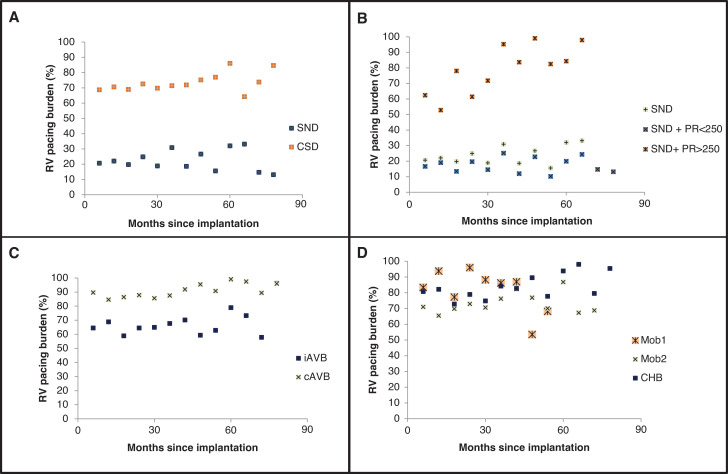
Elevated right ventricular pacing (RVP) burdens are associated with the development of pacing-induced cardiomyopathy. This association is alluded to in the recent European and American pacing guidelines where anticipated pacing burden forms part of the indications for conduction system pacing. Understanding the temporal pattern of RVP burden is important with respect to anticipating future burden and ensuring that the most appropriate pacing modality is selected for patients. To the best of our knowledge, this is the first study to assess how RVP burden changes over time in different pacing indications. A retrospective, single-center, observational study was performed. RVP burdens from pacing checks were extracted and plotted against 6-month time "bins." Graphical plots of RVP burdens for different pacing indications were produced. There was no significant change in the RVP burden across time, independent of the initial pacing indication. Individuals with sinus node disease (SND) and a P-R interval of >250 ms had increased RVP burden. Other than patients with SND and a P-R interval of <250 ms, individuals had pacing burdens higher than those proposed in both the European and American pacing guidelines for conduction system pacing.





 京公网安备 11010802042870号
京ICP备2023020795号-1
京公网安备 11010802042870号
京ICP备2023020795号-1

 分享
分享
 求助内容:
求助内容: 应助结果提醒方式:
 扫码关注我们
