Efficacy of a therapist-guided smartphone-based intervention to support recovery from bulimia nervosa: Study protocol of a randomized controlled multi-centre trial
Sandra Schlegl, Julia Maier, Anna Dieffenbacher, Ulrich Voderholzer
{"title":"Efficacy of a therapist-guided smartphone-based intervention to support recovery from bulimia nervosa: Study protocol of a randomized controlled multi-centre trial","authors":"Sandra Schlegl, Julia Maier, Anna Dieffenbacher, Ulrich Voderholzer","doi":"10.1002/erv.3047","DOIUrl":null,"url":null,"abstract":"<div>\n \n \n <section>\n \n <h3> Objective</h3>\n \n <p>Although inpatient treatment is highly effective for patients with bulimia nervosa (BN), some patients show a resurgence of symptoms and relapse after discharge. Therefore, the aim of this study is to evaluate the efficacy of a guided smartphone-based aftercare intervention following inpatient treatment to support recovery.</p>\n </section>\n \n <section>\n \n <h3> Method</h3>\n \n <p>172 female patients with BN (DSM-5: 307.51) will be randomized to receive a 16-week smartphone-based aftercare intervention (German version of ‘Recovery Record’) with therapist feedback as an add-on element to treatment as usual (TAU) or TAU alone. Assessments will take place at baseline (discharge, T0), during the intervention (after 4 weeks, T1), post-intervention (after 16 weeks, T2) and at 6-month follow-up (T3). Primary outcome will be remission at T2. Moderator and mediator analyses will investigate for whom the aftercare intervention suits best and how it works.</p>\n </section>\n \n <section>\n \n <h3> Conclusions</h3>\n \n <p>This is the first randomized controlled trial to examine a guided smartphone-based aftercare intervention following inpatient treatment of patients with BN. We expect that this innovative aftercare intervention is highly accepted by the patients and that it has the potential to support recovery after inpatient treatment and thereby could contribute to improving aftercare for patients with BN.</p>\n </section>\n </div>","PeriodicalId":48117,"journal":{"name":"European Eating Disorders Review","volume":"32 2","pages":"350-362"},"PeriodicalIF":3.4000,"publicationDate":"2023-11-07","publicationTypes":"Journal Article","fieldsOfStudy":null,"isOpenAccess":false,"openAccessPdf":"https://onlinelibrary.wiley.com/doi/epdf/10.1002/erv.3047","citationCount":"0","resultStr":null,"platform":"Semanticscholar","paperid":null,"PeriodicalName":"European Eating Disorders Review","FirstCategoryId":"102","ListUrlMain":"https://onlinelibrary.wiley.com/doi/10.1002/erv.3047","RegionNum":2,"RegionCategory":"心理学","ArticlePicture":[],"TitleCN":null,"AbstractTextCN":null,"PMCID":null,"EPubDate":"","PubModel":"","JCR":"Q1","JCRName":"PSYCHIATRY","Score":null,"Total":0}
引用次数: 0
Abstract
Objective
Although inpatient treatment is highly effective for patients with bulimia nervosa (BN), some patients show a resurgence of symptoms and relapse after discharge. Therefore, the aim of this study is to evaluate the efficacy of a guided smartphone-based aftercare intervention following inpatient treatment to support recovery.
Method
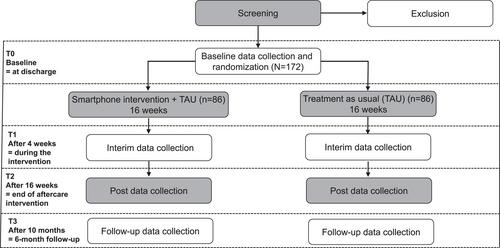
172 female patients with BN (DSM-5: 307.51) will be randomized to receive a 16-week smartphone-based aftercare intervention (German version of ‘Recovery Record’) with therapist feedback as an add-on element to treatment as usual (TAU) or TAU alone. Assessments will take place at baseline (discharge, T0), during the intervention (after 4 weeks, T1), post-intervention (after 16 weeks, T2) and at 6-month follow-up (T3). Primary outcome will be remission at T2. Moderator and mediator analyses will investigate for whom the aftercare intervention suits best and how it works.
Conclusions
This is the first randomized controlled trial to examine a guided smartphone-based aftercare intervention following inpatient treatment of patients with BN. We expect that this innovative aftercare intervention is highly accepted by the patients and that it has the potential to support recovery after inpatient treatment and thereby could contribute to improving aftercare for patients with BN.
期刊介绍:
European Eating Disorders Review publishes authoritative and accessible articles, from all over the world, which review or report original research that has implications for the treatment and care of people with eating disorders, and articles which report innovations and experience in the clinical management of eating disorders. The journal focuses on implications for best practice in diagnosis and treatment. The journal also provides a forum for discussion of the causes and prevention of eating disorders, and related health policy. The aims of the journal are to offer a channel of communication between researchers, practitioners, administrators and policymakers who need to report and understand developments in the field of eating disorders.




 京公网安备 11010802042870号
京ICP备2023020795号-1
京公网安备 11010802042870号
京ICP备2023020795号-1

 分享
分享
 求助内容:
求助内容: 应助结果提醒方式:
 扫码关注我们
