Kåre Nielsen, Michael Sode, Maj-Britt Jensen, Tobias Berg, Ann Knoop, Bent Ejlertsen, Anne-Vibeke Lænkholm
{"title":"High inter-laboratory variability in the assessment of HER2-low breast cancer: a national registry study on 50,714 Danish patients.","authors":"Kåre Nielsen, Michael Sode, Maj-Britt Jensen, Tobias Berg, Ann Knoop, Bent Ejlertsen, Anne-Vibeke Lænkholm","doi":"10.1186/s13058-023-01739-9","DOIUrl":null,"url":null,"abstract":"<p><strong>Background: </strong>Considering the recent advancements in the treatment of breast cancer with low expression of human epidermal growth factor receptor 2 (HER2), we aimed to examine inter-laboratory variability in the assessment of HER2-low breast cancer across all Danish pathology departments.</p><p><strong>Methods: </strong>From the Danish Breast Cancer Group, we obtained data on all women diagnosed with primary invasive breast cancer in 2007-2019 who were subsequently assigned for curatively intended treatment.</p><p><strong>Results: </strong>Of 50,714 patients, HER2 score and status were recorded for 48,382, among whom 59.2% belonged to the HER2-low group (score 1+ or 2+ without gene amplification), 26.8% had a HER2 score of 0, and 14.0% were HER2 positive. The proportion of HER2-low cases ranged from 46.3 to 71.8% among pathology departments (P < 0.0001) and from 49.3 to 65.6% over the years (P < 0.0001). In comparison, HER2 positivity rates ranged from 11.8 to 17.2% among departments (P < 0.0001) and from 12.6 to 15.7% over the years (P = 0.005). In the eight departments with the highest number of patients, variability in HER2-low cases increased from 2011 to 2019, although the same immunohistochemical assay was used. By multivariable logistic regression, the examining department was significantly related to both HER2 score 0 and HER2 positivity (P < 0.0001) but showed greater dispersion in odds ratios in the former case (range 0.25-1.41 vs. 0.84-1.27).</p><p><strong>Conclusions: </strong>Our data showed high inter-laboratory variability in the assessment of HER2-low breast cancer. The findings cast doubt on whether the current test method for HER2 is robust and reliable enough to select HER2-low patients for HER2-targeted treatment in daily clinical practice.</p>","PeriodicalId":49227,"journal":{"name":"Breast Cancer Research","volume":"25 1","pages":"139"},"PeriodicalIF":5.6000,"publicationDate":"2023-11-09","publicationTypes":"Journal Article","fieldsOfStudy":null,"isOpenAccess":false,"openAccessPdf":"https://www.ncbi.nlm.nih.gov/pmc/articles/PMC10636935/pdf/","citationCount":"0","resultStr":null,"platform":"Semanticscholar","paperid":null,"PeriodicalName":"Breast Cancer Research","FirstCategoryId":"3","ListUrlMain":"https://doi.org/10.1186/s13058-023-01739-9","RegionNum":1,"RegionCategory":"医学","ArticlePicture":[],"TitleCN":null,"AbstractTextCN":null,"PMCID":null,"EPubDate":"","PubModel":"","JCR":"Q1","JCRName":"Medicine","Score":null,"Total":0}
引用次数: 0
Abstract
Background: Considering the recent advancements in the treatment of breast cancer with low expression of human epidermal growth factor receptor 2 (HER2), we aimed to examine inter-laboratory variability in the assessment of HER2-low breast cancer across all Danish pathology departments.
Methods: From the Danish Breast Cancer Group, we obtained data on all women diagnosed with primary invasive breast cancer in 2007-2019 who were subsequently assigned for curatively intended treatment.
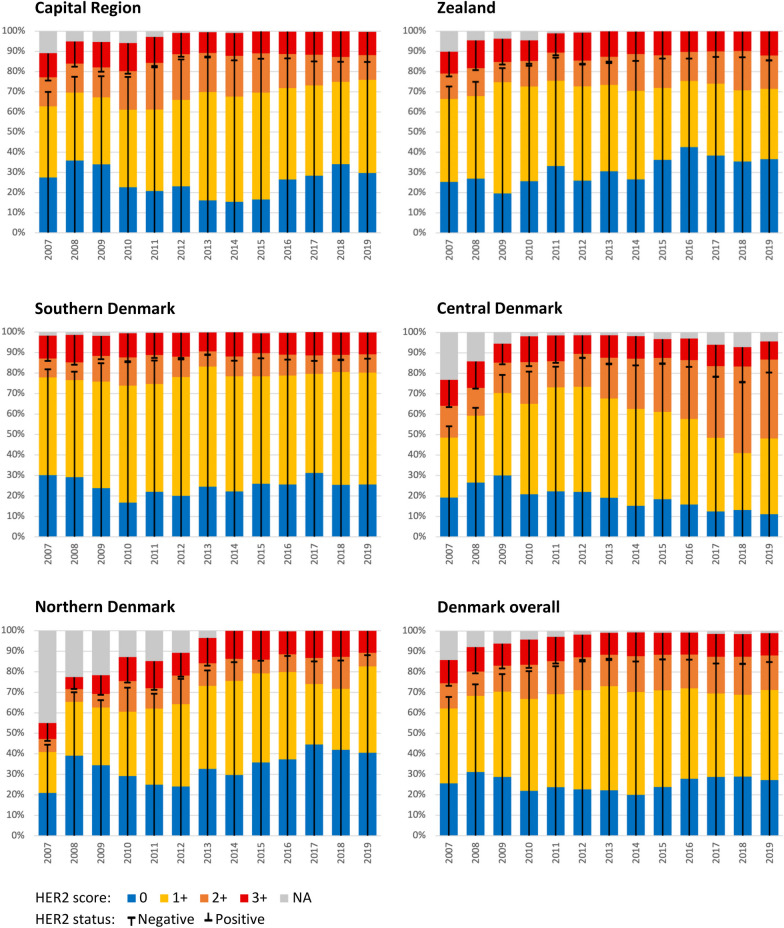
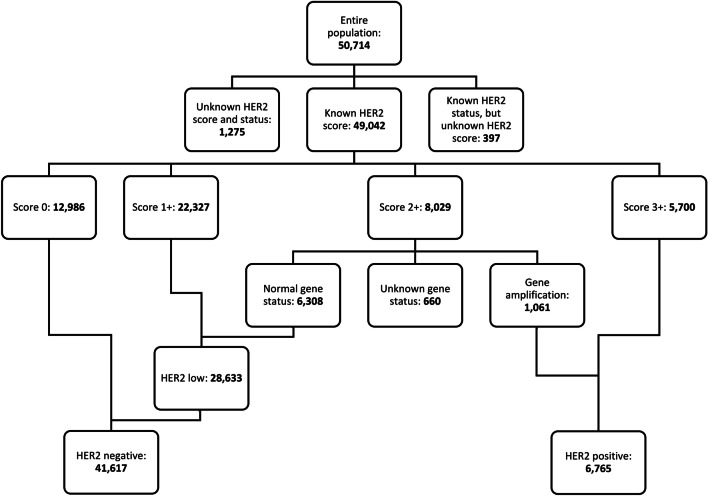
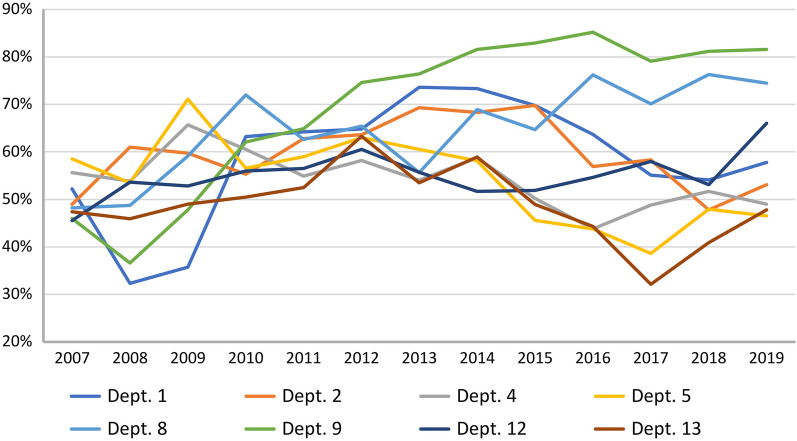
Results: Of 50,714 patients, HER2 score and status were recorded for 48,382, among whom 59.2% belonged to the HER2-low group (score 1+ or 2+ without gene amplification), 26.8% had a HER2 score of 0, and 14.0% were HER2 positive. The proportion of HER2-low cases ranged from 46.3 to 71.8% among pathology departments (P < 0.0001) and from 49.3 to 65.6% over the years (P < 0.0001). In comparison, HER2 positivity rates ranged from 11.8 to 17.2% among departments (P < 0.0001) and from 12.6 to 15.7% over the years (P = 0.005). In the eight departments with the highest number of patients, variability in HER2-low cases increased from 2011 to 2019, although the same immunohistochemical assay was used. By multivariable logistic regression, the examining department was significantly related to both HER2 score 0 and HER2 positivity (P < 0.0001) but showed greater dispersion in odds ratios in the former case (range 0.25-1.41 vs. 0.84-1.27).
Conclusions: Our data showed high inter-laboratory variability in the assessment of HER2-low breast cancer. The findings cast doubt on whether the current test method for HER2 is robust and reliable enough to select HER2-low patients for HER2-targeted treatment in daily clinical practice.
期刊介绍:
Breast Cancer Research, an international, peer-reviewed online journal, publishes original research, reviews, editorials, and reports. It features open-access research articles of exceptional interest across all areas of biology and medicine relevant to breast cancer. This includes normal mammary gland biology, with a special emphasis on the genetic, biochemical, and cellular basis of breast cancer. In addition to basic research, the journal covers preclinical, translational, and clinical studies with a biological basis, including Phase I and Phase II trials.



 京公网安备 11010802042870号
京ICP备2023020795号-1
京公网安备 11010802042870号
京ICP备2023020795号-1

 分享
分享
 求助内容:
求助内容: 应助结果提醒方式:
 扫码关注我们
