Maha M. Eid , Ola M. Eid , Amany H. Abdelrahman , Islam F.S. Abdelrahman , Elshaimaa A.F. Aboelkomsan , Rania M.A. AbdelKader , Mirhane Hassan , Marwa Farid , Alshaymaa A. Ibrahim , Safa N. Abd El-Fattah , Rana Mahrous
{"title":"Detection of AZFc gene deletion in a cohort of Egyptian patients with idiopathic male infertility","authors":"Maha M. Eid , Ola M. Eid , Amany H. Abdelrahman , Islam F.S. Abdelrahman , Elshaimaa A.F. Aboelkomsan , Rania M.A. AbdelKader , Mirhane Hassan , Marwa Farid , Alshaymaa A. Ibrahim , Safa N. Abd El-Fattah , Rana Mahrous","doi":"10.1186/s43141-023-00584-9","DOIUrl":null,"url":null,"abstract":"<div><h3>Background</h3><div>The deletions of azoospermic factor regions (AZF) are considered risk factor of spermatogenic failure. AZF duplications or complex copy number variants (CNVs) were rarely studied because STS-PCR could not always detect these changes. The application of multiplex ligation-dependent probe amplification (MLPA) as a valuable test for detection of the deletion and or duplication was introduced to investigate the AZF sub-region CNVs. The MLPA technique is still not applied on a large scale, and the publications in this area of research are limited. The aim of this work was to evaluate the efficacy of MLPA assay to detect AZF-linked CNVs in idiopathic spermatogenic failure patients and to evaluate its importance as a prognostic marker in the reproduction outcome.</div></div><div><h3>Results</h3><div>Forty infertile men (37 with azoospermia and 3 with severe oligozoospermia) and 20 normal fertile men were subjected to thorough clinical, pathological, and laboratory assessment, chromosomal study, MLPA, STS-PCR assays, histopathology study, and testicular sperm retrieval (TESE). Out of the 40 patients, 7 patients have shown CNV in the AZFc region, 6 patients have partial deletion, and one patient has partial duplication. Only one of the normal control has AZFc duplication. STS-PCR was able to detect the deletion in only 4 out of the 7 positive patients and none of the control.</div></div><div><h3>Conclusion</h3><div>We concluded that MLPA should be applied on a larger scale for the detection of Y chromosome microdeletion as a rapid, efficient, and cheap test.</div></div>","PeriodicalId":53463,"journal":{"name":"Journal of Genetic Engineering and Biotechnology","volume":"21 1","pages":"Article 111"},"PeriodicalIF":2.8000,"publicationDate":"2023-12-01","publicationTypes":"Journal Article","fieldsOfStudy":null,"isOpenAccess":false,"openAccessPdf":"https://www.ncbi.nlm.nih.gov/pmc/articles/PMC10638347/pdf/","citationCount":"0","resultStr":null,"platform":"Semanticscholar","paperid":null,"PeriodicalName":"Journal of Genetic Engineering and Biotechnology","FirstCategoryId":"1085","ListUrlMain":"https://www.sciencedirect.com/science/article/pii/S1687157X23010119","RegionNum":0,"RegionCategory":null,"ArticlePicture":[],"TitleCN":null,"AbstractTextCN":null,"PMCID":null,"EPubDate":"2023/11/10 0:00:00","PubModel":"Epub","JCR":"Q3","JCRName":"Biochemistry, Genetics and Molecular Biology","Score":null,"Total":0}
引用次数: 0
Abstract
Background
The deletions of azoospermic factor regions (AZF) are considered risk factor of spermatogenic failure. AZF duplications or complex copy number variants (CNVs) were rarely studied because STS-PCR could not always detect these changes. The application of multiplex ligation-dependent probe amplification (MLPA) as a valuable test for detection of the deletion and or duplication was introduced to investigate the AZF sub-region CNVs. The MLPA technique is still not applied on a large scale, and the publications in this area of research are limited. The aim of this work was to evaluate the efficacy of MLPA assay to detect AZF-linked CNVs in idiopathic spermatogenic failure patients and to evaluate its importance as a prognostic marker in the reproduction outcome.
Results
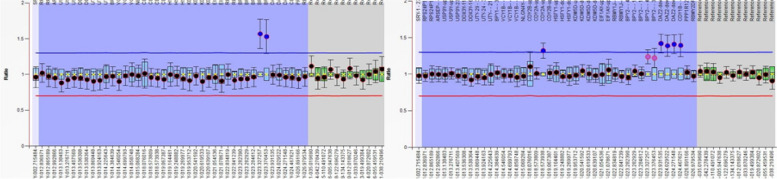
Forty infertile men (37 with azoospermia and 3 with severe oligozoospermia) and 20 normal fertile men were subjected to thorough clinical, pathological, and laboratory assessment, chromosomal study, MLPA, STS-PCR assays, histopathology study, and testicular sperm retrieval (TESE). Out of the 40 patients, 7 patients have shown CNV in the AZFc region, 6 patients have partial deletion, and one patient has partial duplication. Only one of the normal control has AZFc duplication. STS-PCR was able to detect the deletion in only 4 out of the 7 positive patients and none of the control.
Conclusion
We concluded that MLPA should be applied on a larger scale for the detection of Y chromosome microdeletion as a rapid, efficient, and cheap test.
期刊介绍:
Journal of genetic engineering and biotechnology is devoted to rapid publication of full-length research papers that leads to significant contribution in advancing knowledge in genetic engineering and biotechnology and provide novel perspectives in this research area. JGEB includes all major themes related to genetic engineering and recombinant DNA. The area of interest of JGEB includes but not restricted to: •Plant genetics •Animal genetics •Bacterial enzymes •Agricultural Biotechnology, •Biochemistry, •Biophysics, •Bioinformatics, •Environmental Biotechnology, •Industrial Biotechnology, •Microbial biotechnology, •Medical Biotechnology, •Bioenergy, Biosafety, •Biosecurity, •Bioethics, •GMOS, •Genomic, •Proteomic JGEB accepts





 京公网安备 11010802042870号
京ICP备2023020795号-1
京公网安备 11010802042870号
京ICP备2023020795号-1

 分享
分享
 求助内容:
求助内容: 应助结果提醒方式:
 扫码关注我们
