{"title":"Collective narcissism as a framework for understanding populism","authors":"Agnieszka Golec de Zavala, Oliver Keenan","doi":"10.1002/jts5.69","DOIUrl":null,"url":null,"abstract":"<p>Research on national collective narcissism, the belief and resentment that a nation's exceptionality is not sufficiently recognized by others, provides a theoretical framework for understanding the psychological motivations behind the support for right-wing populism. It bridges the findings regarding the economic and sociocultural conditions implicated in the rise of right-wing populism and the findings regarding leadership processes necessary for it to find its political expression. The conditions are interpreted as producing violations to established expectations regarding self-importance via the gradual repeal of the traditional criteria by which members of hegemonic groups evaluated their self-worth. Populist leaders propagate a social identity organized around the collective narcissistic resentment, enhance it, and propose external explanations for frustration of self and in-group-importance. This garners them a committed followership. Research on collective narcissism indicates that distress resulting from violated expectations regarding self-importance stands behind collective narcissism and its narrow vision of “true” national identity (the people), rejection and hostility toward stigmatized in-group members and out-groups as well as the association between collective narcissism and conspiratorial thinking.</p>","PeriodicalId":36271,"journal":{"name":"Journal of Theoretical Social Psychology","volume":"5 2","pages":"54-64"},"PeriodicalIF":1.2000,"publicationDate":"2020-07-06","publicationTypes":"Journal Article","fieldsOfStudy":null,"isOpenAccess":false,"openAccessPdf":"https://sci-hub-pdf.com/10.1002/jts5.69","citationCount":"0","resultStr":null,"platform":"Semanticscholar","paperid":null,"PeriodicalName":"Journal of Theoretical Social Psychology","FirstCategoryId":"1085","ListUrlMain":"https://onlinelibrary.wiley.com/doi/10.1002/jts5.69","RegionNum":0,"RegionCategory":null,"ArticlePicture":[],"TitleCN":null,"AbstractTextCN":null,"PMCID":null,"EPubDate":"","PubModel":"","JCR":"Q2","JCRName":"PSYCHOLOGY, SOCIAL","Score":null,"Total":0}
引用次数: 0
Abstract
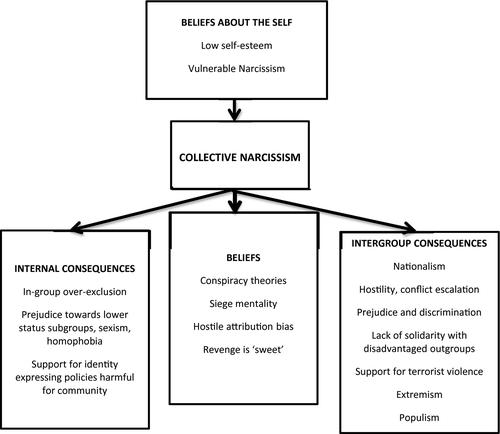
Research on national collective narcissism, the belief and resentment that a nation's exceptionality is not sufficiently recognized by others, provides a theoretical framework for understanding the psychological motivations behind the support for right-wing populism. It bridges the findings regarding the economic and sociocultural conditions implicated in the rise of right-wing populism and the findings regarding leadership processes necessary for it to find its political expression. The conditions are interpreted as producing violations to established expectations regarding self-importance via the gradual repeal of the traditional criteria by which members of hegemonic groups evaluated their self-worth. Populist leaders propagate a social identity organized around the collective narcissistic resentment, enhance it, and propose external explanations for frustration of self and in-group-importance. This garners them a committed followership. Research on collective narcissism indicates that distress resulting from violated expectations regarding self-importance stands behind collective narcissism and its narrow vision of “true” national identity (the people), rejection and hostility toward stigmatized in-group members and out-groups as well as the association between collective narcissism and conspiratorial thinking.




 京公网安备 11010802042870号
京ICP备2023020795号-1
京公网安备 11010802042870号
京ICP备2023020795号-1

 分享
分享
 求助内容:
求助内容: 应助结果提醒方式:
 扫码关注我们
