Frido K Bruehl, Mazen M Osman, Dong Chen, Joanna C Dalland
{"title":"The new WHO and ICC classification systems for myelodysplastic syndromes and their impact on the clinical laboratory.","authors":"Frido K Bruehl, Mazen M Osman, Dong Chen, Joanna C Dalland","doi":"10.1007/s12308-023-00538-7","DOIUrl":null,"url":null,"abstract":"<p><p>The International Consensus Classification (ICC) and World Health Organization (WHO) proposed significant changes to the diagnostic criteria of myelodysplastic syndromes (MDS) in 2022. The impact of these criteria on hematopathology practice is uncertain. This study aims to evaluate the impact of the 2022 ICC and WHO 5th edition classifications on the diagnosis of cytopenias and MDS. Cases from 2021 performed for primary diagnosis of cytopenia(s)/MDS and their clinical, laboratory, and pathologic findings were reviewed and classified according to the new classification systems. The rate of major changes to the diagnosis was determined and potential pitfalls in the diagnostic approach, laboratory workflow, and clinical communication challenges were investigated. A total of 49 cases were recruited. Major changes to the diagnostic entities were made in 18/49 (37%) cases according to the WHO 5th edition, and 23/49 (47%) cases classified according to the ICC. The difference was accounted for by five cases of MDS-EB2 (revised WHO 4th edition) classified as MDS/AML (major change) in the ICC in contrast to no significant change (MDS-IB2) in the WHO 5th edition. MDS-SLD cases were not subject to major reclassification according to either system. The new molecularly defined categories of CCUS/CHIP, MDS-SF3B1, and MDS with biallelic TP53 mutations were almost identically represented in both systems in our cohort. A case of MDS-MLD was reclassified as CMML by both classification systems. There are few but important differences between the new MDS classification systems. A preimplementation assessment is helpful to identify diagnostic and potential clinical impacts of their adoption.</p>","PeriodicalId":797,"journal":{"name":"Theoretical and Mathematical Physics","volume":"105 3","pages":"65-71"},"PeriodicalIF":1.1000,"publicationDate":"2023-06-01","publicationTypes":"Journal Article","fieldsOfStudy":null,"isOpenAccess":false,"openAccessPdf":"","citationCount":"0","resultStr":null,"platform":"Semanticscholar","paperid":null,"PeriodicalName":"Theoretical and Mathematical Physics","FirstCategoryId":"101","ListUrlMain":"https://doi.org/10.1007/s12308-023-00538-7","RegionNum":4,"RegionCategory":"物理与天体物理","ArticlePicture":[],"TitleCN":null,"AbstractTextCN":null,"PMCID":null,"EPubDate":"2023/3/7 0:00:00","PubModel":"Epub","JCR":"Q3","JCRName":"PHYSICS, MATHEMATICAL","Score":null,"Total":0}
引用次数: 0
Abstract
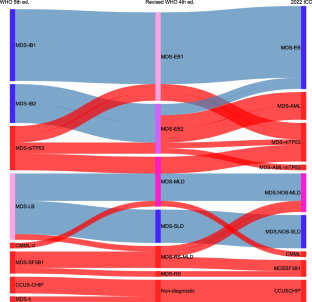
The International Consensus Classification (ICC) and World Health Organization (WHO) proposed significant changes to the diagnostic criteria of myelodysplastic syndromes (MDS) in 2022. The impact of these criteria on hematopathology practice is uncertain. This study aims to evaluate the impact of the 2022 ICC and WHO 5th edition classifications on the diagnosis of cytopenias and MDS. Cases from 2021 performed for primary diagnosis of cytopenia(s)/MDS and their clinical, laboratory, and pathologic findings were reviewed and classified according to the new classification systems. The rate of major changes to the diagnosis was determined and potential pitfalls in the diagnostic approach, laboratory workflow, and clinical communication challenges were investigated. A total of 49 cases were recruited. Major changes to the diagnostic entities were made in 18/49 (37%) cases according to the WHO 5th edition, and 23/49 (47%) cases classified according to the ICC. The difference was accounted for by five cases of MDS-EB2 (revised WHO 4th edition) classified as MDS/AML (major change) in the ICC in contrast to no significant change (MDS-IB2) in the WHO 5th edition. MDS-SLD cases were not subject to major reclassification according to either system. The new molecularly defined categories of CCUS/CHIP, MDS-SF3B1, and MDS with biallelic TP53 mutations were almost identically represented in both systems in our cohort. A case of MDS-MLD was reclassified as CMML by both classification systems. There are few but important differences between the new MDS classification systems. A preimplementation assessment is helpful to identify diagnostic and potential clinical impacts of their adoption.
期刊介绍:
Theoretical and Mathematical Physics covers quantum field theory and theory of elementary particles, fundamental problems of nuclear physics, many-body problems and statistical physics, nonrelativistic quantum mechanics, and basic problems of gravitation theory. Articles report on current developments in theoretical physics as well as related mathematical problems.
Theoretical and Mathematical Physics is published in collaboration with the Steklov Mathematical Institute of the Russian Academy of Sciences.




 京公网安备 11010802042870号
京ICP备2023020795号-1
京公网安备 11010802042870号
京ICP备2023020795号-1

 分享
分享
 求助内容:
求助内容: 应助结果提醒方式:
 扫码关注我们
