Qing Xue , Shengyi Li , Yanan Zhao , Peng Sheng , Li Xu , Zhengxi Li , Bo Zhang , Hui Li , Bo Wang , Libin Yang , Yuliang Cao , Zhongxue Chen
{"title":"Novel Alkaline Sodium-Ion Battery Capacitor Based on Active Carbon||Na0.44MnO2 towards Low Cost, High-Rate Capability and Long-Term Lifespan","authors":"Qing Xue , Shengyi Li , Yanan Zhao , Peng Sheng , Li Xu , Zhengxi Li , Bo Zhang , Hui Li , Bo Wang , Libin Yang , Yuliang Cao , Zhongxue Chen","doi":"10.3866/PKU.WHXB202303041","DOIUrl":null,"url":null,"abstract":"<div><div>As the most advanced battery technology to date, lithium-ion battery has occupied the main battery markets for electric vehicles and grid scale energy storage systems. However, the limited lithium reserves as well as the high price raise concerns about the sustainability of lithium-ion battery. Although sodium-ion battery is proposed as a good supplement to lithium-ion battery, expensive and flammable electrolyte components, harsh assembly environments and potential safety hazards have limited the rapid development to a certain extent. The organic electrolyte was replaced with an aqueous solution to construct a new type of aqueous sodium ion battery capacitor (ASIBC). It is of great significance for next-generation energy storage system owing to its low cost, high power, and inherent safety. However, applicable ASIBC system is rarely reported so far. Here, a rechargeable alkaline sodium ion battery capacitors constructed by using Na<sub>0.44</sub>MnO<sub>2</sub> cathode, activated carbon (AC) anode, 6 mol·L<sup>−1</sup> NaOH electrolyte, and cheap stainless-steel current collector. Because of high overcharge tolerance of Na<sub>0.44</sub>MnO<sub>2</sub> cathode in alkaline electrolyte, the shortcomings of the half-sodium Na<sub>0.44</sub>MnO<sub>2</sub> cathode and low initial Coulombic efficiency of AC anode can be resolved by <em>in situ</em> overcharging pre-activation process during first charging. The available capacity of Na<sub>0.44</sub>MnO<sub>2</sub> in half cell largely increased from ~40 mAh·g<sup>−1</sup> (neutral electrolyte) to 77.3 mAh·g<sup>−1</sup> (alkaline electrolyte) due to broadened Na<sup>+</sup> intercalation potential region. Thus, the AC||Na<sub>0.44</sub>MnO<sub>2</sub> ASIBC delivers outstanding electrochemical properties with a high energy density of 26.6 Wh·kg<sup>−1</sup> at a power density of 85 W·kg<sup>−1</sup> and long cycling stability with a capacity retention of 89% after 10,000 cycles. The advantages of the alkaline electrolyte for the AC||Na<sub>0.44</sub>MnO<sub>2</sub> ASIBC can be concluded as follows: (1) through the <em>in situ</em> electrochemical pre-activation process, the overcharging oxygen evolution reaction during first charging process can balance the adverse effects of the half-sodium Na<sub>0.44</sub>MnO<sub>2</sub> cathode and low initial Coulombic efficiency of AC anode on the energy density of full cell; (2) the overcharging self-protection function can promote the generated oxygen to be eliminated at anode during overcharging, which improves the system safety; (3) the low-cost materials in alkaline environment can be scaled up to construct AC||Na<sub>0.44</sub>MnO<sub>2</sub> ASIBC. In addition, the AC||Na<sub>0.44</sub>MnO<sub>2</sub> ASIBC also possesses wide operating temperature range, achieving satisfied electrochemical performance at a high temperature of 50 °C and a low temperature of −20 °C. Considering the merits of low-cost, high safety, no toxicity and environment-friendly, we believe the AC||Na<sub>0.44</sub>MnO<sub>2</sub> rechargeable alkaline sodium-ion battery capacitors have the potential to be applied to large-scale energy storage.</div><div><span><figure><span><img><ol><li><span><span>Download: <span>Download high-res image (92KB)</span></span></span></li><li><span><span>Download: <span>Download full-size image</span></span></span></li></ol></span></figure></span></div></div>","PeriodicalId":6964,"journal":{"name":"物理化学学报","volume":"40 2","pages":"Article 2303041"},"PeriodicalIF":13.5000,"publicationDate":"2024-02-01","publicationTypes":"Journal Article","fieldsOfStudy":null,"isOpenAccess":false,"openAccessPdf":"","citationCount":"0","resultStr":null,"platform":"Semanticscholar","paperid":null,"PeriodicalName":"物理化学学报","FirstCategoryId":"92","ListUrlMain":"https://www.sciencedirect.com/science/article/pii/S1000681824000602","RegionNum":2,"RegionCategory":"化学","ArticlePicture":[],"TitleCN":null,"AbstractTextCN":null,"PMCID":null,"EPubDate":"","PubModel":"","JCR":"Q1","JCRName":"CHEMISTRY, PHYSICAL","Score":null,"Total":0}
引用次数: 0
Abstract
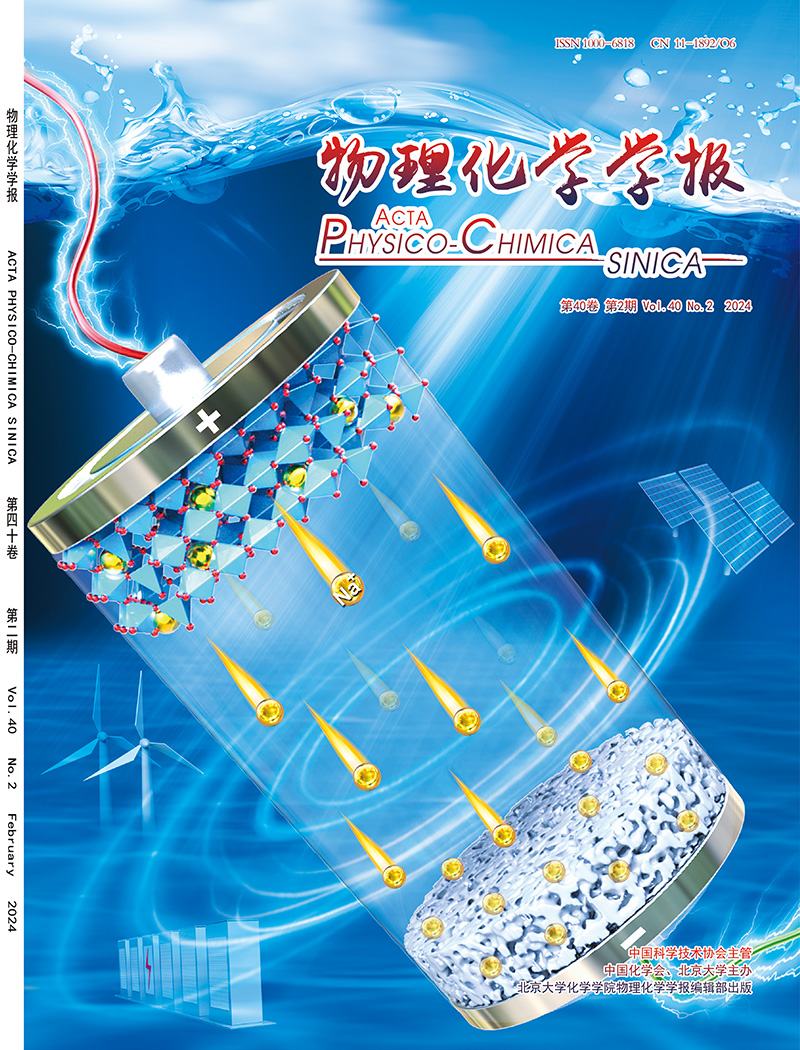
As the most advanced battery technology to date, lithium-ion battery has occupied the main battery markets for electric vehicles and grid scale energy storage systems. However, the limited lithium reserves as well as the high price raise concerns about the sustainability of lithium-ion battery. Although sodium-ion battery is proposed as a good supplement to lithium-ion battery, expensive and flammable electrolyte components, harsh assembly environments and potential safety hazards have limited the rapid development to a certain extent. The organic electrolyte was replaced with an aqueous solution to construct a new type of aqueous sodium ion battery capacitor (ASIBC). It is of great significance for next-generation energy storage system owing to its low cost, high power, and inherent safety. However, applicable ASIBC system is rarely reported so far. Here, a rechargeable alkaline sodium ion battery capacitors constructed by using Na0.44MnO2 cathode, activated carbon (AC) anode, 6 mol·L−1 NaOH electrolyte, and cheap stainless-steel current collector. Because of high overcharge tolerance of Na0.44MnO2 cathode in alkaline electrolyte, the shortcomings of the half-sodium Na0.44MnO2 cathode and low initial Coulombic efficiency of AC anode can be resolved by in situ overcharging pre-activation process during first charging. The available capacity of Na0.44MnO2 in half cell largely increased from ~40 mAh·g−1 (neutral electrolyte) to 77.3 mAh·g−1 (alkaline electrolyte) due to broadened Na+ intercalation potential region. Thus, the AC||Na0.44MnO2 ASIBC delivers outstanding electrochemical properties with a high energy density of 26.6 Wh·kg−1 at a power density of 85 W·kg−1 and long cycling stability with a capacity retention of 89% after 10,000 cycles. The advantages of the alkaline electrolyte for the AC||Na0.44MnO2 ASIBC can be concluded as follows: (1) through the in situ electrochemical pre-activation process, the overcharging oxygen evolution reaction during first charging process can balance the adverse effects of the half-sodium Na0.44MnO2 cathode and low initial Coulombic efficiency of AC anode on the energy density of full cell; (2) the overcharging self-protection function can promote the generated oxygen to be eliminated at anode during overcharging, which improves the system safety; (3) the low-cost materials in alkaline environment can be scaled up to construct AC||Na0.44MnO2 ASIBC. In addition, the AC||Na0.44MnO2 ASIBC also possesses wide operating temperature range, achieving satisfied electrochemical performance at a high temperature of 50 °C and a low temperature of −20 °C. Considering the merits of low-cost, high safety, no toxicity and environment-friendly, we believe the AC||Na0.44MnO2 rechargeable alkaline sodium-ion battery capacitors have the potential to be applied to large-scale energy storage.



 京公网安备 11010802042870号
京ICP备2023020795号-1
京公网安备 11010802042870号
京ICP备2023020795号-1

 分享
分享
 求助内容:
求助内容: 应助结果提醒方式:
 扫码关注我们
