Mustafa Mudhafar Shawkat, Abdul Rahim Bin Risal, Noor J. Mahdi, Ziauddin Safari, Maryam H. Naser, Ahmed W. Al Zand
{"title":"Fluid Flow Behavior Prediction in Naturally Fractured Reservoirs Using Machine Learning Models","authors":"Mustafa Mudhafar Shawkat, Abdul Rahim Bin Risal, Noor J. Mahdi, Ziauddin Safari, Maryam H. Naser, Ahmed W. Al Zand","doi":"10.1155/2023/7953967","DOIUrl":null,"url":null,"abstract":"<div>\n <p>The naturally fractured reservoirs are one of the most challenging due to the tectonic movements that are caused to increase the permeability and conductivity of the fractures. The instability of the permeability and conductivity effects on the fluid flow path causes problems during the transfer of the fluids from the matrix to the fractures and fluid losses during production. In addition, these complications made it difficult for engineers to estimate fluid flow during production. The fracture properties’ study is important to model the fluid flow paths such as the fracture porosity, permeability, and the shape factor, which are considered essential in the stability of fluid flow. To examine this, this research introduced new models including decision tree (DT), random forest (RF), K-nearest regression (KNR), ridge regression (RR), and LASSO regression model,. The research studied the fracture properties in naturally fractured reservoirs like the fracture porosity (FP) and the shape factor (SF). The datasets used in this study were collected from previous studies “i.e., Texas oil and gas fields” to build an intelligence-based predictive model for fluid flow characteristics. The prediction process was conducted based on interporosity flow coefficient, storativity ratio, wellbore radius, matrix permeability, and fracture permeability as input data. This study revealed a positive finding for the adopted machine learning (ML) models and was superior in using statistical accuracy metrics. Overall, the research emphasized the implementation of computer-aided models for naturally fractured reservoir analysis, giving more details on the extensive execution techniques, such as injection or the creation of artificial cracks, to minimize hydrocarbon losses or leakage.</p>\n </div>","PeriodicalId":50653,"journal":{"name":"Complexity","volume":"2023 1","pages":""},"PeriodicalIF":1.7000,"publicationDate":"2023-02-20","publicationTypes":"Journal Article","fieldsOfStudy":null,"isOpenAccess":false,"openAccessPdf":"https://onlinelibrary.wiley.com/doi/epdf/10.1155/2023/7953967","citationCount":"0","resultStr":null,"platform":"Semanticscholar","paperid":null,"PeriodicalName":"Complexity","FirstCategoryId":"5","ListUrlMain":"https://onlinelibrary.wiley.com/doi/10.1155/2023/7953967","RegionNum":4,"RegionCategory":"工程技术","ArticlePicture":[],"TitleCN":null,"AbstractTextCN":null,"PMCID":null,"EPubDate":"","PubModel":"","JCR":"Q2","JCRName":"MATHEMATICS, INTERDISCIPLINARY APPLICATIONS","Score":null,"Total":0}
引用次数: 0
Abstract
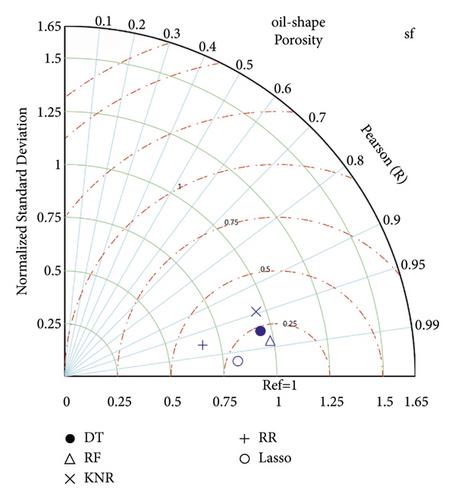
The naturally fractured reservoirs are one of the most challenging due to the tectonic movements that are caused to increase the permeability and conductivity of the fractures. The instability of the permeability and conductivity effects on the fluid flow path causes problems during the transfer of the fluids from the matrix to the fractures and fluid losses during production. In addition, these complications made it difficult for engineers to estimate fluid flow during production. The fracture properties’ study is important to model the fluid flow paths such as the fracture porosity, permeability, and the shape factor, which are considered essential in the stability of fluid flow. To examine this, this research introduced new models including decision tree (DT), random forest (RF), K-nearest regression (KNR), ridge regression (RR), and LASSO regression model,. The research studied the fracture properties in naturally fractured reservoirs like the fracture porosity (FP) and the shape factor (SF). The datasets used in this study were collected from previous studies “i.e., Texas oil and gas fields” to build an intelligence-based predictive model for fluid flow characteristics. The prediction process was conducted based on interporosity flow coefficient, storativity ratio, wellbore radius, matrix permeability, and fracture permeability as input data. This study revealed a positive finding for the adopted machine learning (ML) models and was superior in using statistical accuracy metrics. Overall, the research emphasized the implementation of computer-aided models for naturally fractured reservoir analysis, giving more details on the extensive execution techniques, such as injection or the creation of artificial cracks, to minimize hydrocarbon losses or leakage.
期刊介绍:
Complexity is a cross-disciplinary journal focusing on the rapidly expanding science of complex adaptive systems. The purpose of the journal is to advance the science of complexity. Articles may deal with such methodological themes as chaos, genetic algorithms, cellular automata, neural networks, and evolutionary game theory. Papers treating applications in any area of natural science or human endeavor are welcome, and especially encouraged are papers integrating conceptual themes and applications that cross traditional disciplinary boundaries. Complexity is not meant to serve as a forum for speculation and vague analogies between words like “chaos,” “self-organization,” and “emergence” that are often used in completely different ways in science and in daily life.



 京公网安备 11010802042870号
京ICP备2023020795号-1
京公网安备 11010802042870号
京ICP备2023020795号-1

 分享
分享
 求助内容:
求助内容: 应助结果提醒方式:
 扫码关注我们
