Lobna El Fiky, Badr Eldin Mostafa, Samer Ahmed Ibrahim, Ahmed Abdelmoneim Teaima
{"title":"Landmarks for Proper Round Window Electrode Insertion in Cochlear Implantation.","authors":"Lobna El Fiky, Badr Eldin Mostafa, Samer Ahmed Ibrahim, Ahmed Abdelmoneim Teaima","doi":"10.5152/iao.2022.21435","DOIUrl":null,"url":null,"abstract":"<p><strong>Background: </strong>This study aimed to evaluate the role of landmarks for proper round window electrode insertion in cochlear implantation surgery.</p><p><strong>Methods: </strong>This is a case series study. We included 150 patients undergoing cochlear implantation in a tertiary medical center during the period from January to December 2019. Patients with inner ear malformations or ossification or revision surgery were excluded. Three surgeons partici- pated in the study. During surgery, the round window electrode insertion was marked using 5 surgical landmarks: oval window, pyramid, fustis, round window membrane, and arborization of intracochlear blood vessels. Each surgeon reported on the identification of each landmark and its reliability for round window electrode insertion.</p><p><strong>Results: </strong>Oval window and round window membrane were clearly seen by the 3 surgeons in all cases. Pyramid was seen in 94% of cases, fustis in 85%, and intracochlear wall in 90% of cases. The postoperative transorbital x-ray confirmed the intracochlear position of electrodes in all cases.</p><p><strong>Conclusion: </strong>Round window electrode insertion can be precisely performed using these 5 surgical landmarks in straight forwards cases as well as in difficult cases. These landmarks can also assist in teaching young surgeons, in a step-wise manner, how to properly do round window electrode insertion in cochlear implantation surgery.</p>","PeriodicalId":20281,"journal":{"name":"Polymer Engineering and Science","volume":"36 1","pages":"210-213"},"PeriodicalIF":3.2000,"publicationDate":"2022-05-01","publicationTypes":"Journal Article","fieldsOfStudy":null,"isOpenAccess":false,"openAccessPdf":"https://www.ncbi.nlm.nih.gov/pmc/articles/PMC10682803/pdf/","citationCount":"0","resultStr":null,"platform":"Semanticscholar","paperid":null,"PeriodicalName":"Polymer Engineering and Science","FirstCategoryId":"1085","ListUrlMain":"https://doi.org/10.5152/iao.2022.21435","RegionNum":4,"RegionCategory":"工程技术","ArticlePicture":[],"TitleCN":null,"AbstractTextCN":null,"PMCID":null,"EPubDate":"","PubModel":"","JCR":"Q2","JCRName":"ENGINEERING, CHEMICAL","Score":null,"Total":0}
引用次数: 0
Abstract
Background: This study aimed to evaluate the role of landmarks for proper round window electrode insertion in cochlear implantation surgery.
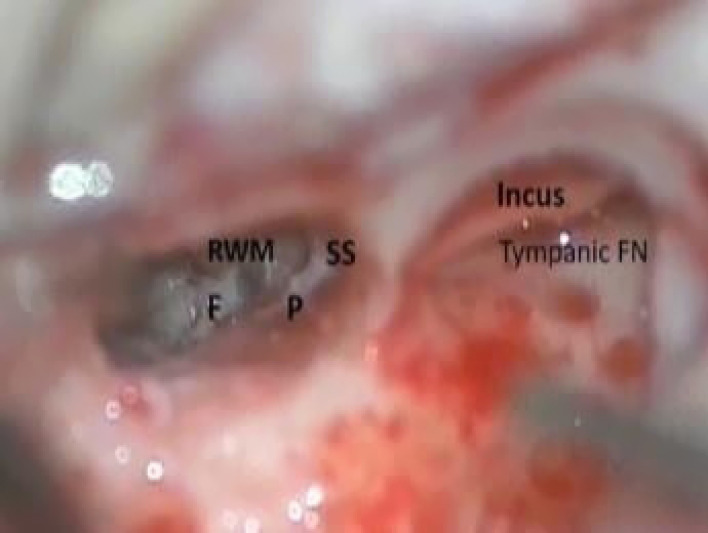
Methods: This is a case series study. We included 150 patients undergoing cochlear implantation in a tertiary medical center during the period from January to December 2019. Patients with inner ear malformations or ossification or revision surgery were excluded. Three surgeons partici- pated in the study. During surgery, the round window electrode insertion was marked using 5 surgical landmarks: oval window, pyramid, fustis, round window membrane, and arborization of intracochlear blood vessels. Each surgeon reported on the identification of each landmark and its reliability for round window electrode insertion.
Results: Oval window and round window membrane were clearly seen by the 3 surgeons in all cases. Pyramid was seen in 94% of cases, fustis in 85%, and intracochlear wall in 90% of cases. The postoperative transorbital x-ray confirmed the intracochlear position of electrodes in all cases.
Conclusion: Round window electrode insertion can be precisely performed using these 5 surgical landmarks in straight forwards cases as well as in difficult cases. These landmarks can also assist in teaching young surgeons, in a step-wise manner, how to properly do round window electrode insertion in cochlear implantation surgery.
期刊介绍:
For more than 30 years, Polymer Engineering & Science has been one of the most highly regarded journals in the field, serving as a forum for authors of treatises on the cutting edge of polymer science and technology. The importance of PE&S is underscored by the frequent rate at which its articles are cited, especially by other publications - literally thousand of times a year. Engineers, researchers, technicians, and academicians worldwide are looking to PE&S for the valuable information they need. There are special issues compiled by distinguished guest editors. These contain proceedings of symposia on such diverse topics as polyblends, mechanics of plastics and polymer welding.





 京公网安备 11010802042870号
京ICP备2023020795号-1
京公网安备 11010802042870号
京ICP备2023020795号-1

 分享
分享
 求助内容:
求助内容: 应助结果提醒方式:
 扫码关注我们
