{"title":"Efficacy and safety of 'dropless vitrectomy surgery' and comparison of outcomes to standard of care topical therapy.","authors":"K V Chalam, Harris Ahmed","doi":"10.3389/fopht.2023.1215968","DOIUrl":null,"url":null,"abstract":"<p><strong>Objective/background: </strong>To compare the effectiveness of intravitreal injection of triamcinolone acetonide/moxifloxacin (Tri-Moxi) with the standard eye drop regimen for controlling postoperative inflammation, intraocular pressure, infections, macular thickness, and visual acuity (VA) in patients undergoing pars plana vitrectomy for various retinal disorders.</p><p><strong>Subject/methods: </strong>In this retrospective longitudinal study, patients who underwent vitrectomy using intravitreal Tri-Moxi at the end of surgery (Group 1) were compared with those who received standard topical steroid antibiotics (Group 2) in terms of intraocular inflammation, intraocular pressure, macular thickness based on optical coherence tomography, and visual acuity.</p><p><strong>Results: </strong>In total, 162 consecutive eyes (group 1 [81 eyes]; group 2 [82 eyes]) were included. VA improved by two lines in both groups at 90 days. In Group 1, preoperative VA (logMAR) was 0.92 (0.66) compared to 0.92 (0.75) in Group 2 (p = 1), while at 3 months, it was 0.61 (0.3) and 0.57 (0.3), respectively (p = 0.46). Group 1 showed superior outcomes concerning central foveal thickness. The average central foveal thickness CFT (µm) in group 2 preoperatively was 423 (95) and 348 (63) at 3 months compared to group 1 526 (109) and 306 (108) preoperatively and 3 months, respectively (p = 0.042). There was no statistically significant difference in the rate of elevated intraocular pressure between the two groups or anterior chamber cell reaction severity, and no cases of endophthalmitis were observed in either group.</p><p><strong>Conclusions: </strong>Tri-Moxi is effective after vitrectomy and is not inferior to standard postoperative topical therapy.</p>","PeriodicalId":20800,"journal":{"name":"Propellants, Explosives, Pyrotechnics","volume":"34 1","pages":"1215968"},"PeriodicalIF":2.0000,"publicationDate":"2023-07-28","publicationTypes":"Journal Article","fieldsOfStudy":null,"isOpenAccess":false,"openAccessPdf":"https://www.ncbi.nlm.nih.gov/pmc/articles/PMC11182295/pdf/","citationCount":"0","resultStr":null,"platform":"Semanticscholar","paperid":null,"PeriodicalName":"Propellants, Explosives, Pyrotechnics","FirstCategoryId":"1085","ListUrlMain":"https://doi.org/10.3389/fopht.2023.1215968","RegionNum":4,"RegionCategory":"工程技术","ArticlePicture":[],"TitleCN":null,"AbstractTextCN":null,"PMCID":null,"EPubDate":"2023/1/1 0:00:00","PubModel":"eCollection","JCR":"Q3","JCRName":"CHEMISTRY, APPLIED","Score":null,"Total":0}
引用次数: 0
Abstract
Objective/background: To compare the effectiveness of intravitreal injection of triamcinolone acetonide/moxifloxacin (Tri-Moxi) with the standard eye drop regimen for controlling postoperative inflammation, intraocular pressure, infections, macular thickness, and visual acuity (VA) in patients undergoing pars plana vitrectomy for various retinal disorders.
Subject/methods: In this retrospective longitudinal study, patients who underwent vitrectomy using intravitreal Tri-Moxi at the end of surgery (Group 1) were compared with those who received standard topical steroid antibiotics (Group 2) in terms of intraocular inflammation, intraocular pressure, macular thickness based on optical coherence tomography, and visual acuity.
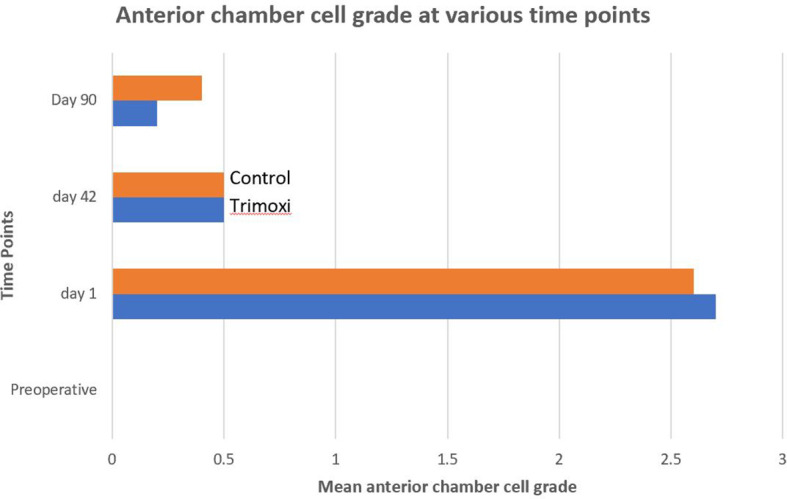
Results: In total, 162 consecutive eyes (group 1 [81 eyes]; group 2 [82 eyes]) were included. VA improved by two lines in both groups at 90 days. In Group 1, preoperative VA (logMAR) was 0.92 (0.66) compared to 0.92 (0.75) in Group 2 (p = 1), while at 3 months, it was 0.61 (0.3) and 0.57 (0.3), respectively (p = 0.46). Group 1 showed superior outcomes concerning central foveal thickness. The average central foveal thickness CFT (µm) in group 2 preoperatively was 423 (95) and 348 (63) at 3 months compared to group 1 526 (109) and 306 (108) preoperatively and 3 months, respectively (p = 0.042). There was no statistically significant difference in the rate of elevated intraocular pressure between the two groups or anterior chamber cell reaction severity, and no cases of endophthalmitis were observed in either group.
Conclusions: Tri-Moxi is effective after vitrectomy and is not inferior to standard postoperative topical therapy.
期刊介绍:
Propellants, Explosives, Pyrotechnics (PEP) is an international, peer-reviewed journal containing Full Papers, Short Communications, critical Reviews, as well as details of forthcoming meetings and book reviews concerned with the research, development and production in relation to propellants, explosives, and pyrotechnics for all applications. Being the official journal of the International Pyrotechnics Society, PEP is a vital medium and the state-of-the-art forum for the exchange of science and technology in energetic materials. PEP is published 12 times a year.
PEP is devoted to advancing the science, technology and engineering elements in the storage and manipulation of chemical energy, specifically in propellants, explosives and pyrotechnics. Articles should provide scientific context, articulate impact, and be generally applicable to the energetic materials and wider scientific community. PEP is not a defense journal and does not feature the weaponization of materials and related systems or include information that would aid in the development or utilization of improvised explosive systems, e.g., synthesis routes to terrorist explosives.





 京公网安备 11010802042870号
京ICP备2023020795号-1
京公网安备 11010802042870号
京ICP备2023020795号-1

 分享
分享
 求助内容:
求助内容: 应助结果提醒方式:
 扫码关注我们
