Yixuan Wang , Canhui Zhang , Xingkun Wang, Jiarui Duan, Kecheng Tong, Shuixing Dai, Lei Chu, Minghua Huang
{"title":"Engineering Carbon-Chainmail-Shell Coated Co9Se8 Nanoparticles as Efficient and Durable Catalysts in Seawater-Based Zn-Air Batteries","authors":"Yixuan Wang , Canhui Zhang , Xingkun Wang, Jiarui Duan, Kecheng Tong, Shuixing Dai, Lei Chu, Minghua Huang","doi":"10.3866/PKU.WHXB202305004","DOIUrl":null,"url":null,"abstract":"<div><div>With the depletion of fossil fuel resources and the increasing severity of environmental pollution, it has become imperative to seek energy conversion devices with low cost, high efficiency and excellent environmental compatibility. Considering their high theoretical energy density, affordability and environmentally friendly nature, Zn-air batteries (ZABs) are regarded as promising energy storage and conversion devices. The utilization of seawater in ZABs (S-ZABs) holds great potential, given the abundance of seawater reserves, offering economic and social benefits such as reducing electrolyte costs and alleviating competition for freshwater consumption in human activities. However, the application of S-ZABs remains challenging, particularly in constructing high-performance cathode oxygen reduction reaction (ORR) catalysts that are highly resistant to Cl<sup>−</sup> corrosion in seawater-based electrolytes. In this study, we have engineered an ultrathin carbon-chainmail-shell encapsulated Co<sub>9</sub>Se<sub>8</sub> nanoparticles on N-doped mesoporous carbon (named as NMC-Co<sub>9</sub>Se<sub>8</sub>) electrocatalysts using the high-temperature selenization strategy. The ultrathin carbon-chainmail-shell on the outside improves electron transfer during the electrocatalysis and suppresses nanoparticles agglomeration. Additionally, it could act as armor for protecting the inner active site from the adsorption of corrosive Cl<sup>−</sup>. Benefit from this unique structure, the NMC-Co<sub>9</sub>Se<sub>8</sub> catalyst exhibits excellent ORR performance, with an onset potential of 0.904 V and a half-wave potential of 0.860 V in seawater-based electrolytes. The catalyst also affords the lowest Tafel slope (35.5 mV·dec<sup>−1</sup>) and the highest kinetics current density of 9.816 mA·cm<sup>−2</sup> at 0.85 V among all investigated samples. Owing to the protective effect of the ultrathin carbon-chainmailshell on the inner active sites, the NMC-Co<sub>9</sub>Se<sub>8</sub> catalyst retains 91.6% of its initial activity after continuous operation for 50000 s, surpassing the commercial Pt/C catalyst (with a current retention rate of 62.8%). More importantly, the S-ZABs based on the NMC-Co<sub>9</sub>Se<sub>8</sub> catalyst deliver a high maximum power density of 172.4 mW·cm<sup>−2</sup> and a high specific capacity of 643.9 mAh·g<sup>−1</sup>, exceeding those of S-ZABs powered by the commercial Pt/C catalyst (151.2 mW·cm<sup>−2</sup> and 548.3 mAh·g<sup>−1</sup>). Furthermore, the S-ZABs driven by the NMC-Co<sub>9</sub>Se<sub>8</sub> catalyst demonstrate a discharge stability for up to 150 h and maintain a stable charge-discharge cycle stability over 200 h, demonstrating the practical application performance of the NMC-Co<sub>9</sub>Se<sub>8</sub> catalyst. In practical applications, the S-ZABs driven by the NMC-Co<sub>9</sub>Se<sub>8</sub> catalyst can illuminate a light-emitting diode (LED) with a driving voltage of 2 V for several hours. This work provides new ideas for developing efficient and durable catalysts with high Cl<sup>−</sup> corrosion resistance for applications in seawater-based Zn-air batteries and other energy conversion technologies.</div><div><span><figure><span><img><ol><li><span><span>Download: <span>Download high-res image (142KB)</span></span></span></li><li><span><span>Download: <span>Download full-size image</span></span></span></li></ol></span></figure></span></div></div>","PeriodicalId":6964,"journal":{"name":"物理化学学报","volume":"40 6","pages":"Article 2305004"},"PeriodicalIF":13.5000,"publicationDate":"2024-06-01","publicationTypes":"Journal Article","fieldsOfStudy":null,"isOpenAccess":false,"openAccessPdf":"","citationCount":"0","resultStr":null,"platform":"Semanticscholar","paperid":null,"PeriodicalName":"物理化学学报","FirstCategoryId":"92","ListUrlMain":"https://www.sciencedirect.com/science/article/pii/S1000681824000936","RegionNum":2,"RegionCategory":"化学","ArticlePicture":[],"TitleCN":null,"AbstractTextCN":null,"PMCID":null,"EPubDate":"","PubModel":"","JCR":"Q1","JCRName":"CHEMISTRY, PHYSICAL","Score":null,"Total":0}
引用次数: 0
Abstract
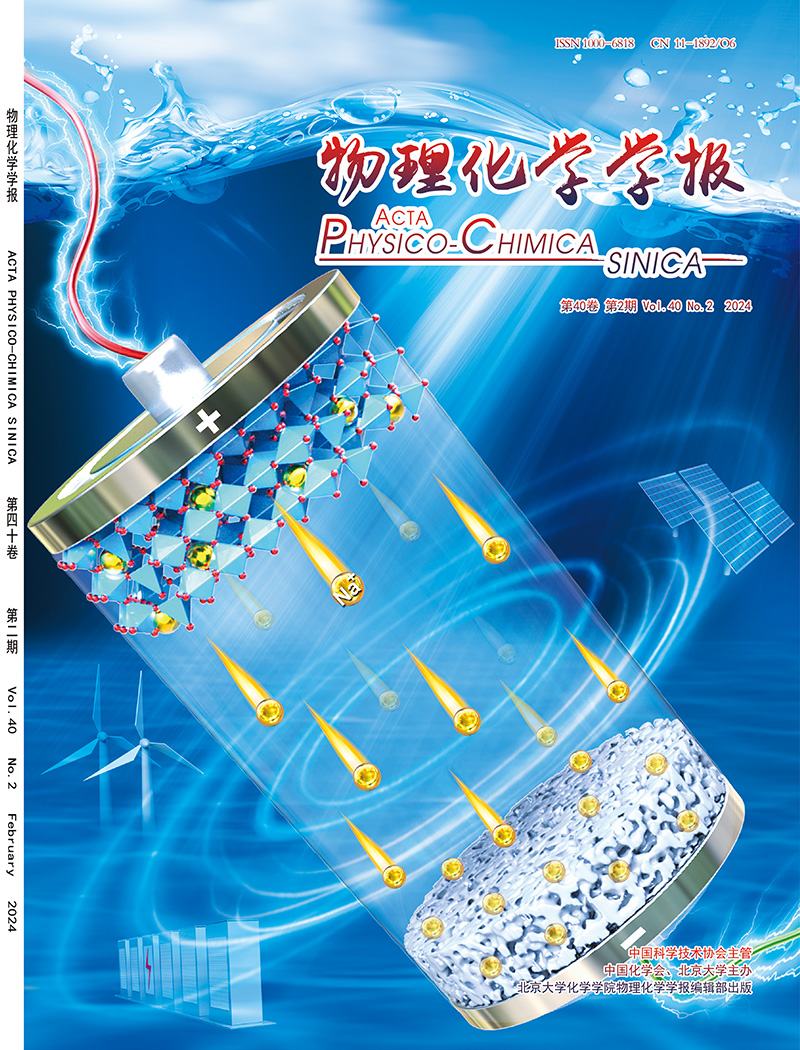
With the depletion of fossil fuel resources and the increasing severity of environmental pollution, it has become imperative to seek energy conversion devices with low cost, high efficiency and excellent environmental compatibility. Considering their high theoretical energy density, affordability and environmentally friendly nature, Zn-air batteries (ZABs) are regarded as promising energy storage and conversion devices. The utilization of seawater in ZABs (S-ZABs) holds great potential, given the abundance of seawater reserves, offering economic and social benefits such as reducing electrolyte costs and alleviating competition for freshwater consumption in human activities. However, the application of S-ZABs remains challenging, particularly in constructing high-performance cathode oxygen reduction reaction (ORR) catalysts that are highly resistant to Cl− corrosion in seawater-based electrolytes. In this study, we have engineered an ultrathin carbon-chainmail-shell encapsulated Co9Se8 nanoparticles on N-doped mesoporous carbon (named as NMC-Co9Se8) electrocatalysts using the high-temperature selenization strategy. The ultrathin carbon-chainmail-shell on the outside improves electron transfer during the electrocatalysis and suppresses nanoparticles agglomeration. Additionally, it could act as armor for protecting the inner active site from the adsorption of corrosive Cl−. Benefit from this unique structure, the NMC-Co9Se8 catalyst exhibits excellent ORR performance, with an onset potential of 0.904 V and a half-wave potential of 0.860 V in seawater-based electrolytes. The catalyst also affords the lowest Tafel slope (35.5 mV·dec−1) and the highest kinetics current density of 9.816 mA·cm−2 at 0.85 V among all investigated samples. Owing to the protective effect of the ultrathin carbon-chainmailshell on the inner active sites, the NMC-Co9Se8 catalyst retains 91.6% of its initial activity after continuous operation for 50000 s, surpassing the commercial Pt/C catalyst (with a current retention rate of 62.8%). More importantly, the S-ZABs based on the NMC-Co9Se8 catalyst deliver a high maximum power density of 172.4 mW·cm−2 and a high specific capacity of 643.9 mAh·g−1, exceeding those of S-ZABs powered by the commercial Pt/C catalyst (151.2 mW·cm−2 and 548.3 mAh·g−1). Furthermore, the S-ZABs driven by the NMC-Co9Se8 catalyst demonstrate a discharge stability for up to 150 h and maintain a stable charge-discharge cycle stability over 200 h, demonstrating the practical application performance of the NMC-Co9Se8 catalyst. In practical applications, the S-ZABs driven by the NMC-Co9Se8 catalyst can illuminate a light-emitting diode (LED) with a driving voltage of 2 V for several hours. This work provides new ideas for developing efficient and durable catalysts with high Cl− corrosion resistance for applications in seawater-based Zn-air batteries and other energy conversion technologies.



 京公网安备 11010802042870号
京ICP备2023020795号-1
京公网安备 11010802042870号
京ICP备2023020795号-1

 分享
分享
 求助内容:
求助内容: 应助结果提醒方式:
 扫码关注我们
