Bruce R Dalton, Sandra J MacTavish, Lauren C Bresee, Nipunie Rajapakse, Otto Vanderkooi, Joseph Vayalumkal, John Conly
{"title":"Antimicrobial use over a four-year period using days of therapy measurement at a Canadian pediatric acute care hospital.","authors":"Bruce R Dalton, Sandra J MacTavish, Lauren C Bresee, Nipunie Rajapakse, Otto Vanderkooi, Joseph Vayalumkal, John Conly","doi":"10.1155/2015/835209","DOIUrl":null,"url":null,"abstract":"<p><strong>Background: </strong>Antimicrobial resistance is a concern that is challenging the ability to treat common infections. Surveillance of antimicrobial use in pediatric acute care institutions is complicated because the common metric unit, the defined daily dose, is problematic for this population.</p><p><strong>Objective: </strong>During a four-year period in which no specific antimicrobial stewardship initiatives were conducted, pediatric antimicrobial use was quantified using days of therapy (DOT) per 100 patient days (PD) (DOT/100 PD) at the Alberta Children's Hospital (Calgary, Alberta) for benchmarking purposes.</p><p><strong>Methods: </strong>Drug use data for systemic antimicrobials administered on wards at the Alberta Children's Hospital were collected from electronic medication administration records. DOT were calculated and rates were determined using 100 PD as the denominator. Changes over the surveillance period and subgroup proportions were represented graphically and assessed using linear regression.</p><p><strong>Results: </strong>Total antimicrobial use decreased from 93.6 DOT/100 PD to 75.7 DOT/100 PD (19.1%) over the 2010/2011 through to the 2013/2014 fiscal years. During this period, a 20.0% increase in PD and an essentially stable absolute count of DOT (2.9% decrease) were observed. Overall, antimicrobial use was highest in the pediatric intensive care and oncology units.</p><p><strong>Discussion: </strong>The exact changes in prescribing patterns that led to the observed reduction in DOT/100 PD with associated increased PD are unclear, but may be a topic for future investigations.</p><p><strong>Conclusion: </strong>Antimicrobial use data from a Canadian acute care pediatric hospital reported in DOT/100 PD were compiled for a four-year time period. These data may be useful for benchmarking purposes.</p>","PeriodicalId":50040,"journal":{"name":"Journal of Statistical Computation and Simulation","volume":"90 1","pages":"253-8"},"PeriodicalIF":1.2000,"publicationDate":"2015-09-01","publicationTypes":"Journal Article","fieldsOfStudy":null,"isOpenAccess":false,"openAccessPdf":"https://www.ncbi.nlm.nih.gov/pmc/articles/PMC4644008/pdf/","citationCount":"0","resultStr":null,"platform":"Semanticscholar","paperid":null,"PeriodicalName":"Journal of Statistical Computation and Simulation","FirstCategoryId":"1085","ListUrlMain":"https://doi.org/10.1155/2015/835209","RegionNum":4,"RegionCategory":"数学","ArticlePicture":[],"TitleCN":null,"AbstractTextCN":null,"PMCID":null,"EPubDate":"","PubModel":"","JCR":"Q4","JCRName":"COMPUTER SCIENCE, INTERDISCIPLINARY APPLICATIONS","Score":null,"Total":0}
引用次数: 0
Abstract
Background: Antimicrobial resistance is a concern that is challenging the ability to treat common infections. Surveillance of antimicrobial use in pediatric acute care institutions is complicated because the common metric unit, the defined daily dose, is problematic for this population.
Objective: During a four-year period in which no specific antimicrobial stewardship initiatives were conducted, pediatric antimicrobial use was quantified using days of therapy (DOT) per 100 patient days (PD) (DOT/100 PD) at the Alberta Children's Hospital (Calgary, Alberta) for benchmarking purposes.
Methods: Drug use data for systemic antimicrobials administered on wards at the Alberta Children's Hospital were collected from electronic medication administration records. DOT were calculated and rates were determined using 100 PD as the denominator. Changes over the surveillance period and subgroup proportions were represented graphically and assessed using linear regression.
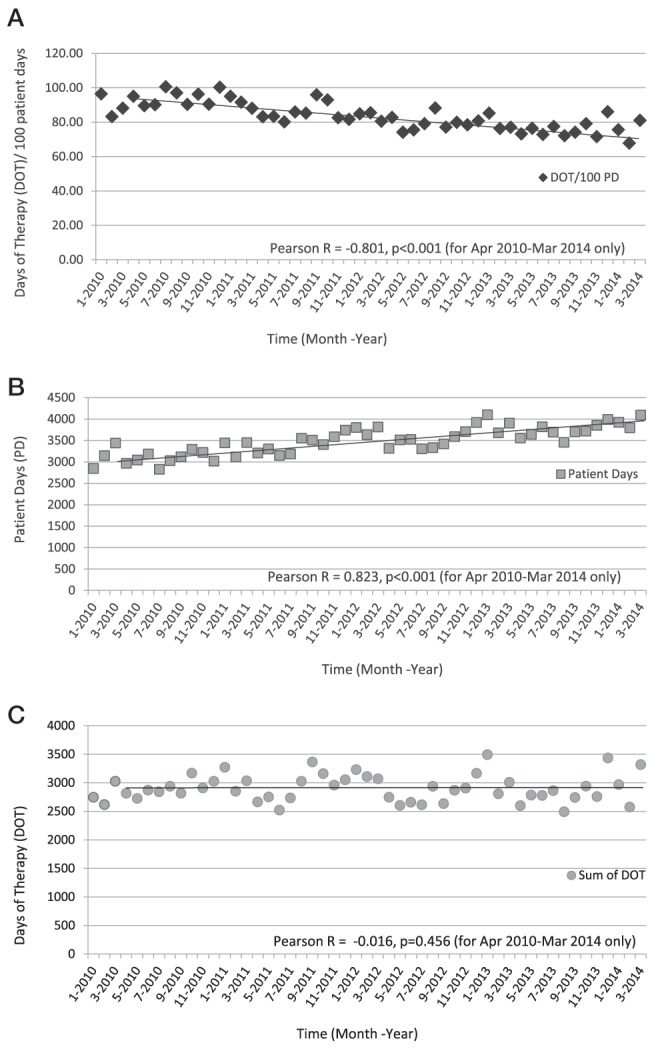
Results: Total antimicrobial use decreased from 93.6 DOT/100 PD to 75.7 DOT/100 PD (19.1%) over the 2010/2011 through to the 2013/2014 fiscal years. During this period, a 20.0% increase in PD and an essentially stable absolute count of DOT (2.9% decrease) were observed. Overall, antimicrobial use was highest in the pediatric intensive care and oncology units.
Discussion: The exact changes in prescribing patterns that led to the observed reduction in DOT/100 PD with associated increased PD are unclear, but may be a topic for future investigations.
Conclusion: Antimicrobial use data from a Canadian acute care pediatric hospital reported in DOT/100 PD were compiled for a four-year time period. These data may be useful for benchmarking purposes.
期刊介绍:
Journal of Statistical Computation and Simulation ( JSCS ) publishes significant and original work in areas of statistics which are related to or dependent upon the computer.
Fields covered include computer algorithms related to probability or statistics, studies in statistical inference by means of simulation techniques, and implementation of interactive statistical systems.
JSCS does not consider applications of statistics to other fields, except as illustrations of the use of the original statistics presented.
Accepted papers should ideally appeal to a wide audience of statisticians and provoke real applications of theoretical constructions.



 京公网安备 11010802042870号
京ICP备2023020795号-1
京公网安备 11010802042870号
京ICP备2023020795号-1

 分享
分享
 求助内容:
求助内容: 应助结果提醒方式:
 扫码关注我们
