A V Popova, R Vladkova, P Borisova, K Georgieva, G Mihailova, V Velikova, T Tsonev, A G Ivanov
{"title":"Photosynthetic response of lutein-deficient mutant <i>lut2</i> of <i>Arabidopsis thaliana</i> to low temperature at high light.","authors":"A V Popova, R Vladkova, P Borisova, K Georgieva, G Mihailova, V Velikova, T Tsonev, A G Ivanov","doi":"10.32615/ps.2022.009","DOIUrl":null,"url":null,"abstract":"<p><p>Alterations in photosynthetic performance of lutein-deficient mutant <i>lut2</i> and wild type (wt) of <i>Arabidopsis thaliana</i> were followed after treatment with low temperature and high light for 6 d. The obtained results indicated lower electrolyte leakage, lower excitation pressure, and higher actual photochemical efficiency of PSII in <i>lut2</i> plants exposed to combined stress compared to wt plants. This implies that <i>lut2</i> is less susceptible to the applied stress conditions. The observed lower values of quantum efficiency of nonphotochemical quenching and energy-dependent component of nonphotochemical quenching in <i>lut2</i> suggest that nonphotochemical quenching mechanism(s) localized within LHCII could not be involved in the acquisition of higher stress tolerance of <i>lut2</i> and alternatives to nonphotochemical quenching mechanisms are involved for dissipation of excess absorbed light. We suggest that the observed enhanced capacity for cyclic electron flow and the higher oxidation state of P<sub>700</sub> (P<sub>700</sub> <sup>+</sup>), which suggests PSI-dependent energy quenching in <i>lut2</i> plants may serve as efficient photoprotective mechanisms, thus explaining the lower susceptibility of <i>lut2</i> to the combined stress treatments.</p>","PeriodicalId":20157,"journal":{"name":"Photosynthetica","volume":"54 1","pages":"110-120"},"PeriodicalIF":1.6000,"publicationDate":"2022-03-01","publicationTypes":"Journal Article","fieldsOfStudy":null,"isOpenAccess":false,"openAccessPdf":"https://www.ncbi.nlm.nih.gov/pmc/articles/PMC11559481/pdf/","citationCount":"0","resultStr":null,"platform":"Semanticscholar","paperid":null,"PeriodicalName":"Photosynthetica","FirstCategoryId":"99","ListUrlMain":"https://doi.org/10.32615/ps.2022.009","RegionNum":4,"RegionCategory":"生物学","ArticlePicture":[],"TitleCN":null,"AbstractTextCN":null,"PMCID":null,"EPubDate":"2022/1/1 0:00:00","PubModel":"eCollection","JCR":"Q2","JCRName":"PLANT SCIENCES","Score":null,"Total":0}
引用次数: 0
Abstract
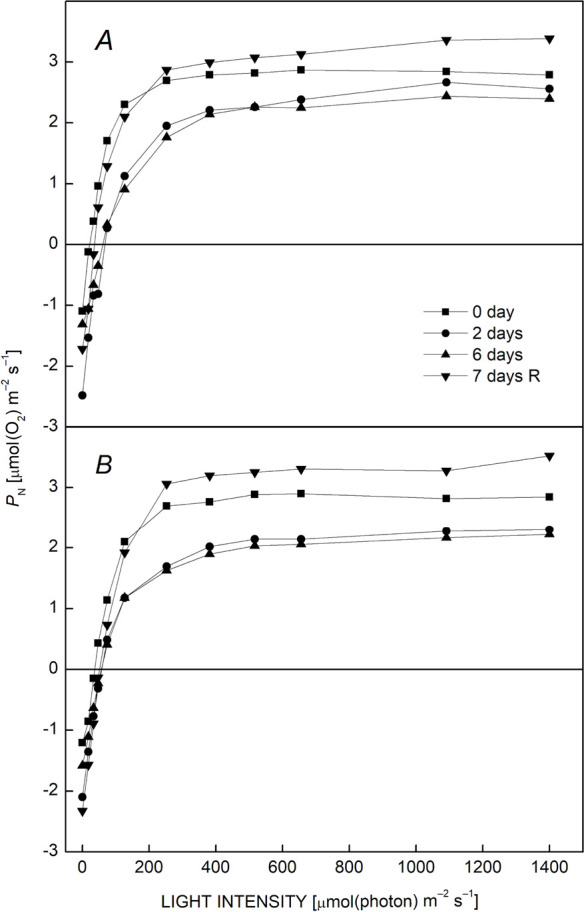
Alterations in photosynthetic performance of lutein-deficient mutant lut2 and wild type (wt) of Arabidopsis thaliana were followed after treatment with low temperature and high light for 6 d. The obtained results indicated lower electrolyte leakage, lower excitation pressure, and higher actual photochemical efficiency of PSII in lut2 plants exposed to combined stress compared to wt plants. This implies that lut2 is less susceptible to the applied stress conditions. The observed lower values of quantum efficiency of nonphotochemical quenching and energy-dependent component of nonphotochemical quenching in lut2 suggest that nonphotochemical quenching mechanism(s) localized within LHCII could not be involved in the acquisition of higher stress tolerance of lut2 and alternatives to nonphotochemical quenching mechanisms are involved for dissipation of excess absorbed light. We suggest that the observed enhanced capacity for cyclic electron flow and the higher oxidation state of P700 (P700+), which suggests PSI-dependent energy quenching in lut2 plants may serve as efficient photoprotective mechanisms, thus explaining the lower susceptibility of lut2 to the combined stress treatments.
期刊介绍:
Photosynthetica publishes original scientific papers and brief communications, reviews on specialized topics, book reviews and announcements and reports covering wide range of photosynthesis research or research including photosynthetic parameters of both experimental and theoretical nature and dealing with physiology, biophysics, biochemistry, molecular biology on one side and leaf optics, stress physiology and ecology of photosynthesis on the other side.
The language of journal is English (British or American). Papers should not be published or under consideration for publication elsewhere.





 京公网安备 11010802042870号
京ICP备2023020795号-1
京公网安备 11010802042870号
京ICP备2023020795号-1

 分享
分享
 求助内容:
求助内容: 应助结果提醒方式:
 扫码关注我们
