Christine L Sumner, Naseeb Bolduc, Marina Ag von Keyserlingk
{"title":"Using focus groups with dairy cattle veterinarians to explore learning about calf welfare.","authors":"Christine L Sumner, Naseeb Bolduc, Marina Ag von Keyserlingk","doi":"10.1017/awf.2022.7","DOIUrl":null,"url":null,"abstract":"<p><p>Dairy calf welfare is a growing interest within the veterinary field. However, a limited understanding of the conception of calf welfare by dairy cattle veterinarians can hinder efforts to promote welfare improvements on farms. The aim of this study was to explore how focus groups can promote learning about dairy calf welfare issues among cattle veterinarians. Focus groups (n = 5), that collectively had 33 participants representing five Canadian provinces and different geographical regions, were conducted as part of a continuing education workshop for Canadian cattle veterinarians. Two trained individuals undertook exploratory data analyses using applied thematic analysis and adult learning theory to develop a codebook of the data and identify the main themes. There were three main themes about learning that emerged from guided peer-discussion: (i) defining a shared concept of animal welfare from the veterinary perspective to diagnose the problem; (ii) understanding the problems of calf welfare by self-examination and group reflection; and (iii) negotiating the best approach to address the problems through sharing of ideas on improving calf welfare, including strategies for addressing welfare problems. In conclusion, focus groups can facilitate animal welfare learning within the veterinary profession.</p>","PeriodicalId":19723,"journal":{"name":"Nonlinear Dynamics","volume":"77 1","pages":"e6"},"PeriodicalIF":5.2000,"publicationDate":"2023-01-27","publicationTypes":"Journal Article","fieldsOfStudy":null,"isOpenAccess":false,"openAccessPdf":"https://www.ncbi.nlm.nih.gov/pmc/articles/PMC10936294/pdf/","citationCount":"0","resultStr":null,"platform":"Semanticscholar","paperid":null,"PeriodicalName":"Nonlinear Dynamics","FirstCategoryId":"97","ListUrlMain":"https://doi.org/10.1017/awf.2022.7","RegionNum":2,"RegionCategory":"工程技术","ArticlePicture":[],"TitleCN":null,"AbstractTextCN":null,"PMCID":null,"EPubDate":"2023/1/1 0:00:00","PubModel":"eCollection","JCR":"Q1","JCRName":"ENGINEERING, MECHANICAL","Score":null,"Total":0}
引用次数: 0
Abstract
Dairy calf welfare is a growing interest within the veterinary field. However, a limited understanding of the conception of calf welfare by dairy cattle veterinarians can hinder efforts to promote welfare improvements on farms. The aim of this study was to explore how focus groups can promote learning about dairy calf welfare issues among cattle veterinarians. Focus groups (n = 5), that collectively had 33 participants representing five Canadian provinces and different geographical regions, were conducted as part of a continuing education workshop for Canadian cattle veterinarians. Two trained individuals undertook exploratory data analyses using applied thematic analysis and adult learning theory to develop a codebook of the data and identify the main themes. There were three main themes about learning that emerged from guided peer-discussion: (i) defining a shared concept of animal welfare from the veterinary perspective to diagnose the problem; (ii) understanding the problems of calf welfare by self-examination and group reflection; and (iii) negotiating the best approach to address the problems through sharing of ideas on improving calf welfare, including strategies for addressing welfare problems. In conclusion, focus groups can facilitate animal welfare learning within the veterinary profession.
期刊介绍:
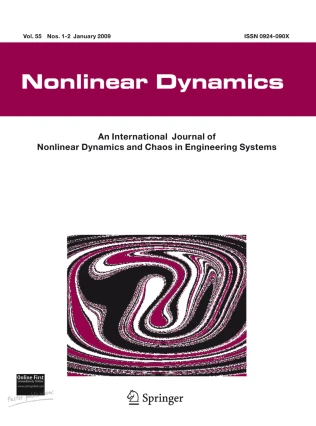
Nonlinear Dynamics provides a forum for the rapid publication of original research in the field. The journal’s scope encompasses all nonlinear dynamic phenomena associated with mechanical, structural, civil, aeronautical, ocean, electrical, and control systems. Review articles and original contributions are based on analytical, computational, and experimental methods.
The journal examines such topics as perturbation and computational methods, symbolic manipulation, dynamic stability, local and global methods, bifurcations, chaos, and deterministic and random vibrations. The journal also investigates Lie groups, multibody dynamics, robotics, fluid-solid interactions, system modeling and identification, friction and damping models, signal analysis, and measurement techniques.




 京公网安备 11010802042870号
京ICP备2023020795号-1
京公网安备 11010802042870号
京ICP备2023020795号-1

 分享
分享
 求助内容:
求助内容: 应助结果提醒方式:
 扫码关注我们
