Methodology and results of real-world cost-effectiveness of carfilzomib in combination with lenalidomide and dexamethasone in relapsed multiple myeloma using registry data.
M Campioni, I Agirrezabal, R Hajek, J Minarik, L Pour, I Spicka, S Gonzalez-McQuire, P Jandova, V Maisnar
{"title":"Methodology and results of real-world cost-effectiveness of carfilzomib in combination with lenalidomide and dexamethasone in relapsed multiple myeloma using registry data.","authors":"M Campioni, I Agirrezabal, R Hajek, J Minarik, L Pour, I Spicka, S Gonzalez-McQuire, P Jandova, V Maisnar","doi":"10.1007/s10198-019-01122-6","DOIUrl":null,"url":null,"abstract":"<p><strong>Objective: </strong>To predict the real-world (RW) cost-effectiveness of carfilzomib in combination with lenalidomide and dexamethasone (KRd) versus lenalidomide and dexamethasone (Rd) in relapsed multiple myeloma (MM) patients after one to three prior therapies.</p><p><strong>Methods: </strong>A partitioned survival model that included three health states (progression-free, progressed disease and death) was built. Progression-free survival (PFS), overall survival (OS) and time to discontinuation (TTD) data for the Rd arm were derived using the Registry of Monoclonal Gammopathies in the Czech Republic; the relative treatment effects of KRd versus Rd were estimated from the phase 3, randomised, ASPIRE trial, and were used to predict PFS, OS and TTD for KRd. The model was developed from the payer perspective and included drug costs, administration costs, monitoring costs, palliative care costs and adverse-event related costs collected from Czech sources.</p><p><strong>Results: </strong>The base case incremental cost effectiveness ratio for KRd compared with Rd was €73,156 per quality-adjusted life year (QALY) gained. Patients on KRd incurred costs of €117,534 over their lifetime compared with €53,165 for patients on Rd. The QALYs gained were 2.63 and 1.75 for patients on KRd and Rd, respectively.</p><p><strong>Conclusions: </strong>Combining the strengths of randomised controlled trials and observational databases in cost-effectiveness models can generate policy-relevant results to allow well-informed decision-making. The current model showed that KRd is likely to be cost-effective versus Rd in the RW and, therefore, the reimbursement of KRd represents an efficient allocation of resources within the healthcare system.</p>","PeriodicalId":362,"journal":{"name":"Journal of Hydrology","volume":"44 1","pages":"219-233"},"PeriodicalIF":6.3000,"publicationDate":"2020-03-01","publicationTypes":"Journal Article","fieldsOfStudy":null,"isOpenAccess":false,"openAccessPdf":"https://sci-hub-pdf.com/10.1007/s10198-019-01122-6","citationCount":"4","resultStr":null,"platform":"Semanticscholar","paperid":null,"PeriodicalName":"Journal of Hydrology","FirstCategoryId":"1085","ListUrlMain":"https://doi.org/10.1007/s10198-019-01122-6","RegionNum":1,"RegionCategory":"地球科学","ArticlePicture":[],"TitleCN":null,"AbstractTextCN":null,"PMCID":null,"EPubDate":"2019/10/31 0:00:00","PubModel":"Epub","JCR":"Q1","JCRName":"ENGINEERING, CIVIL","Score":null,"Total":0}
引用次数: 4
Abstract
Objective: To predict the real-world (RW) cost-effectiveness of carfilzomib in combination with lenalidomide and dexamethasone (KRd) versus lenalidomide and dexamethasone (Rd) in relapsed multiple myeloma (MM) patients after one to three prior therapies.
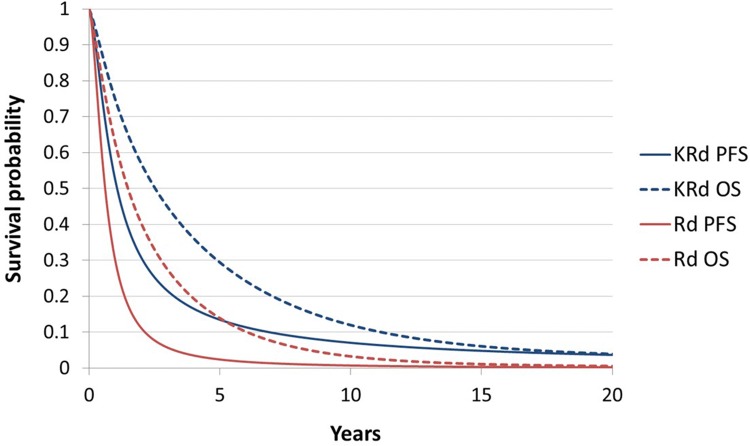
Methods: A partitioned survival model that included three health states (progression-free, progressed disease and death) was built. Progression-free survival (PFS), overall survival (OS) and time to discontinuation (TTD) data for the Rd arm were derived using the Registry of Monoclonal Gammopathies in the Czech Republic; the relative treatment effects of KRd versus Rd were estimated from the phase 3, randomised, ASPIRE trial, and were used to predict PFS, OS and TTD for KRd. The model was developed from the payer perspective and included drug costs, administration costs, monitoring costs, palliative care costs and adverse-event related costs collected from Czech sources.
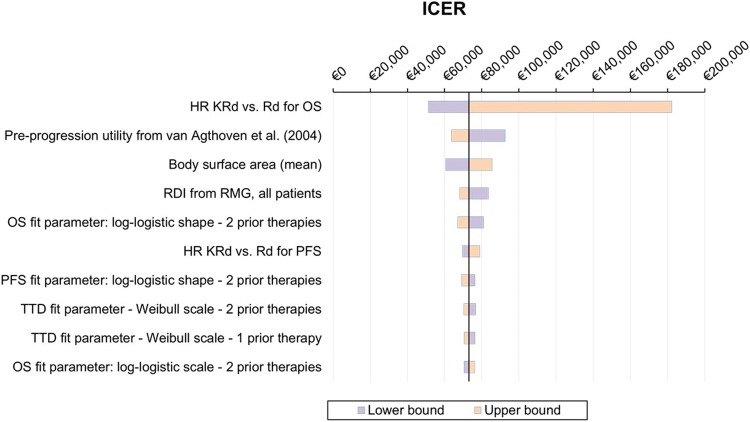
Results: The base case incremental cost effectiveness ratio for KRd compared with Rd was €73,156 per quality-adjusted life year (QALY) gained. Patients on KRd incurred costs of €117,534 over their lifetime compared with €53,165 for patients on Rd. The QALYs gained were 2.63 and 1.75 for patients on KRd and Rd, respectively.
Conclusions: Combining the strengths of randomised controlled trials and observational databases in cost-effectiveness models can generate policy-relevant results to allow well-informed decision-making. The current model showed that KRd is likely to be cost-effective versus Rd in the RW and, therefore, the reimbursement of KRd represents an efficient allocation of resources within the healthcare system.
期刊介绍:
The Journal of Hydrology publishes original research papers and comprehensive reviews in all the subfields of the hydrological sciences including water based management and policy issues that impact on economics and society. These comprise, but are not limited to the physical, chemical, biogeochemical, stochastic and systems aspects of surface and groundwater hydrology, hydrometeorology and hydrogeology. Relevant topics incorporating the insights and methodologies of disciplines such as climatology, water resource systems, hydraulics, agrohydrology, geomorphology, soil science, instrumentation and remote sensing, civil and environmental engineering are included. Social science perspectives on hydrological problems such as resource and ecological economics, environmental sociology, psychology and behavioural science, management and policy analysis are also invited. Multi-and interdisciplinary analyses of hydrological problems are within scope. The science published in the Journal of Hydrology is relevant to catchment scales rather than exclusively to a local scale or site.




 京公网安备 11010802042870号
京ICP备2023020795号-1
京公网安备 11010802042870号
京ICP备2023020795号-1

 分享
分享
 求助内容:
求助内容: 应助结果提醒方式:
 扫码关注我们
