Marscha S Holleman, Maiwenn J Al, Remziye Zaim, Harry J M Groen, Carin A Uyl-de Groot
{"title":"Cost-effectiveness analysis of the first-line EGFR-TKIs in patients with non-small cell lung cancer harbouring EGFR mutations.","authors":"Marscha S Holleman, Maiwenn J Al, Remziye Zaim, Harry J M Groen, Carin A Uyl-de Groot","doi":"10.1007/s10198-019-01117-3","DOIUrl":null,"url":null,"abstract":"<p><strong>Objectives: </strong>To compare the cost-effectiveness of first-line gefitinib, erlotinib, afatinib, and osimertinib in patients with non-small cell lung cancer (NSCLC) harbouring epidermal growth factor receptor (EGFR) mutations.</p><p><strong>Methods: </strong>A systematic review and network meta-analysis (NMA) were conducted to compare the relative efficacy of gefitinib, erlotinib, afatinib, and osimertinib in EGFR-mutated NSCLC. To assess the cost-effectiveness of these treatments, a Markov model was developed from Dutch societal perspective. The model was based on the clinical studies included in the NMA. Incremental costs per life-year (LY) and per quality-adjusted life-year (QALY) gained were estimated. Deterministic and probabilistic sensitivity analyses (PSA) were conducted.</p><p><strong>Results: </strong>Total discounted per patient costs for gefitinib, erlotinib, afatinib, and osimertinib were €65,889, €64,035, €69,418, and €131,997, and mean QALYs were 1.36, 1.39, 1.52, and 2.01 per patient, respectively. Erlotinib dominated gefitinib. Afatinib versus erlotinib yielded incremental costs of €27,058/LY and €41,504/QALY gained. Osimertinib resulted in €91,726/LY and €128,343/QALY gained compared to afatinib. PSA showed that gefitinib, erlotinib, afatinib, and osimertinib had 13%, 19%, 43%, and 26% probability to be cost-effective at a threshold of €80,000/QALY. A price reduction of osimertinib of 30% is required for osimertinib to be cost-effective at a threshold of €80,000/QALY.</p><p><strong>Conclusions: </strong>Osimertinib has a better effectiveness compared to all other TKIs. However, at a Dutch threshold of €80,000/QALY, osimertinib appears not to be cost-effective.</p>","PeriodicalId":8076,"journal":{"name":"Annals of The Entomological Society of America","volume":"114 1","pages":"153-164"},"PeriodicalIF":1.8000,"publicationDate":"2020-02-01","publicationTypes":"Journal Article","fieldsOfStudy":null,"isOpenAccess":false,"openAccessPdf":"https://www.ncbi.nlm.nih.gov/pmc/articles/PMC7058671/pdf/","citationCount":"0","resultStr":null,"platform":"Semanticscholar","paperid":null,"PeriodicalName":"Annals of The Entomological Society of America","FirstCategoryId":"97","ListUrlMain":"https://doi.org/10.1007/s10198-019-01117-3","RegionNum":3,"RegionCategory":"农林科学","ArticlePicture":[],"TitleCN":null,"AbstractTextCN":null,"PMCID":null,"EPubDate":"2019/9/20 0:00:00","PubModel":"Epub","JCR":"Q1","JCRName":"ENTOMOLOGY","Score":null,"Total":0}
引用次数: 0
Abstract
Objectives: To compare the cost-effectiveness of first-line gefitinib, erlotinib, afatinib, and osimertinib in patients with non-small cell lung cancer (NSCLC) harbouring epidermal growth factor receptor (EGFR) mutations.
Methods: A systematic review and network meta-analysis (NMA) were conducted to compare the relative efficacy of gefitinib, erlotinib, afatinib, and osimertinib in EGFR-mutated NSCLC. To assess the cost-effectiveness of these treatments, a Markov model was developed from Dutch societal perspective. The model was based on the clinical studies included in the NMA. Incremental costs per life-year (LY) and per quality-adjusted life-year (QALY) gained were estimated. Deterministic and probabilistic sensitivity analyses (PSA) were conducted.
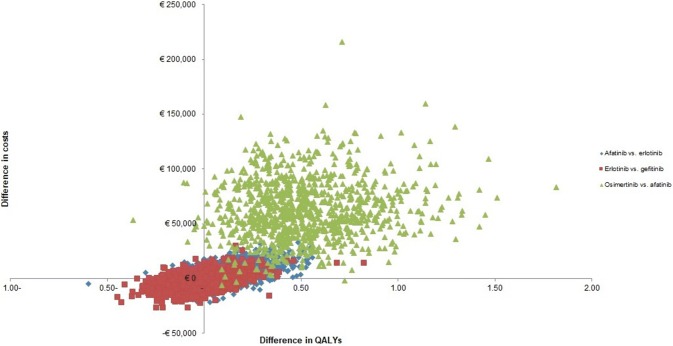
Results: Total discounted per patient costs for gefitinib, erlotinib, afatinib, and osimertinib were €65,889, €64,035, €69,418, and €131,997, and mean QALYs were 1.36, 1.39, 1.52, and 2.01 per patient, respectively. Erlotinib dominated gefitinib. Afatinib versus erlotinib yielded incremental costs of €27,058/LY and €41,504/QALY gained. Osimertinib resulted in €91,726/LY and €128,343/QALY gained compared to afatinib. PSA showed that gefitinib, erlotinib, afatinib, and osimertinib had 13%, 19%, 43%, and 26% probability to be cost-effective at a threshold of €80,000/QALY. A price reduction of osimertinib of 30% is required for osimertinib to be cost-effective at a threshold of €80,000/QALY.
Conclusions: Osimertinib has a better effectiveness compared to all other TKIs. However, at a Dutch threshold of €80,000/QALY, osimertinib appears not to be cost-effective.
期刊介绍:
The Annals of the Entomological Society of America exists to stimulate interdisciplinary dialogue across the entomological disciplines and to advance cooperative interaction among diverse groups of entomologists. It seeks to attract and publish cutting-edge research, reviews, collections of articles on a common topic of broad interest, and discussion of topics with national or international importance. We especially welcome articles covering developing areas of research, controversial issues or debate, and topics of importance to society. Manuscripts that are primarily reports of new species, methodology, pest management, or the biology of single species generally will be referred to other journals of the ESA. The most important criteria for acceptance are quality of work and breadth of interest to the readership.





 京公网安备 11010802042870号
京ICP备2023020795号-1
京公网安备 11010802042870号
京ICP备2023020795号-1

 分享
分享
 求助内容:
求助内容: 应助结果提醒方式:
 扫码关注我们
