Elisa Grifoni, Andrea Baroncelli, Gabriele Pinto, Eleonora Cosentino, Irene Micheletti, Ira Signorini, Grazia Panigada, Giancarlo Landini, Luca Masotti
{"title":"Efficacy and Safety of Edoxaban in Cancer-Associated Venous Thromboembolism: A Real World Retrospective Study.","authors":"Elisa Grifoni, Andrea Baroncelli, Gabriele Pinto, Eleonora Cosentino, Irene Micheletti, Ira Signorini, Grazia Panigada, Giancarlo Landini, Luca Masotti","doi":"10.1055/a-1783-9744","DOIUrl":null,"url":null,"abstract":"<p><p><b>Introduction</b> Few data exist on the use of edoxaban in cancer-associated venous thromboembolism (VTE) outside of clinical trials. Aim of this study was to evaluate the characteristics and outcomes of these patients in a real world clinical setting. <b>Methods</b> We retrospectively analyzed the characteristics of patients with cancer-associated VTE who were prescribed edoxaban. Follow-up at 3, 6, and 12 months was performed: VTE recurrences, bleedings, mortality, cancer progression and treatment, edoxaban interruption and its reason were assessed. <b>Results</b> Fifty-four patients, 38 females (70.4%), mean age 71 ± 14 years, were enrolled. In 38 patients (70.4%), the episode of VTE was the first one, in 28 (51.8%) it was an isolated deep vein thrombosis (DVT), in 13 (24.1%) a pulmonary embolism (PE) associated with DVT, in 13 (24.1%) an isolated PE. Median time between cancer and VTE diagnosis was 6 (interquartile range [IQR] 2-47) months. Median time between VTE diagnosis and edoxaban prescription was 36 (IQR 7-117) days. At 3, 6, and 12 months the incidence of all-cause mortality was 16.6, 22.2, and 38.8%, that of VTE recurrence 1.8, 1.8, and 3.7%, and that of major bleeding 7.4, 9.2, and 12.9%, respectively. No bleeding was fatal. Of the 33 patients alive at 12 months, 32 (96.9%) were still on edoxaban therapy, in seven (21.2%) cancer was in progression. <b>Conclusion</b> Our study, conducted on a real world population of patients with cancer-associated VTE, confirms the results of randomized controlled clinical trials, and supports the use of edoxaban as effective and safe treatment in this context.</p>","PeriodicalId":367,"journal":{"name":"Journal of Materials Processing Technology","volume":"162 1","pages":"e99-e106"},"PeriodicalIF":7.5000,"publicationDate":"2022-03-01","publicationTypes":"Journal Article","fieldsOfStudy":null,"isOpenAccess":false,"openAccessPdf":"https://www.ncbi.nlm.nih.gov/pmc/articles/PMC9113858/pdf/","citationCount":"0","resultStr":null,"platform":"Semanticscholar","paperid":null,"PeriodicalName":"Journal of Materials Processing Technology","FirstCategoryId":"1085","ListUrlMain":"https://doi.org/10.1055/a-1783-9744","RegionNum":2,"RegionCategory":"材料科学","ArticlePicture":[],"TitleCN":null,"AbstractTextCN":null,"PMCID":null,"EPubDate":"2022/4/1 0:00:00","PubModel":"eCollection","JCR":"Q1","JCRName":"ENGINEERING, INDUSTRIAL","Score":null,"Total":0}
引用次数: 0
Abstract
Introduction Few data exist on the use of edoxaban in cancer-associated venous thromboembolism (VTE) outside of clinical trials. Aim of this study was to evaluate the characteristics and outcomes of these patients in a real world clinical setting. Methods We retrospectively analyzed the characteristics of patients with cancer-associated VTE who were prescribed edoxaban. Follow-up at 3, 6, and 12 months was performed: VTE recurrences, bleedings, mortality, cancer progression and treatment, edoxaban interruption and its reason were assessed. Results Fifty-four patients, 38 females (70.4%), mean age 71 ± 14 years, were enrolled. In 38 patients (70.4%), the episode of VTE was the first one, in 28 (51.8%) it was an isolated deep vein thrombosis (DVT), in 13 (24.1%) a pulmonary embolism (PE) associated with DVT, in 13 (24.1%) an isolated PE. Median time between cancer and VTE diagnosis was 6 (interquartile range [IQR] 2-47) months. Median time between VTE diagnosis and edoxaban prescription was 36 (IQR 7-117) days. At 3, 6, and 12 months the incidence of all-cause mortality was 16.6, 22.2, and 38.8%, that of VTE recurrence 1.8, 1.8, and 3.7%, and that of major bleeding 7.4, 9.2, and 12.9%, respectively. No bleeding was fatal. Of the 33 patients alive at 12 months, 32 (96.9%) were still on edoxaban therapy, in seven (21.2%) cancer was in progression. Conclusion Our study, conducted on a real world population of patients with cancer-associated VTE, confirms the results of randomized controlled clinical trials, and supports the use of edoxaban as effective and safe treatment in this context.
期刊介绍:
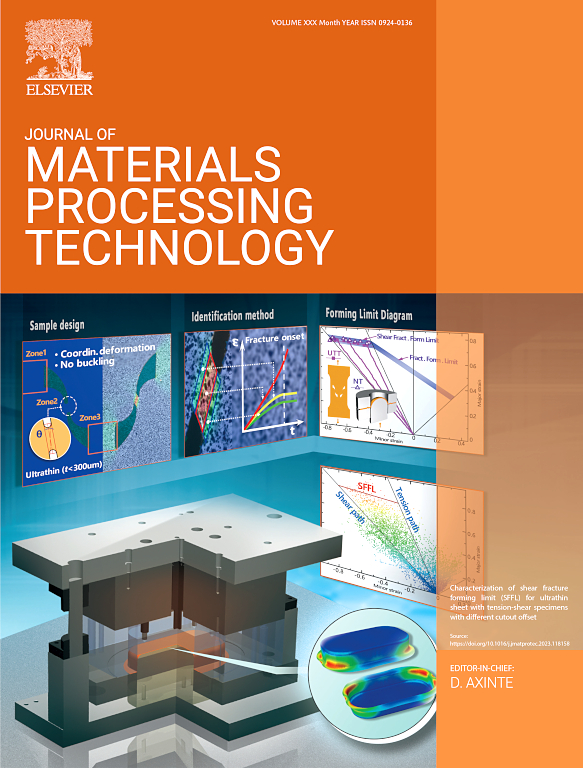
The Journal of Materials Processing Technology covers the processing techniques used in manufacturing components from metals and other materials. The journal aims to publish full research papers of original, significant and rigorous work and so to contribute to increased production efficiency and improved component performance.
Areas of interest to the journal include:
• Casting, forming and machining
• Additive processing and joining technologies
• The evolution of material properties under the specific conditions met in manufacturing processes
• Surface engineering when it relates specifically to a manufacturing process
• Design and behavior of equipment and tools.





 京公网安备 11010802042870号
京ICP备2023020795号-1
京公网安备 11010802042870号
京ICP备2023020795号-1

 分享
分享
 求助内容:
求助内容: 应助结果提醒方式:
 扫码关注我们
