Christopher Avery, Jessica S. Howell, M. Pender, Bruce I. Sacerdote
{"title":"Policies and Payoffs to Addressing America's College Graduation Deficit","authors":"Christopher Avery, Jessica S. Howell, M. Pender, Bruce I. Sacerdote","doi":"10.1353/eca.2019.0013","DOIUrl":null,"url":null,"abstract":"ABSTRACT:We consider four distinct policy levers available to states for raising bachelor's degree completion rates in the United States through their public colleges and universities. We simulate these policies using elasticities from the existing literature and a matched College Board/National Student Clearinghouse data set on enrollment and degree completion. Increasing spending at public colleges and targeted elimination of tuition and fees at four-year public colleges with an income cutoff are projected to be the most effective of these policies in terms of cost per additional bachelor's degree. Reducing tuition and fees at public colleges and a distinct policy of moving students to the best available in-state public college (BISPO) are next best on a cost-benefit basis. Free community college policies are significantly less cost-effective at raising bachelor's degree completion, though such policies do improve other outcomes. Reducing community college tuition and fees to zero does lead to more associate degrees, though students are drawn away from the four-year sector in the process. Low-income students see the smallest gains from free community college policies since these students already face very low net prices of attendance.","PeriodicalId":51405,"journal":{"name":"Brookings Papers on Economic Activity","volume":"51 1","pages":"172 - 93"},"PeriodicalIF":2.8000,"publicationDate":"2020-09-17","publicationTypes":"Journal Article","fieldsOfStudy":null,"isOpenAccess":false,"openAccessPdf":"","citationCount":"8","resultStr":null,"platform":"Semanticscholar","paperid":null,"PeriodicalName":"Brookings Papers on Economic Activity","FirstCategoryId":"96","ListUrlMain":"https://doi.org/10.1353/eca.2019.0013","RegionNum":3,"RegionCategory":"经济学","ArticlePicture":[],"TitleCN":null,"AbstractTextCN":null,"PMCID":null,"EPubDate":"","PubModel":"","JCR":"Q1","JCRName":"ECONOMICS","Score":null,"Total":0}
引用次数: 8
Abstract
ABSTRACT:We consider four distinct policy levers available to states for raising bachelor's degree completion rates in the United States through their public colleges and universities. We simulate these policies using elasticities from the existing literature and a matched College Board/National Student Clearinghouse data set on enrollment and degree completion. Increasing spending at public colleges and targeted elimination of tuition and fees at four-year public colleges with an income cutoff are projected to be the most effective of these policies in terms of cost per additional bachelor's degree. Reducing tuition and fees at public colleges and a distinct policy of moving students to the best available in-state public college (BISPO) are next best on a cost-benefit basis. Free community college policies are significantly less cost-effective at raising bachelor's degree completion, though such policies do improve other outcomes. Reducing community college tuition and fees to zero does lead to more associate degrees, though students are drawn away from the four-year sector in the process. Low-income students see the smallest gains from free community college policies since these students already face very low net prices of attendance.
期刊介绍:
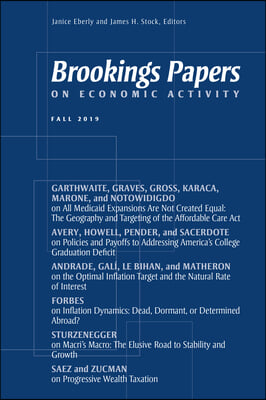
The Brookings Papers on Economic Activity (BPEA) is a semi-annual academic conference and journal that pairs rigorous research with real-time policy analysis to address the most urgent economic challenges of the day. Working drafts of the papers are presented and discussed at conferences typically held twice each year, and the final versions of the papers and comments along with summaries of the general discussions are published in the journal several months later. The views expressed by the authors, discussants and conference participants in BPEA are strictly those of the authors, discussants and conference participants, and not of the Brookings Institution. As an independent think tank, the Brookings Institution does not take institutional positions on any issue.



 京公网安备 11010802042870号
京ICP备2023020795号-1
京公网安备 11010802042870号
京ICP备2023020795号-1

 分享
分享
 求助内容:
求助内容: 应助结果提醒方式:
 扫码关注我们
