Changes in dietary habits and chronic diseases before and after COVID-19 by regions using data from the 2018-2020 Korea Community Health Survey and Consumer Behavior Survey for Foods: a cross-sectional study.
{"title":"Changes in dietary habits and chronic diseases before and after COVID-19 by regions using data from the 2018-2020 Korea Community Health Survey and Consumer Behavior Survey for Foods: a cross-sectional study.","authors":"Surim Park, Eun-Hee Jang, Seungmin Lee","doi":"10.5720/kjcn.2023.28.2.124","DOIUrl":null,"url":null,"abstract":"<p><strong>Objectives: </strong>This study examined the changes in dietary habits, the prevalence of chronic diseases, and mental health problems in the regional areas of the Republic of Korea before and after the COVID-19 pandemic to provide evidence of the status of regional health inequalities.</p><p><strong>Methods: </strong>This study analyzed Korean adults aged 19 or older who participated in the Korea Community Health Survey (n = 686,708) and Consumer Behavior Survey for Foods (n = 19,109) from 2018 to 2020. The participants were classified according to their residence area (Seoul metropolitan area, Metropolitan cities, Provinces); 2018-2019 were defined as before COVID-19, and 2020 as after COVID-19. The dietary behaviors, chronic diseases, and mental health problems were measured using a self-report questionnaire.</p><p><strong>Results: </strong>After COVID-19, the eating-out usage rate in the Seoul metropolitan area and Provinces decreased compared to before COVID-19 (<i>P</i> < 0.001), and when responding that they eat out, the frequency of eating out with household members in the Seoul metropolitan area increased (<i>P</i> = 0.024). The deliveries/takeout usage rate in the Provinces decreased after COVID-19 compared to before (<i>P</i> < 0.001). After COVID-19, the prevalence of obesity decreased in all regions (<i>P</i> < 0.001), and the prevalence of hypertension increased significantly in the Provinces (<i>P</i> = 0.015). The prevalence of diabetes mellitus increased continuously before and after COVID-19 in all regions (<i>P</i> < 0.002). High-risk subjective stress levels increased significantly in the Seoul metropolitan area (<i>P</i> < 0.001), and sleep duration significantly increased in all regions (<i>P</i> < 0.001). Major depressive disorder was reduced significantly in Metropolitan cities (<i>P</i> = 0.042) and Provinces (<i>P</i> < 0.001).</p><p><strong>Conclusions: </strong>After the COVID-19 pandemic, the prevalence of chronic diseases and mental health problems showed regional differences along with changes in dietary habits. It is necessary to reflect the regional differences in dietary habits in future policies resolving regional health inequalities.</p>","PeriodicalId":74046,"journal":{"name":"Korean journal of community nutrition","volume":"7 1","pages":"124-140"},"PeriodicalIF":0.0000,"publicationDate":"2023-04-01","publicationTypes":"Journal Article","fieldsOfStudy":null,"isOpenAccess":false,"openAccessPdf":"https://www.ncbi.nlm.nih.gov/pmc/articles/PMC12782794/pdf/","citationCount":"0","resultStr":null,"platform":"Semanticscholar","paperid":null,"PeriodicalName":"Korean journal of community nutrition","FirstCategoryId":"1085","ListUrlMain":"https://doi.org/10.5720/kjcn.2023.28.2.124","RegionNum":0,"RegionCategory":null,"ArticlePicture":[],"TitleCN":null,"AbstractTextCN":null,"PMCID":null,"EPubDate":"2023/4/30 0:00:00","PubModel":"Epub","JCR":"","JCRName":"","Score":null,"Total":0}
引用次数: 0
Abstract
Objectives: This study examined the changes in dietary habits, the prevalence of chronic diseases, and mental health problems in the regional areas of the Republic of Korea before and after the COVID-19 pandemic to provide evidence of the status of regional health inequalities.
Methods: This study analyzed Korean adults aged 19 or older who participated in the Korea Community Health Survey (n = 686,708) and Consumer Behavior Survey for Foods (n = 19,109) from 2018 to 2020. The participants were classified according to their residence area (Seoul metropolitan area, Metropolitan cities, Provinces); 2018-2019 were defined as before COVID-19, and 2020 as after COVID-19. The dietary behaviors, chronic diseases, and mental health problems were measured using a self-report questionnaire.
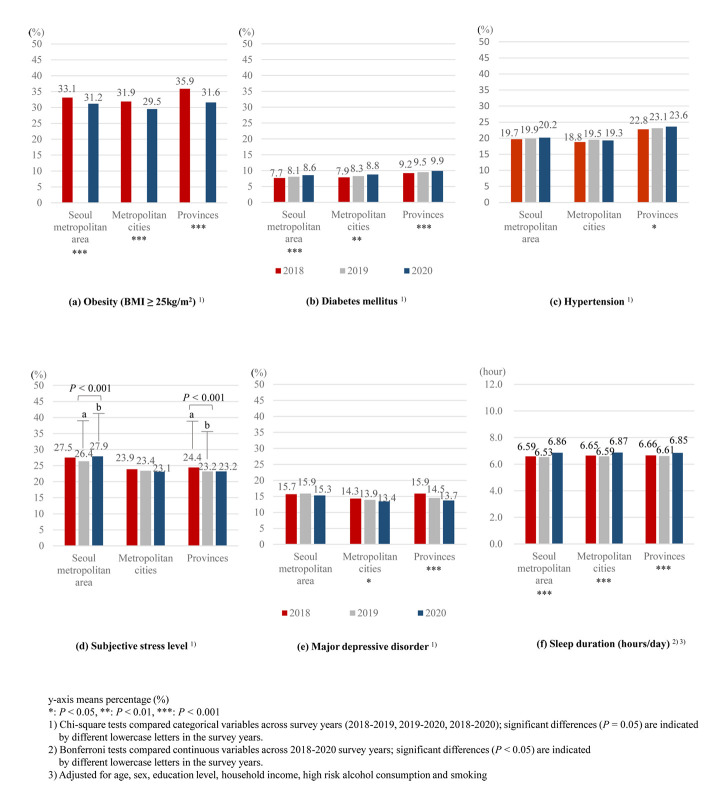
Results: After COVID-19, the eating-out usage rate in the Seoul metropolitan area and Provinces decreased compared to before COVID-19 (P < 0.001), and when responding that they eat out, the frequency of eating out with household members in the Seoul metropolitan area increased (P = 0.024). The deliveries/takeout usage rate in the Provinces decreased after COVID-19 compared to before (P < 0.001). After COVID-19, the prevalence of obesity decreased in all regions (P < 0.001), and the prevalence of hypertension increased significantly in the Provinces (P = 0.015). The prevalence of diabetes mellitus increased continuously before and after COVID-19 in all regions (P < 0.002). High-risk subjective stress levels increased significantly in the Seoul metropolitan area (P < 0.001), and sleep duration significantly increased in all regions (P < 0.001). Major depressive disorder was reduced significantly in Metropolitan cities (P = 0.042) and Provinces (P < 0.001).
Conclusions: After the COVID-19 pandemic, the prevalence of chronic diseases and mental health problems showed regional differences along with changes in dietary habits. It is necessary to reflect the regional differences in dietary habits in future policies resolving regional health inequalities.



 京公网安备 11010802042870号
京ICP备2023020795号-1
京公网安备 11010802042870号
京ICP备2023020795号-1

 分享
分享

 求助内容:
求助内容: 应助结果提醒方式:
 扫码关注我们
