{"title":"The effect on diurnal intraocular pressure of the fixed combination of latanoprost 0.005% and timolol 0.5% in patients with ocular hypertension","authors":"Lill-Inger Larsson","doi":"10.1034/j.1600-0420.2001.079002125.x","DOIUrl":null,"url":null,"abstract":"PURPOSE\nTo measure the effect on intraocular pressure (IOP) after single-dose administration of the fixed combination of latanoprost 0.005% and timolol 0.5%.\n\n\nMETHODS\nA randomized, double-masked placebo-controlled parallel-group study was carried out. Twenty patients with ocular hypertension received the fixed combination of latanoprost+timolol, while 10 received placebo eyedrops. On baseline day no eyedrops were given, but IOP was measured repeatedly between 8.00 a.m. and 8.00 p.m. On Day 7 the eyedrops were given at 8.00 a.m., and IOP measured as on baseline day. On Day 8 and Day 9, IOP was again measured at 8.00 a.m.\n\n\nRESULTS\nThere was no difference in IOP in the placebo group. In the latanoprost+timolol group maximal IOP reduction (12.4+/-2.8 mmHg; mean+/-standard deviation) occurred 6.4 hours after drug administration (5.2--7.7 hours; 95% confidence interval [CI]). The mean IOP reduction after 24 hours was 9.8 mmHg (7.4--12.2 mmHg; 95% CI; p<0.001), and after 48 hours 5.7 mmHg (3.4--8.1 mmHg; 95% CI; p<0.001).\n\n\nCONCLUSIONS\nThe fixed combination of latanoprost+timolol statistically significantly reduced IOP after single-dose administration. The maximal effect was noted after about 6 hours, and the IOP reduction was still pronounced after 48 hours.","PeriodicalId":6915,"journal":{"name":"Acta Ophthalmologica","volume":"79 2","pages":"125-128"},"PeriodicalIF":2.8000,"publicationDate":"2002-01-15","publicationTypes":"Journal Article","fieldsOfStudy":null,"isOpenAccess":false,"openAccessPdf":"https://sci-hub-pdf.com/10.1034/j.1600-0420.2001.079002125.x","citationCount":"13","resultStr":null,"platform":"Semanticscholar","paperid":null,"PeriodicalName":"Acta Ophthalmologica","FirstCategoryId":"3","ListUrlMain":"https://onlinelibrary.wiley.com/doi/10.1034/j.1600-0420.2001.079002125.x","RegionNum":3,"RegionCategory":"医学","ArticlePicture":[],"TitleCN":null,"AbstractTextCN":null,"PMCID":null,"EPubDate":"","PubModel":"","JCR":"Q1","JCRName":"OPHTHALMOLOGY","Score":null,"Total":0}
引用次数: 13
Abstract
PURPOSE
To measure the effect on intraocular pressure (IOP) after single-dose administration of the fixed combination of latanoprost 0.005% and timolol 0.5%.
METHODS
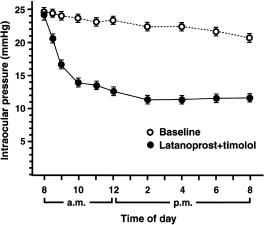
A randomized, double-masked placebo-controlled parallel-group study was carried out. Twenty patients with ocular hypertension received the fixed combination of latanoprost+timolol, while 10 received placebo eyedrops. On baseline day no eyedrops were given, but IOP was measured repeatedly between 8.00 a.m. and 8.00 p.m. On Day 7 the eyedrops were given at 8.00 a.m., and IOP measured as on baseline day. On Day 8 and Day 9, IOP was again measured at 8.00 a.m.
RESULTS
There was no difference in IOP in the placebo group. In the latanoprost+timolol group maximal IOP reduction (12.4+/-2.8 mmHg; mean+/-standard deviation) occurred 6.4 hours after drug administration (5.2--7.7 hours; 95% confidence interval [CI]). The mean IOP reduction after 24 hours was 9.8 mmHg (7.4--12.2 mmHg; 95% CI; p<0.001), and after 48 hours 5.7 mmHg (3.4--8.1 mmHg; 95% CI; p<0.001).
CONCLUSIONS
The fixed combination of latanoprost+timolol statistically significantly reduced IOP after single-dose administration. The maximal effect was noted after about 6 hours, and the IOP reduction was still pronounced after 48 hours.
期刊介绍:
Acta Ophthalmologica is published on behalf of the Acta Ophthalmologica Scandinavica Foundation and is the official scientific publication of the following societies: The Danish Ophthalmological Society, The Finnish Ophthalmological Society, The Icelandic Ophthalmological Society, The Norwegian Ophthalmological Society and The Swedish Ophthalmological Society, and also the European Association for Vision and Eye Research (EVER).
Acta Ophthalmologica publishes clinical and experimental original articles, reviews, editorials, educational photo essays (Diagnosis and Therapy in Ophthalmology), case reports and case series, letters to the editor and doctoral theses.




 京公网安备 11010802042870号
京ICP备2023020795号-1
京公网安备 11010802042870号
京ICP备2023020795号-1

 分享
分享
 求助内容:
求助内容: 应助结果提醒方式:
 扫码关注我们
