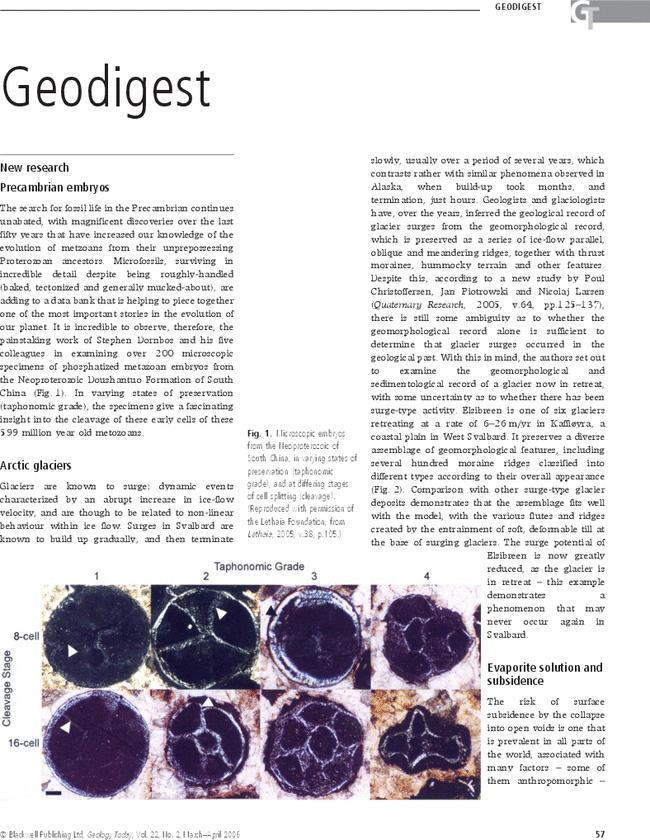
{"title":"Geodigest","authors":"","doi":"10.1111/j.1365-2451.2006.00553.x","DOIUrl":null,"url":null,"abstract":"The search for fossil life in the Precambrian continues unabated, with magnificent discoveries over the last fifty years that have increased our knowledge of the evolution of metzoans from their unprepossessing Proterozoan ancestors. Microfossils, surviving in incredible detail despite being roughly-handled (baked, tectonized and generally mucked-about), are adding to a data bank that is helping to piece together one of the most important stories in the evolution of our planet. It is incredible to observe, therefore, the painstaking work of Stephen Dornbos and his five colleagues in examining over 200 microscopic specimens of phosphatized metazoan embryos from the Neoproterozoic Doushantuo Formation of South China (Fig. 1). In varying states of preservation (taphonomic grade), the specimens give a fascinating insight into the cleavage of these early cells of these 599 million year old metozoans.","PeriodicalId":100581,"journal":{"name":"Geology Today","volume":"22 2","pages":"57-59"},"PeriodicalIF":0.0000,"publicationDate":"2006-06-09","publicationTypes":"Journal Article","fieldsOfStudy":null,"isOpenAccess":false,"openAccessPdf":"https://sci-hub-pdf.com/10.1111/j.1365-2451.2006.00553.x","citationCount":"0","resultStr":null,"platform":"Semanticscholar","paperid":null,"PeriodicalName":"Geology Today","FirstCategoryId":"1085","ListUrlMain":"https://onlinelibrary.wiley.com/doi/10.1111/j.1365-2451.2006.00553.x","RegionNum":0,"RegionCategory":null,"ArticlePicture":[],"TitleCN":null,"AbstractTextCN":null,"PMCID":null,"EPubDate":"","PubModel":"","JCR":"","JCRName":"","Score":null,"Total":0}
引用次数: 0
Abstract
The search for fossil life in the Precambrian continues unabated, with magnificent discoveries over the last fifty years that have increased our knowledge of the evolution of metzoans from their unprepossessing Proterozoan ancestors. Microfossils, surviving in incredible detail despite being roughly-handled (baked, tectonized and generally mucked-about), are adding to a data bank that is helping to piece together one of the most important stories in the evolution of our planet. It is incredible to observe, therefore, the painstaking work of Stephen Dornbos and his five colleagues in examining over 200 microscopic specimens of phosphatized metazoan embryos from the Neoproterozoic Doushantuo Formation of South China (Fig. 1). In varying states of preservation (taphonomic grade), the specimens give a fascinating insight into the cleavage of these early cells of these 599 million year old metozoans.



 京公网安备 11010802042870号
京ICP备2023020795号-1
京公网安备 11010802042870号
京ICP备2023020795号-1

 分享
分享

 求助内容:
求助内容: 应助结果提醒方式:
 扫码关注我们
