Lucas Saldanha da Rosa, Kiara Serafini Dapieve, Fernanda Dalla-Nora, Marília Pivetta Rippe, Luiz Felipe Valandro, Rafael Sarkis-Onofre, Gabriel Kalil Rocha Pereira
{"title":"Does Adhesive Luting Reinforce the Mechanical Properties of Dental Ceramics Used as Restorative Materials? A Systematic Review and Meta-Analysis.","authors":"Lucas Saldanha da Rosa, Kiara Serafini Dapieve, Fernanda Dalla-Nora, Marília Pivetta Rippe, Luiz Felipe Valandro, Rafael Sarkis-Onofre, Gabriel Kalil Rocha Pereira","doi":"10.3290/j.jad.b2916469","DOIUrl":null,"url":null,"abstract":"<p><strong>Purpose: </strong>This systematic review aims to explore and compile the effect of adhesive luting on the mechanical properties of dental ceramics used as restorative materials.</p><p><strong>Materials and methods: </strong>The PubMed/MEDLINE, Web of Science and Scopus databases were searched on January 31st, 2021 to select laboratory studies written in English, without publishing-date restrictions, which compared the mechanical properties of commercially available dental ceramics as restorative materials luted using adhesive vs non-adhesive strategies. A total of 20 (out of 2039) studies were eligible and included in the analysis. Two authors independently selected the studies, extracted the data and assessed the risk of bias. Mean differences (RevMan5.1, random effects model, α = 0.05) were obtained by comparing resistance values of adhesive and non-adhesive conditions (global analysis). Subgroup analyses were performed considering ceramic composition and aging.</p><p><strong>Results: </strong>In the global analysis, adhesive luting induced higher mechanical resistance values compared to non-adhesive luting (p ≤ 0.01). The same effect was observed for glass and alumina ceramics (p ≤ 0.01), but not for zirconia polycrystals (p = 0.83). Adhesive luting was favorable in both the aged and non-aged subgroup analysis (p ≤ 0.01). High heterogeneity was found in all meta-analyses. All analyzed studies in the systematic review scored negatively for risk of bias in most of the factors considered.</p><p><strong>Conclusions: </strong>Adhesive luting reinforces the mechanical properties of dental ceramics used as restorative materials, with the exception of zirconia polycrystals.</p>","PeriodicalId":20278,"journal":{"name":"Polyhedron","volume":"11 1","pages":"209-222"},"PeriodicalIF":2.6000,"publicationDate":"2022-04-13","publicationTypes":"Journal Article","fieldsOfStudy":null,"isOpenAccess":false,"openAccessPdf":"https://www.ncbi.nlm.nih.gov/pmc/articles/PMC11734317/pdf/","citationCount":"0","resultStr":null,"platform":"Semanticscholar","paperid":null,"PeriodicalName":"Polyhedron","FirstCategoryId":"92","ListUrlMain":"https://doi.org/10.3290/j.jad.b2916469","RegionNum":3,"RegionCategory":"化学","ArticlePicture":[],"TitleCN":null,"AbstractTextCN":null,"PMCID":null,"EPubDate":"","PubModel":"","JCR":"Q2","JCRName":"CHEMISTRY, INORGANIC & NUCLEAR","Score":null,"Total":0}
引用次数: 0
Abstract
Purpose: This systematic review aims to explore and compile the effect of adhesive luting on the mechanical properties of dental ceramics used as restorative materials.
Materials and methods: The PubMed/MEDLINE, Web of Science and Scopus databases were searched on January 31st, 2021 to select laboratory studies written in English, without publishing-date restrictions, which compared the mechanical properties of commercially available dental ceramics as restorative materials luted using adhesive vs non-adhesive strategies. A total of 20 (out of 2039) studies were eligible and included in the analysis. Two authors independently selected the studies, extracted the data and assessed the risk of bias. Mean differences (RevMan5.1, random effects model, α = 0.05) were obtained by comparing resistance values of adhesive and non-adhesive conditions (global analysis). Subgroup analyses were performed considering ceramic composition and aging.
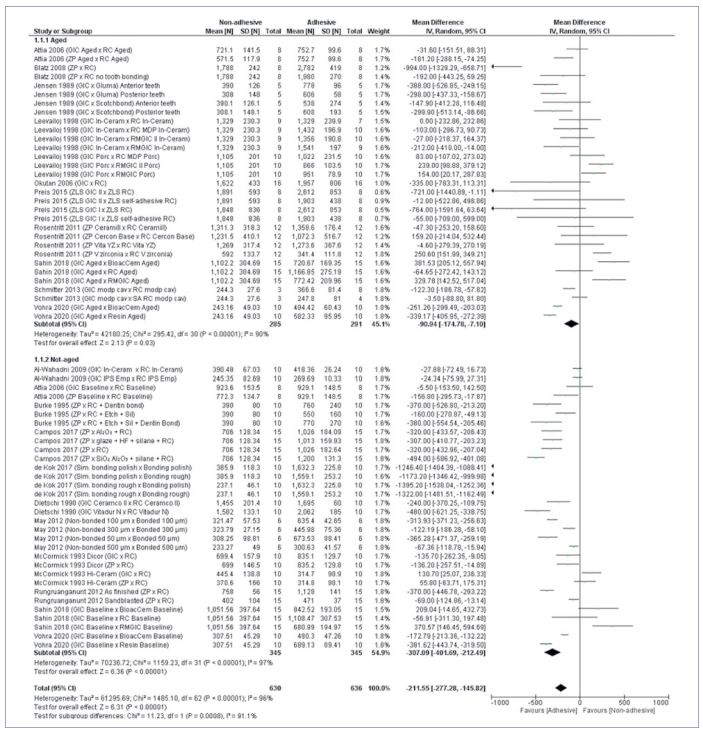
Results: In the global analysis, adhesive luting induced higher mechanical resistance values compared to non-adhesive luting (p ≤ 0.01). The same effect was observed for glass and alumina ceramics (p ≤ 0.01), but not for zirconia polycrystals (p = 0.83). Adhesive luting was favorable in both the aged and non-aged subgroup analysis (p ≤ 0.01). High heterogeneity was found in all meta-analyses. All analyzed studies in the systematic review scored negatively for risk of bias in most of the factors considered.
Conclusions: Adhesive luting reinforces the mechanical properties of dental ceramics used as restorative materials, with the exception of zirconia polycrystals.
期刊介绍:
Polyhedron publishes original, fundamental, experimental and theoretical work of the highest quality in all the major areas of inorganic chemistry. This includes synthetic chemistry, coordination chemistry, organometallic chemistry, bioinorganic chemistry, and solid-state and materials chemistry.
Papers should be significant pieces of work, and all new compounds must be appropriately characterized. The inclusion of single-crystal X-ray structural data is strongly encouraged, but papers reporting only the X-ray structure determination of a single compound will usually not be considered. Papers on solid-state or materials chemistry will be expected to have a significant molecular chemistry component (such as the synthesis and characterization of the molecular precursors and/or a systematic study of the use of different precursors or reaction conditions) or demonstrate a cutting-edge application (for example inorganic materials for energy applications). Papers dealing only with stability constants are not considered.





 京公网安备 11010802042870号
京ICP备2023020795号-1
京公网安备 11010802042870号
京ICP备2023020795号-1

 分享
分享
 求助内容:
求助内容: 应助结果提醒方式:
 扫码关注我们
