Lara C Oliveira, Anna K Bonkhoff, Ana Ponciano, Carissa Tuozzo, Anand Viswanathan, Natalia S Rost, Mark R Etherton
{"title":"Determinants of post-stroke cognitive impairment and dementia: association with objective measures and patient-reported outcomes.","authors":"Lara C Oliveira, Anna K Bonkhoff, Ana Ponciano, Carissa Tuozzo, Anand Viswanathan, Natalia S Rost, Mark R Etherton","doi":"10.3389/fstro.2023.1190477","DOIUrl":null,"url":null,"abstract":"<p><strong>Background: </strong>Post-stroke cognitive impairment and dementia (PSCID) is a sequel of ischemic stroke (IS), highly prevalent and linked to poor long-term outcomes. Thus, early recognition of the clinical determinants of PSCID is urgent for identifying high-risk individuals who are susceptible to PSCID. And investigating objective measures of PSCID in relation to patient-reported outcome measures (PROMs) is essential for understanding the impact of IS. Here we identify the clinical determinants associated with PSCID and the relationship of PSCID to patient-reported outcomes in a population with IS.</p><p><strong>Methods: </strong>This was a cohort study. We enrolled 138 patients who were admitted to our hospital between February 2017 and February 2020, with IS and no pre-stroke diagnosis of dementia. Clinical variables were acquired on admission. At 3 months, patients underwent a follow-up evaluation including the Telephone Interview for Cognitive Status (TICS), modified Rankin scale (mRS), Barthel Index (BI), and PROMs, using the Patient-Reported Outcomes Measurement information System Global Health (PROMIS GH). MCI/Dementia was defined as a TICS score of <36. Regression analyses were used to identify clinical, functional, and patient-reported outcome determinants of the 3-month TICS score. Analyses were adjusted for age, stroke severity, and prior IS.</p><p><strong>Results: </strong>At follow-up, 113 participants (82%) were found to have MCI/Dementia. Patients with PSCID were more likely to be older, and at 3-months post-stroke they had lower rates of PROMIS GH T Mental (mean 47.69 vs. 52.13) and T Physical (mean 46.75 vs. 50.64). In multivariable linear regression analyses, increasing age (<i>β</i> = -0.07, <i>p</i> = 0.03) and Peripheral Artery Disease (PAD; <i>β</i> = -3.60, <i>p</i> = 0.03) were independently associated with a lower TICS score. Functional and patient-reported outcomes were also associated with worse TICS, including mRS ≥ 2, BI, T Mental, Global Mental, T Physical, and Global Physical in adjusted analyses. Individual components of PROMs were also associated with TICS, including quality of life, mental health, social satisfaction, and physical activities.</p><p><strong>Conclusions: </strong>In patients with IS, increased age and a pre-admission diagnosis of PAD are independently associated with worse objective measures of PSCID. Worse functional and patient-reported outcomes are also strongly linked to PSCID.</p>","PeriodicalId":73108,"journal":{"name":"Frontiers in stroke","volume":"122 1","pages":"1190477"},"PeriodicalIF":0.0000,"publicationDate":"2023-08-23","publicationTypes":"Journal Article","fieldsOfStudy":null,"isOpenAccess":false,"openAccessPdf":"https://www.ncbi.nlm.nih.gov/pmc/articles/PMC12802749/pdf/","citationCount":"0","resultStr":null,"platform":"Semanticscholar","paperid":null,"PeriodicalName":"Frontiers in stroke","FirstCategoryId":"1085","ListUrlMain":"https://doi.org/10.3389/fstro.2023.1190477","RegionNum":0,"RegionCategory":null,"ArticlePicture":[],"TitleCN":null,"AbstractTextCN":null,"PMCID":null,"EPubDate":"2023/1/1 0:00:00","PubModel":"eCollection","JCR":"","JCRName":"","Score":null,"Total":0}
引用次数: 0
Abstract
Background: Post-stroke cognitive impairment and dementia (PSCID) is a sequel of ischemic stroke (IS), highly prevalent and linked to poor long-term outcomes. Thus, early recognition of the clinical determinants of PSCID is urgent for identifying high-risk individuals who are susceptible to PSCID. And investigating objective measures of PSCID in relation to patient-reported outcome measures (PROMs) is essential for understanding the impact of IS. Here we identify the clinical determinants associated with PSCID and the relationship of PSCID to patient-reported outcomes in a population with IS.
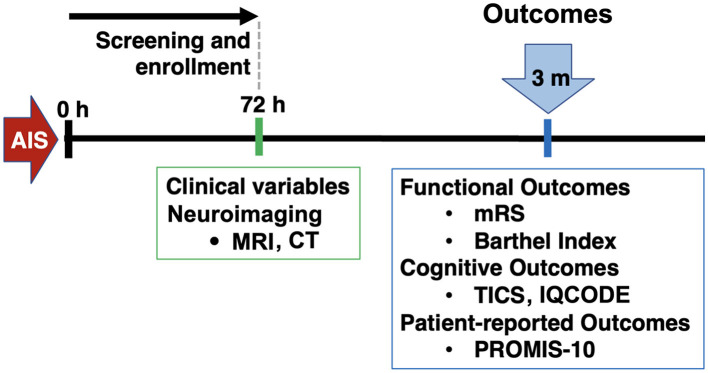
Methods: This was a cohort study. We enrolled 138 patients who were admitted to our hospital between February 2017 and February 2020, with IS and no pre-stroke diagnosis of dementia. Clinical variables were acquired on admission. At 3 months, patients underwent a follow-up evaluation including the Telephone Interview for Cognitive Status (TICS), modified Rankin scale (mRS), Barthel Index (BI), and PROMs, using the Patient-Reported Outcomes Measurement information System Global Health (PROMIS GH). MCI/Dementia was defined as a TICS score of <36. Regression analyses were used to identify clinical, functional, and patient-reported outcome determinants of the 3-month TICS score. Analyses were adjusted for age, stroke severity, and prior IS.
Results: At follow-up, 113 participants (82%) were found to have MCI/Dementia. Patients with PSCID were more likely to be older, and at 3-months post-stroke they had lower rates of PROMIS GH T Mental (mean 47.69 vs. 52.13) and T Physical (mean 46.75 vs. 50.64). In multivariable linear regression analyses, increasing age (β = -0.07, p = 0.03) and Peripheral Artery Disease (PAD; β = -3.60, p = 0.03) were independently associated with a lower TICS score. Functional and patient-reported outcomes were also associated with worse TICS, including mRS ≥ 2, BI, T Mental, Global Mental, T Physical, and Global Physical in adjusted analyses. Individual components of PROMs were also associated with TICS, including quality of life, mental health, social satisfaction, and physical activities.
Conclusions: In patients with IS, increased age and a pre-admission diagnosis of PAD are independently associated with worse objective measures of PSCID. Worse functional and patient-reported outcomes are also strongly linked to PSCID.




 京公网安备 11010802042870号
京ICP备2023020795号-1
京公网安备 11010802042870号
京ICP备2023020795号-1

 分享
分享

 求助内容:
求助内容: 应助结果提醒方式:
 扫码关注我们
