Nicolás Younes Cárdenas , Karen E. Joyce , Stefan W. Maier
{"title":"Monitoring mangrove forests: Are we taking full advantage of technology?","authors":"Nicolás Younes Cárdenas , Karen E. Joyce , Stefan W. Maier","doi":"10.1016/j.jag.2017.07.004","DOIUrl":null,"url":null,"abstract":"<div><p><span>Mangrove forests grow in the estuaries of 124 tropical countries around the world. Because in-situ monitoring of mangroves is difficult and time-consuming, remote sensing technologies are commonly used to monitor these ecosystems. </span>Landsat satellites have provided regular and systematic images of mangrove ecosystems for over 30 years, yet researchers often cite budget and infrastructure constraints to justify the underuse this resource. Since 2001, over 50 studies have used Landsat or ASTER imagery for mangrove monitoring, and most focus on the spatial extent of mangroves, rarely using more than five images. Even after the Landsat archive was made free for public use, few studies used more than five images, despite the clear advantages of using more images (e.g. lower signal-to-noise ratios). The main argument of this paper is that, with freely available imagery and high performance computing facilities around the world, it is up to researchers to acquire the necessary programming skills to use these resources. Programming skills allow researchers to automate repetitive and time-consuming tasks, such as image acquisition and processing, consequently reducing up to 60% of the time dedicated to these activities. These skills also help scientists to review and re-use algorithms, hence making mangrove research more agile. This paper contributes to the debate on why scientists need to learn to program, not only to challenge prevailing approaches to mangrove research, but also to expand the temporal and spatial extents that are commonly used for mangrove research.</p></div>","PeriodicalId":73423,"journal":{"name":"International journal of applied earth observation and geoinformation : ITC journal","volume":"63 ","pages":"Pages 1-14"},"PeriodicalIF":8.6000,"publicationDate":"2017-12-01","publicationTypes":"Journal Article","fieldsOfStudy":null,"isOpenAccess":false,"openAccessPdf":"https://sci-hub-pdf.com/10.1016/j.jag.2017.07.004","citationCount":"71","resultStr":null,"platform":"Semanticscholar","paperid":null,"PeriodicalName":"International journal of applied earth observation and geoinformation : ITC journal","FirstCategoryId":"1085","ListUrlMain":"https://www.sciencedirect.com/science/article/pii/S0303243417301435","RegionNum":0,"RegionCategory":null,"ArticlePicture":[],"TitleCN":null,"AbstractTextCN":null,"PMCID":null,"EPubDate":"","PubModel":"","JCR":"Q1","JCRName":"REMOTE SENSING","Score":null,"Total":0}
引用次数: 71
Abstract
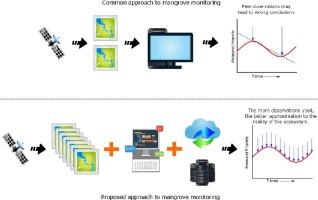
Mangrove forests grow in the estuaries of 124 tropical countries around the world. Because in-situ monitoring of mangroves is difficult and time-consuming, remote sensing technologies are commonly used to monitor these ecosystems. Landsat satellites have provided regular and systematic images of mangrove ecosystems for over 30 years, yet researchers often cite budget and infrastructure constraints to justify the underuse this resource. Since 2001, over 50 studies have used Landsat or ASTER imagery for mangrove monitoring, and most focus on the spatial extent of mangroves, rarely using more than five images. Even after the Landsat archive was made free for public use, few studies used more than five images, despite the clear advantages of using more images (e.g. lower signal-to-noise ratios). The main argument of this paper is that, with freely available imagery and high performance computing facilities around the world, it is up to researchers to acquire the necessary programming skills to use these resources. Programming skills allow researchers to automate repetitive and time-consuming tasks, such as image acquisition and processing, consequently reducing up to 60% of the time dedicated to these activities. These skills also help scientists to review and re-use algorithms, hence making mangrove research more agile. This paper contributes to the debate on why scientists need to learn to program, not only to challenge prevailing approaches to mangrove research, but also to expand the temporal and spatial extents that are commonly used for mangrove research.
期刊介绍:
The International Journal of Applied Earth Observation and Geoinformation publishes original papers that utilize earth observation data for natural resource and environmental inventory and management. These data primarily originate from remote sensing platforms, including satellites and aircraft, supplemented by surface and subsurface measurements. Addressing natural resources such as forests, agricultural land, soils, and water, as well as environmental concerns like biodiversity, land degradation, and hazards, the journal explores conceptual and data-driven approaches. It covers geoinformation themes like capturing, databasing, visualization, interpretation, data quality, and spatial uncertainty.



 京公网安备 11010802042870号
京ICP备2023020795号-1
京公网安备 11010802042870号
京ICP备2023020795号-1

 分享
分享
 求助内容:
求助内容: 应助结果提醒方式:
 扫码关注我们
