Lukas Hausmanninger, Igor Komnik, Mario Fleiter, Wolfgang Potthast
{"title":"Biomechanical investigation of load differences on the upper extremities in dynamic hand strikes and isometric hand pushes during assembly tasks","authors":"Lukas Hausmanninger, Igor Komnik, Mario Fleiter, Wolfgang Potthast","doi":"10.1002/hfm.20949","DOIUrl":null,"url":null,"abstract":"<p>This study determines the effects of increasing forces on different musculoskeletal load parameters, such as muscle activity and joint movement, during assembly task-related dynamic hand strikes and isometric push forces. Fifteen subjects (12 men and 3 women) were instructed to strike and push on a force plate in two selected conditions. In the first condition, the palmar surface of the dominant hand is oriented horizontal to the measuring surface; in the second condition, the body position is maintained, but the hand is turned 90° to allow the use of the ulnar side of the hand (fist strike position). The subjects accomplished four force levels in ascending order (i.e., 150, 250, 350, and 400 N) within the corresponding striking and pushing conditions. The extracted kinematic variables of interest were strike velocity, recoil velocity, force plate contact time, peak vertical reaction force component (force plate), force impulse, muscle activity, and maximum joint ranges of motion during the push or strike process. Differences in the results between pushes and strikes and, under certain circumstances, between fist and palm strikes were identified. Increasing push forces correlate with the muscle activity in the pectoralis and lower arm extensor muscles. The fact that, at push forces > 250 N, the subjects modify and adapt their upper body and arm posture to achieve the required force could reveal an obvious feasibility limit and explain why assembly workers tend to use their hands as a hammer.</p>","PeriodicalId":73259,"journal":{"name":"","volume":"32 4","pages":"345-355"},"PeriodicalIF":0.0,"publicationDate":"2022-02-23","publicationTypes":"Journal Article","fieldsOfStudy":null,"isOpenAccess":false,"openAccessPdf":"https://onlinelibrary.wiley.com/doi/epdf/10.1002/hfm.20949","citationCount":"0","resultStr":null,"platform":"Semanticscholar","paperid":null,"PeriodicalName":"","FirstCategoryId":"5","ListUrlMain":"https://onlinelibrary.wiley.com/doi/10.1002/hfm.20949","RegionNum":0,"RegionCategory":null,"ArticlePicture":[],"TitleCN":null,"AbstractTextCN":null,"PMCID":null,"EPubDate":"","PubModel":"","JCR":"","JCRName":"","Score":null,"Total":0}
引用次数: 0
Abstract
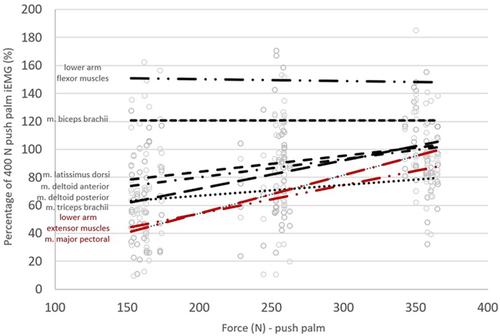
This study determines the effects of increasing forces on different musculoskeletal load parameters, such as muscle activity and joint movement, during assembly task-related dynamic hand strikes and isometric push forces. Fifteen subjects (12 men and 3 women) were instructed to strike and push on a force plate in two selected conditions. In the first condition, the palmar surface of the dominant hand is oriented horizontal to the measuring surface; in the second condition, the body position is maintained, but the hand is turned 90° to allow the use of the ulnar side of the hand (fist strike position). The subjects accomplished four force levels in ascending order (i.e., 150, 250, 350, and 400 N) within the corresponding striking and pushing conditions. The extracted kinematic variables of interest were strike velocity, recoil velocity, force plate contact time, peak vertical reaction force component (force plate), force impulse, muscle activity, and maximum joint ranges of motion during the push or strike process. Differences in the results between pushes and strikes and, under certain circumstances, between fist and palm strikes were identified. Increasing push forces correlate with the muscle activity in the pectoralis and lower arm extensor muscles. The fact that, at push forces > 250 N, the subjects modify and adapt their upper body and arm posture to achieve the required force could reveal an obvious feasibility limit and explain why assembly workers tend to use their hands as a hammer.



 京公网安备 11010802042870号
京ICP备2023020795号-1
京公网安备 11010802042870号
京ICP备2023020795号-1

 分享
分享
 求助内容:
求助内容: 应助结果提醒方式:
 扫码关注我们
