Yan Xin , Yunnian Ge , Zezhong Li , Qiaobao Zhang , Huajun Tian
{"title":"Research Progress on Modification Strategies of Organic Electrode Materials for Energy Storage Batteries","authors":"Yan Xin , Yunnian Ge , Zezhong Li , Qiaobao Zhang , Huajun Tian","doi":"10.3866/PKU.WHXB202303060","DOIUrl":null,"url":null,"abstract":"<div><div>With the development of modern society, the demand for energy is increasing. Consequently, the efficient utilization of renewable energy has become the primary concern in the energy sector. Secondary batteries can accomplish energy storage through efficient electrical/chemical energy conversion, thereby providing an effective solution for the utilization of renewable energy. Lithium-ion batteries have been the most widely used secondary battery systems, owing to their high energy densities and long lifetimes. Nevertheless, traditional inorganic cathode materials have recently encountered problems such as increasing manufacturing costs, lithium supply-chain constraints, and safety issues. Meanwhile, organic electrode materials (OEMs) have emerged as promising electrode candidates for secondary batteries owing to several advantages, such as their low costs, abundant resources, environmental friendliness, and structural designability. In recent decades, considerable efforts have been dedicated to OEM research. To date, commonly used OEMs include carbonyl polymers, conductive polymers, nitrile compounds, organic sulfides, organic free radical compounds, imine compounds, and Azo compounds. OEMs have been used in various metal ion battery systems, including lithium-, sodium-, aluminum-, zinc-, magnesium-, potassium-, and calcium-based batteries. However, the commercialization of OEMs still encounters several challenges, mainly owing to their low conductivity, high solubility, and low discharge potential. The low intrinsic conductivity of OEMs leads to difficulties in ion diffusion, while their high solubility in organic electrolytes inevitably reduces cyclic stability. Moreover, the low discharge potential of OEMs decreases energy density and rate performance. In view of the technical restrictions affecting OEMs, researchers have focused on modifications and optimizations of the structure, preparation strategies, and sizes of OEMs. In this paper, we review the development history and applications of OEMs and systemically summarize their classification, reaction mechanisms, and primary challenges. In addition, we thoroughly report on OEM modification strategies. By shaping their molecular structures, such as either by substituent introduction, conjugated structure formation, or small molecule polymerization, the solubility of OEMs can be reduced, and their discharge potential can be enhanced. The conductivity of OEMs can be improved significantly by combining them with conductive carbon materials. Nano-sized optimization and electrode-electrolyte coupling can also significantly improve their cycle stability and rate performance. Additionally, the electrochemical performance of OEMs can be improved by optimizing preparation processes and determining the best technological parameters. Finally, we envision future research paths of OEM modification, which could provide a future reference in OEM design and research.</div><div><span><figure><span><img><ol><li><span><span>Download: <span>Download high-res image (87KB)</span></span></span></li><li><span><span>Download: <span>Download full-size image</span></span></span></li></ol></span></figure></span></div></div>","PeriodicalId":6964,"journal":{"name":"物理化学学报","volume":"40 2","pages":"Article 2303060"},"PeriodicalIF":13.5000,"publicationDate":"2024-02-01","publicationTypes":"Journal Article","fieldsOfStudy":null,"isOpenAccess":false,"openAccessPdf":"","citationCount":"0","resultStr":null,"platform":"Semanticscholar","paperid":null,"PeriodicalName":"物理化学学报","FirstCategoryId":"92","ListUrlMain":"https://www.sciencedirect.com/science/article/pii/S1000681824000547","RegionNum":2,"RegionCategory":"化学","ArticlePicture":[],"TitleCN":null,"AbstractTextCN":null,"PMCID":null,"EPubDate":"","PubModel":"","JCR":"Q1","JCRName":"CHEMISTRY, PHYSICAL","Score":null,"Total":0}
引用次数: 0
Abstract
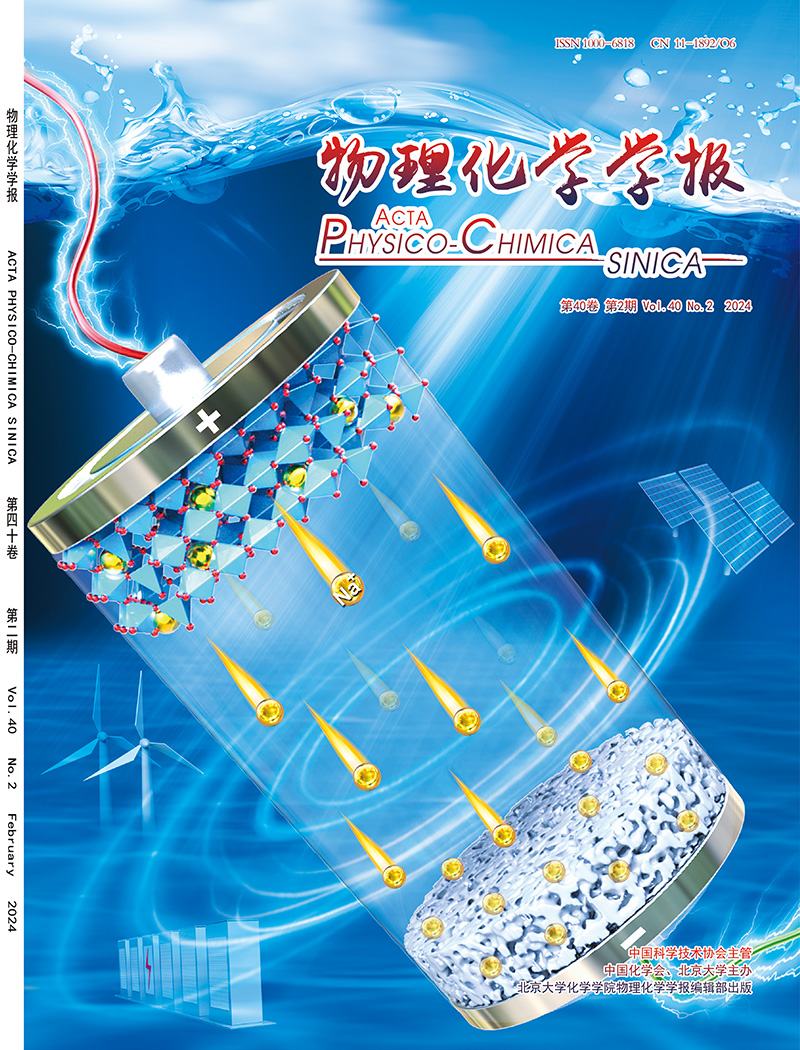
With the development of modern society, the demand for energy is increasing. Consequently, the efficient utilization of renewable energy has become the primary concern in the energy sector. Secondary batteries can accomplish energy storage through efficient electrical/chemical energy conversion, thereby providing an effective solution for the utilization of renewable energy. Lithium-ion batteries have been the most widely used secondary battery systems, owing to their high energy densities and long lifetimes. Nevertheless, traditional inorganic cathode materials have recently encountered problems such as increasing manufacturing costs, lithium supply-chain constraints, and safety issues. Meanwhile, organic electrode materials (OEMs) have emerged as promising electrode candidates for secondary batteries owing to several advantages, such as their low costs, abundant resources, environmental friendliness, and structural designability. In recent decades, considerable efforts have been dedicated to OEM research. To date, commonly used OEMs include carbonyl polymers, conductive polymers, nitrile compounds, organic sulfides, organic free radical compounds, imine compounds, and Azo compounds. OEMs have been used in various metal ion battery systems, including lithium-, sodium-, aluminum-, zinc-, magnesium-, potassium-, and calcium-based batteries. However, the commercialization of OEMs still encounters several challenges, mainly owing to their low conductivity, high solubility, and low discharge potential. The low intrinsic conductivity of OEMs leads to difficulties in ion diffusion, while their high solubility in organic electrolytes inevitably reduces cyclic stability. Moreover, the low discharge potential of OEMs decreases energy density and rate performance. In view of the technical restrictions affecting OEMs, researchers have focused on modifications and optimizations of the structure, preparation strategies, and sizes of OEMs. In this paper, we review the development history and applications of OEMs and systemically summarize their classification, reaction mechanisms, and primary challenges. In addition, we thoroughly report on OEM modification strategies. By shaping their molecular structures, such as either by substituent introduction, conjugated structure formation, or small molecule polymerization, the solubility of OEMs can be reduced, and their discharge potential can be enhanced. The conductivity of OEMs can be improved significantly by combining them with conductive carbon materials. Nano-sized optimization and electrode-electrolyte coupling can also significantly improve their cycle stability and rate performance. Additionally, the electrochemical performance of OEMs can be improved by optimizing preparation processes and determining the best technological parameters. Finally, we envision future research paths of OEM modification, which could provide a future reference in OEM design and research.



 京公网安备 11010802042870号
京ICP备2023020795号-1
京公网安备 11010802042870号
京ICP备2023020795号-1

 分享
分享
 求助内容:
求助内容: 应助结果提醒方式:
 扫码关注我们
