{"title":"Wake Prediction in 3D Porous–Fluid Flows: A Numerical Study Using a Brinkman Penalization LBM Approach","authors":"Mimeau Chloé, Marié Simon, Roussel Léo, Mortazavi Iraj","doi":"10.1007/s10494-023-00471-w","DOIUrl":null,"url":null,"abstract":"<div><p>The simulation of the wake past porous obstacles is numerically challenging because since it requires both an accurate model of the porous medium and a good grid resolution in the fluid domain. In this study a single-domain Brinkman penalization technique in a LBM framework is employed to investigate wake prediction in 3D porous–fluid flows. First we assess the ability of the Brinkman model to predict porous flow features with different permeability values (Darcy numbers). In particular the flow over a porous bed is studied to characterize the ability of this approach to predict the thickness of the porous boundary layer (called Brinkman boundary layer) and the slip velocity at the porous/fluid interface. The porous boundary layer is well described with this model and a finer grid resolution at the wall is needed for low permeability values (low Darcy numbers). Then the impact of these quantities on the wake prediction of a 3D porous sphere is studied for various Darcy and Reynolds numbers. It is shown that wake transitions are well recovered and some further studies are made in terms of grid resolution. Some preliminary results are presented for higher Reynolds numbers.</p></div>","PeriodicalId":559,"journal":{"name":"Flow, Turbulence and Combustion","volume":"112 1","pages":"273 - 301"},"PeriodicalIF":2.4000,"publicationDate":"2023-08-28","publicationTypes":"Journal Article","fieldsOfStudy":null,"isOpenAccess":false,"openAccessPdf":"","citationCount":"0","resultStr":null,"platform":"Semanticscholar","paperid":null,"PeriodicalName":"Flow, Turbulence and Combustion","FirstCategoryId":"5","ListUrlMain":"https://link.springer.com/article/10.1007/s10494-023-00471-w","RegionNum":3,"RegionCategory":"工程技术","ArticlePicture":[],"TitleCN":null,"AbstractTextCN":null,"PMCID":null,"EPubDate":"","PubModel":"","JCR":"Q3","JCRName":"MECHANICS","Score":null,"Total":0}
引用次数: 0
Abstract
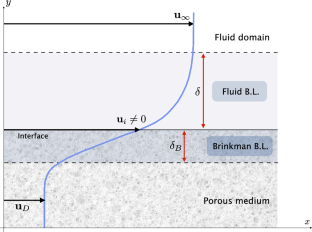
The simulation of the wake past porous obstacles is numerically challenging because since it requires both an accurate model of the porous medium and a good grid resolution in the fluid domain. In this study a single-domain Brinkman penalization technique in a LBM framework is employed to investigate wake prediction in 3D porous–fluid flows. First we assess the ability of the Brinkman model to predict porous flow features with different permeability values (Darcy numbers). In particular the flow over a porous bed is studied to characterize the ability of this approach to predict the thickness of the porous boundary layer (called Brinkman boundary layer) and the slip velocity at the porous/fluid interface. The porous boundary layer is well described with this model and a finer grid resolution at the wall is needed for low permeability values (low Darcy numbers). Then the impact of these quantities on the wake prediction of a 3D porous sphere is studied for various Darcy and Reynolds numbers. It is shown that wake transitions are well recovered and some further studies are made in terms of grid resolution. Some preliminary results are presented for higher Reynolds numbers.
期刊介绍:
Flow, Turbulence and Combustion provides a global forum for the publication of original and innovative research results that contribute to the solution of fundamental and applied problems encountered in single-phase, multi-phase and reacting flows, in both idealized and real systems. The scope of coverage encompasses topics in fluid dynamics, scalar transport, multi-physics interactions and flow control. From time to time the journal publishes Special or Theme Issues featuring invited articles.
Contributions may report research that falls within the broad spectrum of analytical, computational and experimental methods. This includes research conducted in academia, industry and a variety of environmental and geophysical sectors. Turbulence, transition and associated phenomena are expected to play a significant role in the majority of studies reported, although non-turbulent flows, typical of those in micro-devices, would be regarded as falling within the scope covered. The emphasis is on originality, timeliness, quality and thematic fit, as exemplified by the title of the journal and the qualifications described above. Relevance to real-world problems and industrial applications are regarded as strengths.