{"title":"Platelet-rich plasma injection in the treatment of patellar tendinopathy: a systematic review and meta-analysis.","authors":"Apurba Barman, Mithilesh K Sinha, Jagannatha Sahoo, Debasish Jena, Vikas Patel, Suman Patel, Souvik Bhattacharjee, Debanjan Baral","doi":"10.1186/s43019-022-00151-5","DOIUrl":null,"url":null,"abstract":"<p><strong>Purpose: </strong>The objective of the study was to assess the efficacy of autologous platelet-rich plasma (PRP) injections in the treatment of patellar tendinopathy.</p><p><strong>Methods: </strong>The PubMed, MEDLINE, EMBASE, CINAHL, and Cochrane Central Register of Controlled Trials databases were searched for clinical trials which compared PRP injection with other 'active treatment' interventions ('Non-PRP' injection and 'No-injection' treatments) or 'No-active treatment' interventions. Randomized and non-randomized clinical trials that had been published up to 15 November 2021, were included in the meta-analysis. The primary outcome, pain relief, was measured on a 'visual analog scale.' Secondary outcomes were knee functional activities and quality of life (QoL). The PRISMA guidelines were followed throughout the study.</p><p><strong>Results: </strong>Eight comparative studies were identified for inclusion in the meta-analysis. Assessment of these studies revealed that there were no significant differences in pain relief, functional outcomes, and QoL in the short, medium, and long term between PRP injection and Non-PRP injection interventions. Similarly, comparison of PRP injection to the No-active treatment intervention showed no differences in short- and medium-term pain relief. However, when PRP injection was compared to the No-injection treatment intervention extracorporeal shock wave therapy (ECWT), the former was found to be more effective in terms of pain relief in the medium term (mean difference [MD] - 1.50; 95% confidence interval [CI] - 2.72 to - 0.28) and long term (MD - 1.70; 95% CI, - 2.90 to - 0.50) and functional outcomes in the medium term (MD 13.0; 95% CI 3.01-22.99) and long term (MD 13.70; 95% CI 4.62-22.78).</p><p><strong>Conclusions: </strong>In terms of pain relief and functional outcomes, the PRP injection did not provide significantly greater clinical benefit than Non-PRP injections in the treatment of patellar tendinopathy. However, in comparison with ESWT, there was a significant benefit in favor of PRP injection.</p>","PeriodicalId":23631,"journal":{"name":"Vox Sanguinis","volume":"81 1","pages":"22"},"PeriodicalIF":1.6000,"publicationDate":"2022-05-04","publicationTypes":"Journal Article","fieldsOfStudy":null,"isOpenAccess":false,"openAccessPdf":"https://www.ncbi.nlm.nih.gov/pmc/articles/PMC9066802/pdf/","citationCount":"0","resultStr":null,"platform":"Semanticscholar","paperid":null,"PeriodicalName":"Vox Sanguinis","FirstCategoryId":"1085","ListUrlMain":"https://doi.org/10.1186/s43019-022-00151-5","RegionNum":4,"RegionCategory":"医学","ArticlePicture":[],"TitleCN":null,"AbstractTextCN":null,"PMCID":null,"EPubDate":"","PubModel":"","JCR":"Q3","JCRName":"HEMATOLOGY","Score":null,"Total":0}
引用次数: 0
Abstract
Purpose: The objective of the study was to assess the efficacy of autologous platelet-rich plasma (PRP) injections in the treatment of patellar tendinopathy.
Methods: The PubMed, MEDLINE, EMBASE, CINAHL, and Cochrane Central Register of Controlled Trials databases were searched for clinical trials which compared PRP injection with other 'active treatment' interventions ('Non-PRP' injection and 'No-injection' treatments) or 'No-active treatment' interventions. Randomized and non-randomized clinical trials that had been published up to 15 November 2021, were included in the meta-analysis. The primary outcome, pain relief, was measured on a 'visual analog scale.' Secondary outcomes were knee functional activities and quality of life (QoL). The PRISMA guidelines were followed throughout the study.
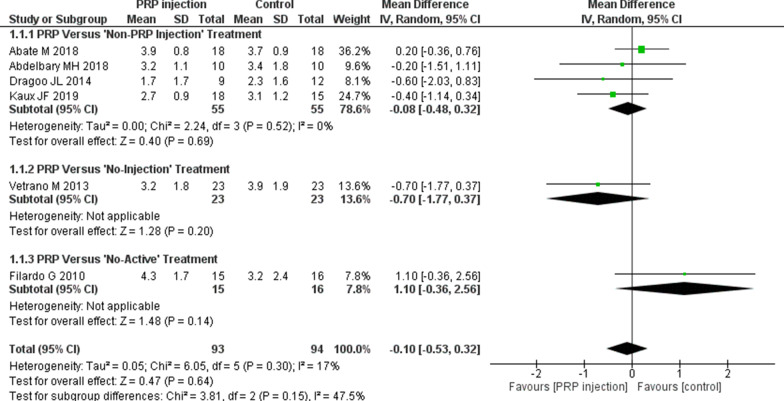
Results: Eight comparative studies were identified for inclusion in the meta-analysis. Assessment of these studies revealed that there were no significant differences in pain relief, functional outcomes, and QoL in the short, medium, and long term between PRP injection and Non-PRP injection interventions. Similarly, comparison of PRP injection to the No-active treatment intervention showed no differences in short- and medium-term pain relief. However, when PRP injection was compared to the No-injection treatment intervention extracorporeal shock wave therapy (ECWT), the former was found to be more effective in terms of pain relief in the medium term (mean difference [MD] - 1.50; 95% confidence interval [CI] - 2.72 to - 0.28) and long term (MD - 1.70; 95% CI, - 2.90 to - 0.50) and functional outcomes in the medium term (MD 13.0; 95% CI 3.01-22.99) and long term (MD 13.70; 95% CI 4.62-22.78).
Conclusions: In terms of pain relief and functional outcomes, the PRP injection did not provide significantly greater clinical benefit than Non-PRP injections in the treatment of patellar tendinopathy. However, in comparison with ESWT, there was a significant benefit in favor of PRP injection.
期刊介绍:
Vox Sanguinis reports on important, novel developments in transfusion medicine. Original papers, reviews and international fora are published on all aspects of blood transfusion and tissue transplantation, comprising five main sections:
1) Transfusion - Transmitted Disease and its Prevention:
Identification and epidemiology of infectious agents transmissible by blood;
Bacterial contamination of blood components;
Donor recruitment and selection methods;
Pathogen inactivation.
2) Blood Component Collection and Production:
Blood collection methods and devices (including apheresis);
Plasma fractionation techniques and plasma derivatives;
Preparation of labile blood components;
Inventory management;
Hematopoietic progenitor cell collection and storage;
Collection and storage of tissues;
Quality management and good manufacturing practice;
Automation and information technology.
3) Transfusion Medicine and New Therapies:
Transfusion thresholds and audits;
Haemovigilance;
Clinical trials regarding appropriate haemotherapy;
Non-infectious adverse affects of transfusion;
Therapeutic apheresis;
Support of transplant patients;
Gene therapy and immunotherapy.
4) Immunohaematology and Immunogenetics:
Autoimmunity in haematology;
Alloimmunity of blood;
Pre-transfusion testing;
Immunodiagnostics;
Immunobiology;
Complement in immunohaematology;
Blood typing reagents;
Genetic markers of blood cells and serum proteins: polymorphisms and function;
Genetic markers and disease;
Parentage testing and forensic immunohaematology.
5) Cellular Therapy:
Cell-based therapies;
Stem cell sources;
Stem cell processing and storage;
Stem cell products;
Stem cell plasticity;
Regenerative medicine with cells;
Cellular immunotherapy;
Molecular therapy;
Gene therapy.





 京公网安备 11010802042870号
京ICP备2023020795号-1
京公网安备 11010802042870号
京ICP备2023020795号-1

 分享
分享
 求助内容:
求助内容: 应助结果提醒方式:
 扫码关注我们
