{"title":"Influence of the coating method on the formation of superhydrophobic silicone–urea surfaces modified with fumed silica nanoparticles","authors":"Cagla Kosak Söz, Emel Yilgör, Iskender Yilgör","doi":"10.1016/j.porgcoat.2015.03.015","DOIUrl":null,"url":null,"abstract":"<div><p>Effect of the coating method on the formation of superhydrophobic polydimethylsiloxane–urea copolymer (TPSC) surfaces, modified by the incorporation of hydrophobic fumed silica nanoparticles was investigated. Four different coating methods employed were: (i) layer-by-layer spin-coating of hydrophobic fumed silica dispersed in an organic solvent onto TPSC films, (ii) spin-coating of silica–polymer mixture onto a glass substrate, (iii) spray coating of silica/polymer mixture by an air-brush onto a glass substrate, and (iv) direct coating of silica–polymer mixture by a doctor blade onto a glass substrate. Influence of the coating method, composition of the polymer/silica mixture and the number of silica layers applied on the topography and wetting behavior of the surfaces were determined. Surfaces obtained were characterized by scanning electron microscopy (SEM), white light interferometry (WLI) and advancing and receding water contact angle measurements. It was demonstrated that superhydrophobic surfaces could be obtained by all methods. Surfaces obtained displayed hierarchical micro-nano structures and superhydrophobic behavior with static and advancing water contact angles well above 150° and fairly low contact angle hysteresis values.</p></div>","PeriodicalId":20834,"journal":{"name":"Progress in Organic Coatings","volume":"84 ","pages":"Pages 143-152"},"PeriodicalIF":7.3000,"publicationDate":"2015-07-01","publicationTypes":"Journal Article","fieldsOfStudy":null,"isOpenAccess":false,"openAccessPdf":"https://sci-hub-pdf.com/10.1016/j.porgcoat.2015.03.015","citationCount":"36","resultStr":null,"platform":"Semanticscholar","paperid":null,"PeriodicalName":"Progress in Organic Coatings","FirstCategoryId":"88","ListUrlMain":"https://www.sciencedirect.com/science/article/pii/S030094401500096X","RegionNum":2,"RegionCategory":"材料科学","ArticlePicture":[],"TitleCN":null,"AbstractTextCN":null,"PMCID":null,"EPubDate":"","PubModel":"","JCR":"Q1","JCRName":"CHEMISTRY, APPLIED","Score":null,"Total":0}
引用次数: 36
Abstract
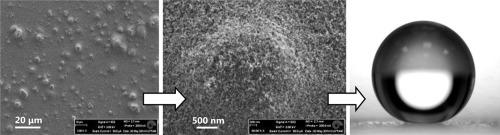
Effect of the coating method on the formation of superhydrophobic polydimethylsiloxane–urea copolymer (TPSC) surfaces, modified by the incorporation of hydrophobic fumed silica nanoparticles was investigated. Four different coating methods employed were: (i) layer-by-layer spin-coating of hydrophobic fumed silica dispersed in an organic solvent onto TPSC films, (ii) spin-coating of silica–polymer mixture onto a glass substrate, (iii) spray coating of silica/polymer mixture by an air-brush onto a glass substrate, and (iv) direct coating of silica–polymer mixture by a doctor blade onto a glass substrate. Influence of the coating method, composition of the polymer/silica mixture and the number of silica layers applied on the topography and wetting behavior of the surfaces were determined. Surfaces obtained were characterized by scanning electron microscopy (SEM), white light interferometry (WLI) and advancing and receding water contact angle measurements. It was demonstrated that superhydrophobic surfaces could be obtained by all methods. Surfaces obtained displayed hierarchical micro-nano structures and superhydrophobic behavior with static and advancing water contact angles well above 150° and fairly low contact angle hysteresis values.
期刊介绍:
The aim of this international journal is to analyse and publicise the progress and current state of knowledge in the field of organic coatings and related materials. The Editors and the Editorial Board members will solicit both review and research papers from academic and industrial scientists who are actively engaged in research and development or, in the case of review papers, have extensive experience in the subject to be reviewed. Unsolicited manuscripts will be accepted if they meet the journal''s requirements. The journal publishes papers dealing with such subjects as:
• Chemical, physical and technological properties of organic coatings and related materials
• Problems and methods of preparation, manufacture and application of these materials
• Performance, testing and analysis.