{"title":"Seeding the Spatial Prisoner’s Dilemma with Ulam’s Spiral","authors":"Tim Johnson","doi":"10.1155/2023/1649440","DOIUrl":null,"url":null,"abstract":"<div>\n <p>Ulam’s spiral reveals patterns in the prime numbers by presenting positive integers in a right-angled whorl. The classic spatial prisoner’s dilemma (PD) reveals pathways to cooperation by presenting a model of agents interacting on a grid. This paper brings these tools together via a deterministic spatial PD model that distributes cooperators at the prime-numbered locations of Ulam’s spiral. The model focuses on a narrow boundary game variant of the PD for ease of comparison with early studies of the spatial PD. Despite constituting an initially small portion of the population, cooperators arranged in Ulam’s spiral always grow to dominance when (i) the payoff to free-riding is less than or equal to 8/6 (≈1.33) times the payoff to mutual cooperation and (ii) grid size equals or exceeds 23 × 23. As in any spatial PD model, particular formations of cooperators spur this growth and here these formations draw attention to rare configurations in Ulam’s spiral.</p>\n </div>","PeriodicalId":50653,"journal":{"name":"Complexity","volume":"2023 1","pages":""},"PeriodicalIF":1.7000,"publicationDate":"2023-04-25","publicationTypes":"Journal Article","fieldsOfStudy":null,"isOpenAccess":false,"openAccessPdf":"https://onlinelibrary.wiley.com/doi/epdf/10.1155/2023/1649440","citationCount":"0","resultStr":null,"platform":"Semanticscholar","paperid":null,"PeriodicalName":"Complexity","FirstCategoryId":"5","ListUrlMain":"https://onlinelibrary.wiley.com/doi/10.1155/2023/1649440","RegionNum":4,"RegionCategory":"工程技术","ArticlePicture":[],"TitleCN":null,"AbstractTextCN":null,"PMCID":null,"EPubDate":"","PubModel":"","JCR":"Q2","JCRName":"MATHEMATICS, INTERDISCIPLINARY APPLICATIONS","Score":null,"Total":0}
引用次数: 0
Abstract
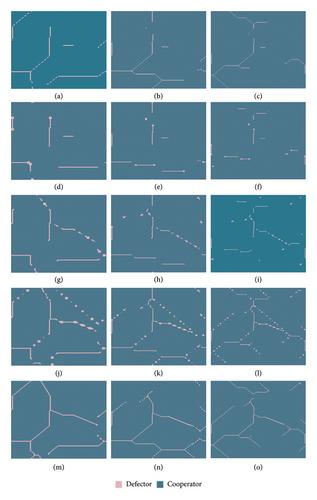
Ulam’s spiral reveals patterns in the prime numbers by presenting positive integers in a right-angled whorl. The classic spatial prisoner’s dilemma (PD) reveals pathways to cooperation by presenting a model of agents interacting on a grid. This paper brings these tools together via a deterministic spatial PD model that distributes cooperators at the prime-numbered locations of Ulam’s spiral. The model focuses on a narrow boundary game variant of the PD for ease of comparison with early studies of the spatial PD. Despite constituting an initially small portion of the population, cooperators arranged in Ulam’s spiral always grow to dominance when (i) the payoff to free-riding is less than or equal to 8/6 (≈1.33) times the payoff to mutual cooperation and (ii) grid size equals or exceeds 23 × 23. As in any spatial PD model, particular formations of cooperators spur this growth and here these formations draw attention to rare configurations in Ulam’s spiral.
期刊介绍:
Complexity is a cross-disciplinary journal focusing on the rapidly expanding science of complex adaptive systems. The purpose of the journal is to advance the science of complexity. Articles may deal with such methodological themes as chaos, genetic algorithms, cellular automata, neural networks, and evolutionary game theory. Papers treating applications in any area of natural science or human endeavor are welcome, and especially encouraged are papers integrating conceptual themes and applications that cross traditional disciplinary boundaries. Complexity is not meant to serve as a forum for speculation and vague analogies between words like “chaos,” “self-organization,” and “emergence” that are often used in completely different ways in science and in daily life.



 京公网安备 11010802042870号
京ICP备2023020795号-1
京公网安备 11010802042870号
京ICP备2023020795号-1

 分享
分享
 求助内容:
求助内容: 应助结果提醒方式:
 扫码关注我们
