Effectiveness of a mobile health intervention on weight loss and dietary behavior changes among employees with overweight and obesity: a 12-week intervention study investigating the role of engagement.
{"title":"Effectiveness of a mobile health intervention on weight loss and dietary behavior changes among employees with overweight and obesity: a 12-week intervention study investigating the role of engagement.","authors":"Imhuei Son, Jiyoun Hong, Young-Hee Han, Bo Jeong Gong, Meng Yuan Zhang, Woori Na, Cheongmin Sohn, Taisun Hyun","doi":"10.5720/kjcn.2023.28.2.141","DOIUrl":null,"url":null,"abstract":"<p><strong>Objectives: </strong>This study aimed to determine whether a mobile health (mhealth) intervention is effective in reducing weight and changing dietary behavior among employees with overweight and obesity. The study also investigated whether engagement with the intervention affected its effectiveness.</p><p><strong>Methods: </strong>The intervention involved the use of a dietary coaching app, a wearable device for monitoring physical activity and body composition, and a messenger app for communicating with participants and an intervention manager. A total of 235 employees were recruited for a 12-week intervention from eight workplaces in Korea. Questionnaire surveys, anthropometric measurements, and 24-h dietary recalls were conducted at baseline and after the intervention.</p><p><strong>Results: </strong>After the intervention, significant decreases in the mean body weight, body mass index, body fat percentage, and waist circumference were observed. Furthermore, the consumption frequencies of multigrain rice and legumes significantly increased, whereas those of pork belly, instant noodles, processed meat, carbonated beverages, and fast food significantly decreased compared with those at baseline. The mean dietary intake of energy and most nutrients also decreased after the intervention. When the participants were categorized into three groups according to their engagement level, significant differences in anthropometric data, dietary behaviors, and energy intake were observed following the intervention, although there were no differences at baseline, indicating that higher engagement level led to greater improvements in weight loss and dietary behavior.</p><p><strong>Conclusions: </strong>The intervention had positive effects on weight loss and dietary behavior changes, particularly among employees with higher engagement levels. These results indicate the importance of increasing the level of engagement in the intervention to enhance its effectiveness. The mhealth intervention is a promising model for health promotion for busy workers with limited time.</p>","PeriodicalId":74046,"journal":{"name":"Korean journal of community nutrition","volume":"167 1","pages":"141-159"},"PeriodicalIF":0.0000,"publicationDate":"2023-04-01","publicationTypes":"Journal Article","fieldsOfStudy":null,"isOpenAccess":false,"openAccessPdf":"https://www.ncbi.nlm.nih.gov/pmc/articles/PMC12782785/pdf/","citationCount":"0","resultStr":null,"platform":"Semanticscholar","paperid":null,"PeriodicalName":"Korean journal of community nutrition","FirstCategoryId":"1085","ListUrlMain":"https://doi.org/10.5720/kjcn.2023.28.2.141","RegionNum":0,"RegionCategory":null,"ArticlePicture":[],"TitleCN":null,"AbstractTextCN":null,"PMCID":null,"EPubDate":"2023/4/30 0:00:00","PubModel":"Epub","JCR":"","JCRName":"","Score":null,"Total":0}
引用次数: 0
Abstract
Objectives: This study aimed to determine whether a mobile health (mhealth) intervention is effective in reducing weight and changing dietary behavior among employees with overweight and obesity. The study also investigated whether engagement with the intervention affected its effectiveness.
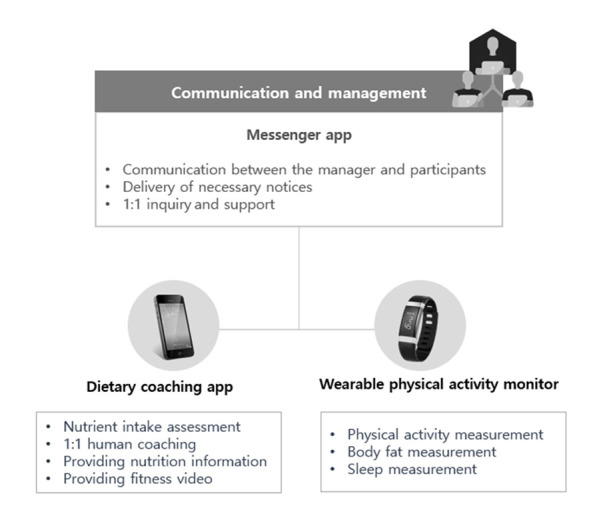
Methods: The intervention involved the use of a dietary coaching app, a wearable device for monitoring physical activity and body composition, and a messenger app for communicating with participants and an intervention manager. A total of 235 employees were recruited for a 12-week intervention from eight workplaces in Korea. Questionnaire surveys, anthropometric measurements, and 24-h dietary recalls were conducted at baseline and after the intervention.
Results: After the intervention, significant decreases in the mean body weight, body mass index, body fat percentage, and waist circumference were observed. Furthermore, the consumption frequencies of multigrain rice and legumes significantly increased, whereas those of pork belly, instant noodles, processed meat, carbonated beverages, and fast food significantly decreased compared with those at baseline. The mean dietary intake of energy and most nutrients also decreased after the intervention. When the participants were categorized into three groups according to their engagement level, significant differences in anthropometric data, dietary behaviors, and energy intake were observed following the intervention, although there were no differences at baseline, indicating that higher engagement level led to greater improvements in weight loss and dietary behavior.
Conclusions: The intervention had positive effects on weight loss and dietary behavior changes, particularly among employees with higher engagement levels. These results indicate the importance of increasing the level of engagement in the intervention to enhance its effectiveness. The mhealth intervention is a promising model for health promotion for busy workers with limited time.



 京公网安备 11010802042870号
京ICP备2023020795号-1
京公网安备 11010802042870号
京ICP备2023020795号-1

 分享
分享

 求助内容:
求助内容: 应助结果提醒方式:
 扫码关注我们
