Susanne Kobel, Sarah Kettner, Christine Lämmle, Jürgen M Steinacker
{"title":"Physical activity of German children during different segments of the school day.","authors":"Susanne Kobel, Sarah Kettner, Christine Lämmle, Jürgen M Steinacker","doi":"10.1007/s10389-016-0755-2","DOIUrl":null,"url":null,"abstract":"<p><strong>Aim: </strong>This study objectively investigated the amount and intensity of German primary school children's physical activity (PA) during different segments of the school day and explored the contribution of physical education (PE) and break times to daily moderate to vigorous PA (MVPA).</p><p><strong>Subject and methods: </strong>PA of 294 children (7.1 ± 0.7 years, 48 % male) was objectively measured for 6 days using Actiheart®. Based on children's timetables, break times and PE periods were determined and PA was calculated individually and subsequently classified in light (1.5-3 MET), moderate (3-6 MET) and vigorous (>6 MET) intensities. Weight status was determined during a school visit.</p><p><strong>Results: </strong>Children spent 133 ± 61 min in MVPA; on weekdays, this amount increased significantly (141 ± 66 min, <i>p</i> ≤ 0.01). 45.9 % of children reached physical activity guidelines of 60 min of MVPA daily, with boys achieving this goal significantly more often than girls (65.6 vs. 28.7 %, respectively; <i>p</i> ≤ 0.01). PE lessons and break times accounted for 15 ± 13 min (12.7 %) and 7 ± 6 min (5.8 %) of daily MVPA, respectively. On days with PE, children spent 144 ± 68 min in MVPA, whereas on days without PE, this time decreased significantly to 122 ± 63 min (<i>p</i> ≤ 0.01).</p><p><strong>Conclusion: </strong>The findings suggest that segments such as PE lessons and morning breaks are important sources for MVPA for boys and girls. This should therefore be considered for policies, timetables and curriculums in order to offer sufficient opportunities for children to be physically active during the school day.</p>","PeriodicalId":51186,"journal":{"name":"Suchttherapie","volume":"8 1","pages":"29-35"},"PeriodicalIF":0.2000,"publicationDate":"2017-01-01","publicationTypes":"Journal Article","fieldsOfStudy":null,"isOpenAccess":false,"openAccessPdf":"https://www.ncbi.nlm.nih.gov/pmc/articles/PMC5236069/pdf/","citationCount":"0","resultStr":null,"platform":"Semanticscholar","paperid":null,"PeriodicalName":"Suchttherapie","FirstCategoryId":"1085","ListUrlMain":"https://doi.org/10.1007/s10389-016-0755-2","RegionNum":4,"RegionCategory":"医学","ArticlePicture":[],"TitleCN":null,"AbstractTextCN":null,"PMCID":null,"EPubDate":"2016/8/3 0:00:00","PubModel":"Epub","JCR":"Q4","JCRName":"PSYCHIATRY","Score":null,"Total":0}
引用次数: 0
Abstract
Aim: This study objectively investigated the amount and intensity of German primary school children's physical activity (PA) during different segments of the school day and explored the contribution of physical education (PE) and break times to daily moderate to vigorous PA (MVPA).
Subject and methods: PA of 294 children (7.1 ± 0.7 years, 48 % male) was objectively measured for 6 days using Actiheart®. Based on children's timetables, break times and PE periods were determined and PA was calculated individually and subsequently classified in light (1.5-3 MET), moderate (3-6 MET) and vigorous (>6 MET) intensities. Weight status was determined during a school visit.
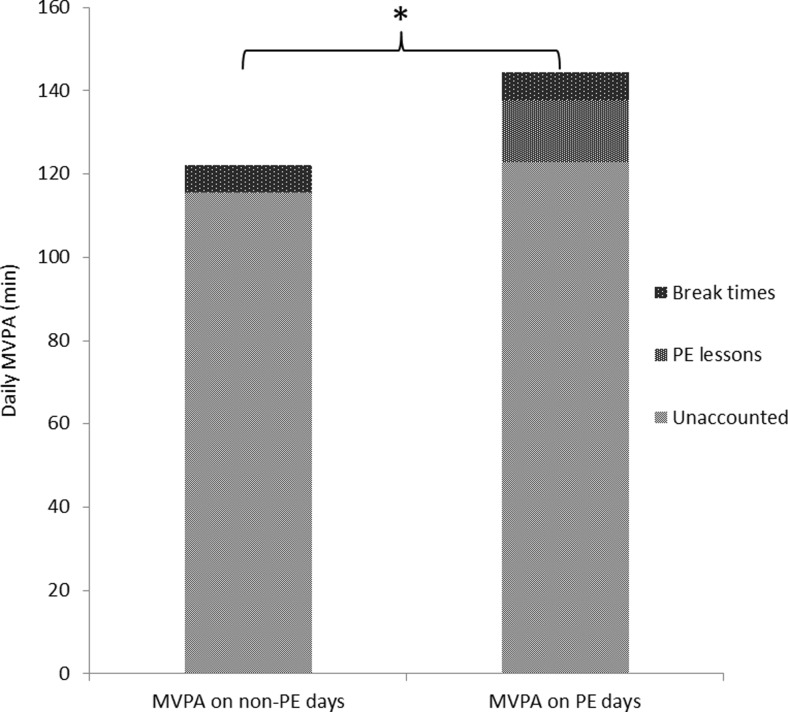
Results: Children spent 133 ± 61 min in MVPA; on weekdays, this amount increased significantly (141 ± 66 min, p ≤ 0.01). 45.9 % of children reached physical activity guidelines of 60 min of MVPA daily, with boys achieving this goal significantly more often than girls (65.6 vs. 28.7 %, respectively; p ≤ 0.01). PE lessons and break times accounted for 15 ± 13 min (12.7 %) and 7 ± 6 min (5.8 %) of daily MVPA, respectively. On days with PE, children spent 144 ± 68 min in MVPA, whereas on days without PE, this time decreased significantly to 122 ± 63 min (p ≤ 0.01).
Conclusion: The findings suggest that segments such as PE lessons and morning breaks are important sources for MVPA for boys and girls. This should therefore be considered for policies, timetables and curriculums in order to offer sufficient opportunities for children to be physically active during the school day.
期刊介绍:
The journal addiction therapy is the forum for all who are active in the areas of addiction prevention, addiction treatment and addiction research. All contributions are selected and prepared in such a way that they are attractive for the various specialist disciplines - regardless of whether they are psychotherapists, doctors, psychologists, social workers or social educators in outpatient and inpatient facilities of addiction care, whether scientists in the field of addiction research or whether family doctor or internist.
Practical relevance is clearly in the focus: Fundamentals and new approaches to addiction prevention, therapy and policy are presented and reflected. Basic scientific topics are also taken up and it is shown what suggestions arise from this for the care and treatment practice.
The addiction as a whole is sometimes prone to doctrines, dogmas and beliefs. The addiction treatment questioned existing, developed it through controversial discourses on and is open to different theoretical and practical approaches. Important international treatment and research approaches are also taken up and fed into the local discussion.



 京公网安备 11010802042870号
京ICP备2023020795号-1
京公网安备 11010802042870号
京ICP备2023020795号-1

 分享
分享
 求助内容:
求助内容: 应助结果提醒方式:
 扫码关注我们
