{"title":"Excision of Umbilical Keloids after Laparoscopic Surgery and Reconstruction by Skin Grafting: Original Research.","authors":"Yuki Tsujimoto, Satoru Nakayama, Ie Nie, Satoshi Takada, Toshihiro Kitayama, Yoichi Nishii","doi":"10.53045/jprs.2021-0034","DOIUrl":null,"url":null,"abstract":"<p><strong>Objectives: </strong>The umbilicus is often used as a port insertion site during laparoscopic surgery because the wound is invisible after the surgery. However, its concave shape makes postoperative treatment difficult, resulting in umbilical keloids due to infection. Current study reports four cases of the excision of umbilical keloids with satisfactory results following full-thickness skin grafts and postoperative radiation therapy.</p><p><strong>Methods: </strong>Umbilical keloids were excised and the skin grafts were taken from the lower abdomen. The grafts were anchored at the bottom of the umbilicus and implanted along the umbilical cavity. All skin grafts were irradiated at a dose of 4 Gy for 5 days from the first postoperative day.</p><p><strong>Results: </strong>No recurrence has been observed in any of the patients at 6 months after surgery, the shapes of the umbilicus were favorable, and normal scarring was observed at the donor skin sites. Generally, all patients are satisfied with the results.</p><p><strong>Conclusions: </strong>Simple suture or local flap reconstruction after keloid excision may result in some cosmetic problems, e.g., flatted umbilicus, because of the concave shapes of the umbilicus. The treatment of umbilical keloids using skin grafts and electron beam irradiation can reproduce the concave shapes of the umbilical cavities and provide sufficient decompression of the umbilical region, which is useful both in terms of cosmetic appearance and risk reduction of recurrence. Accordingly, careful follow-up is necessary because of the risks of necrosis of the skin grafts due to electron beam irradiation.</p>","PeriodicalId":76521,"journal":{"name":"Scandinavian journal of plastic and reconstructive surgery","volume":"90 1","pages":"89-93"},"PeriodicalIF":0.0000,"publicationDate":"2022-09-05","publicationTypes":"Journal Article","fieldsOfStudy":null,"isOpenAccess":false,"openAccessPdf":"https://www.ncbi.nlm.nih.gov/pmc/articles/PMC12078094/pdf/","citationCount":"0","resultStr":null,"platform":"Semanticscholar","paperid":null,"PeriodicalName":"Scandinavian journal of plastic and reconstructive surgery","FirstCategoryId":"1085","ListUrlMain":"https://doi.org/10.53045/jprs.2021-0034","RegionNum":0,"RegionCategory":null,"ArticlePicture":[],"TitleCN":null,"AbstractTextCN":null,"PMCID":null,"EPubDate":"2023/7/27 0:00:00","PubModel":"eCollection","JCR":"","JCRName":"","Score":null,"Total":0}
引用次数: 0
Abstract
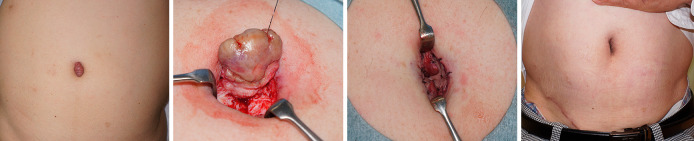
Objectives: The umbilicus is often used as a port insertion site during laparoscopic surgery because the wound is invisible after the surgery. However, its concave shape makes postoperative treatment difficult, resulting in umbilical keloids due to infection. Current study reports four cases of the excision of umbilical keloids with satisfactory results following full-thickness skin grafts and postoperative radiation therapy.
Methods: Umbilical keloids were excised and the skin grafts were taken from the lower abdomen. The grafts were anchored at the bottom of the umbilicus and implanted along the umbilical cavity. All skin grafts were irradiated at a dose of 4 Gy for 5 days from the first postoperative day.
Results: No recurrence has been observed in any of the patients at 6 months after surgery, the shapes of the umbilicus were favorable, and normal scarring was observed at the donor skin sites. Generally, all patients are satisfied with the results.
Conclusions: Simple suture or local flap reconstruction after keloid excision may result in some cosmetic problems, e.g., flatted umbilicus, because of the concave shapes of the umbilicus. The treatment of umbilical keloids using skin grafts and electron beam irradiation can reproduce the concave shapes of the umbilical cavities and provide sufficient decompression of the umbilical region, which is useful both in terms of cosmetic appearance and risk reduction of recurrence. Accordingly, careful follow-up is necessary because of the risks of necrosis of the skin grafts due to electron beam irradiation.





 京公网安备 11010802042870号
京ICP备2023020795号-1
京公网安备 11010802042870号
京ICP备2023020795号-1

 分享
分享

 求助内容:
求助内容: 应助结果提醒方式:
 扫码关注我们
