{"title":"Mediating Role of Inhibition Control in the Relationship Between Age and Memory Changes Throughout Adulthood: An Aging Developmental Study in Iran.","authors":"Atieh Sadat Mottaghi Ghamsari, Reza Kormi-Nouri, Hossein Karsazi, Javad Hatami","doi":"10.32598/bcn.2022.261.3","DOIUrl":null,"url":null,"abstract":"<p><strong>Introduction: </strong>This study aimed to investigate the age trends in various types of memory, including priming, working memory (WM), episodic memory (EM), and semantic memory (SM) from adulthood to old age, as well as the mediating role of inhibition control (IC) in the relationship between age and memory.</p><p><strong>Methods: </strong>A total of 796 healthy adults aged between 25 and 83 years participated in this cross-sectional study. They underwent assessment using a comprehensive battery of memory tests (adapted from the Betula battery), digit span tasks (to measure WM), and the Stroop color-word test (to measure IC).</p><p><strong>Results: </strong>The scatter plot with locally estimated scatterplot smoothing (LOESS) fitting line showed EM and WM declined steadily from age 25, while SM exhibited a mild increase up to age 55 followed by a decline. Priming did not show significant changes with age. Mediation analysis and bootstrap tests indicated that IC mediated the relationship between age and EM (β=-0.097, P=0.002) and between age and SM (β=-0.086, P=0.001).</p><p><strong>Conclusion: </strong>Our results showed that age affects various types of memory differently, and inhibition control plays a fundamental mediating role in explaining age-related declines in SM and EM.</p>","PeriodicalId":14369,"journal":{"name":"International Journal of Remote Sensing","volume":"34 1","pages":"49-60"},"PeriodicalIF":2.6000,"publicationDate":"2024-01-01","publicationTypes":"Journal Article","fieldsOfStudy":null,"isOpenAccess":false,"openAccessPdf":"https://www.ncbi.nlm.nih.gov/pmc/articles/PMC11403110/pdf/","citationCount":"0","resultStr":null,"platform":"Semanticscholar","paperid":null,"PeriodicalName":"International Journal of Remote Sensing","FirstCategoryId":"1085","ListUrlMain":"https://doi.org/10.32598/bcn.2022.261.3","RegionNum":3,"RegionCategory":"地球科学","ArticlePicture":[],"TitleCN":null,"AbstractTextCN":null,"PMCID":null,"EPubDate":"","PubModel":"","JCR":"Q2","JCRName":"IMAGING SCIENCE & PHOTOGRAPHIC TECHNOLOGY","Score":null,"Total":0}
引用次数: 0
Abstract
Introduction: This study aimed to investigate the age trends in various types of memory, including priming, working memory (WM), episodic memory (EM), and semantic memory (SM) from adulthood to old age, as well as the mediating role of inhibition control (IC) in the relationship between age and memory.
Methods: A total of 796 healthy adults aged between 25 and 83 years participated in this cross-sectional study. They underwent assessment using a comprehensive battery of memory tests (adapted from the Betula battery), digit span tasks (to measure WM), and the Stroop color-word test (to measure IC).
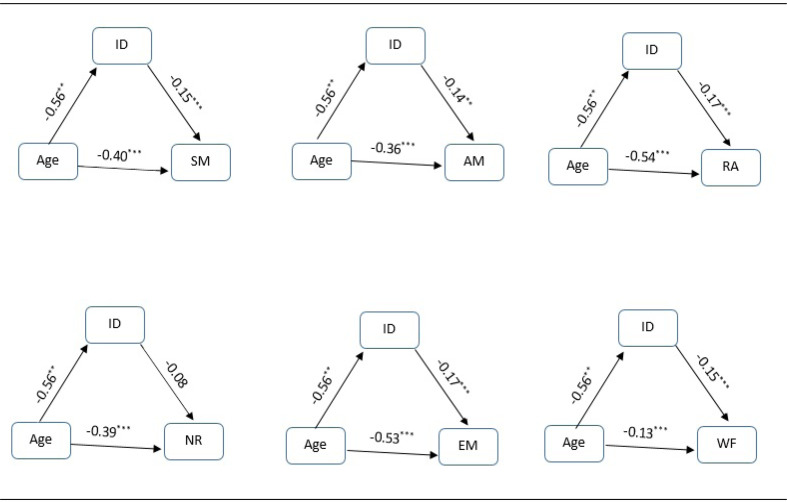
Results: The scatter plot with locally estimated scatterplot smoothing (LOESS) fitting line showed EM and WM declined steadily from age 25, while SM exhibited a mild increase up to age 55 followed by a decline. Priming did not show significant changes with age. Mediation analysis and bootstrap tests indicated that IC mediated the relationship between age and EM (β=-0.097, P=0.002) and between age and SM (β=-0.086, P=0.001).
Conclusion: Our results showed that age affects various types of memory differently, and inhibition control plays a fundamental mediating role in explaining age-related declines in SM and EM.
期刊介绍:
The International Journal of Remote Sensing ( IJRS) is concerned with the theory, science and technology of remote sensing and novel applications of remotely sensed data. The journal’s focus includes remote sensing of the atmosphere, biosphere, cryosphere and the terrestrial earth, as well as human modifications to the earth system. Principal topics include:
• Remotely sensed data collection, analysis, interpretation and display.
• Surveying from space, air, water and ground platforms.
• Imaging and related sensors.
• Image processing.
• Use of remotely sensed data.
• Economic surveys and cost-benefit analyses.
• Drones Section: Remote sensing with unmanned aerial systems (UASs, also known as unmanned aerial vehicles (UAVs), or drones).




 京公网安备 11010802042870号
京ICP备2023020795号-1
京公网安备 11010802042870号
京ICP备2023020795号-1

 分享
分享
 求助内容:
求助内容: 应助结果提醒方式:
 扫码关注我们
