Xiangjun Shi*, Qifeng Chen, Yu Deng, Xiaoyi Xing, Chao Wang, Zejie Ding and Weike Su,
{"title":"New Case of Pharmaceutical Solid-State Forms: Several Novel Solvates/Polymorphs of Nilotinib and Their Phase Transformation Controls","authors":"Xiangjun Shi*, Qifeng Chen, Yu Deng, Xiaoyi Xing, Chao Wang, Zejie Ding and Weike Su, ","doi":"10.1021/acs.cgd.2c00253","DOIUrl":null,"url":null,"abstract":"<p >Nilotinib as a type of anticancer drug was designed for the treatment of chronic myeloid leukemia that is resistant to imatinib. Presently, very few studies of nilotinib polymorphs have been reported because of the sparing solubility of the free base compared with its salt forms. Besides, there are also hardly reports for its solvates. Notably, in this study, eight different nilotinib solid-state forms, including six new solvates (form H1, form H2a, form H2b, form H2c, form H3, and form H4) and two desolvated polymorphs (form C and form D) were initially obtained. The crystallography data of form H2a, form H2b, and form H2c were obtained using single-crystal X-ray diffraction. We found that form H2a, form H2b, and form H2c were isolated site solvates. Besides, form H1 and form H3 are suspected to be isolated site solvates based on their thermal characterizations. Furthermore, we performed antisolvent experiments and used the diffusion theory to explain the mechanism successfully. In addition, we performed a series of solvent-mediated phase transformation experiments of the solid-state forms specifically and studied the transformation between nilotinib solvates. To the best of our knowledge, this is the first study to report the eight new crystal forms of nilotinib. Therefore, the present study fulfills the research blank in the crystallography field of nilotinib.</p>","PeriodicalId":34,"journal":{"name":"Crystal Growth & Design","volume":"22 8","pages":"4794–4812"},"PeriodicalIF":3.4000,"publicationDate":"2022-07-25","publicationTypes":"Journal Article","fieldsOfStudy":null,"isOpenAccess":false,"openAccessPdf":"","citationCount":"3","resultStr":null,"platform":"Semanticscholar","paperid":null,"PeriodicalName":"Crystal Growth & Design","FirstCategoryId":"92","ListUrlMain":"https://pubs.acs.org/doi/10.1021/acs.cgd.2c00253","RegionNum":2,"RegionCategory":"化学","ArticlePicture":[],"TitleCN":null,"AbstractTextCN":null,"PMCID":null,"EPubDate":"","PubModel":"","JCR":"Q2","JCRName":"CHEMISTRY, MULTIDISCIPLINARY","Score":null,"Total":0}
引用次数: 3
Abstract
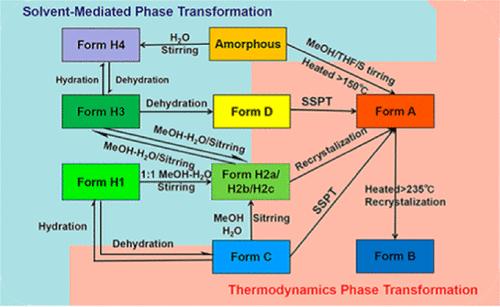
Nilotinib as a type of anticancer drug was designed for the treatment of chronic myeloid leukemia that is resistant to imatinib. Presently, very few studies of nilotinib polymorphs have been reported because of the sparing solubility of the free base compared with its salt forms. Besides, there are also hardly reports for its solvates. Notably, in this study, eight different nilotinib solid-state forms, including six new solvates (form H1, form H2a, form H2b, form H2c, form H3, and form H4) and two desolvated polymorphs (form C and form D) were initially obtained. The crystallography data of form H2a, form H2b, and form H2c were obtained using single-crystal X-ray diffraction. We found that form H2a, form H2b, and form H2c were isolated site solvates. Besides, form H1 and form H3 are suspected to be isolated site solvates based on their thermal characterizations. Furthermore, we performed antisolvent experiments and used the diffusion theory to explain the mechanism successfully. In addition, we performed a series of solvent-mediated phase transformation experiments of the solid-state forms specifically and studied the transformation between nilotinib solvates. To the best of our knowledge, this is the first study to report the eight new crystal forms of nilotinib. Therefore, the present study fulfills the research blank in the crystallography field of nilotinib.
期刊介绍:
The aim of Crystal Growth & Design is to stimulate crossfertilization of knowledge among scientists and engineers working in the fields of crystal growth, crystal engineering, and the industrial application of crystalline materials.
Crystal Growth & Design publishes theoretical and experimental studies of the physical, chemical, and biological phenomena and processes related to the design, growth, and application of crystalline materials. Synergistic approaches originating from different disciplines and technologies and integrating the fields of crystal growth, crystal engineering, intermolecular interactions, and industrial application are encouraged.



 京公网安备 11010802042870号
京ICP备2023020795号-1
京公网安备 11010802042870号
京ICP备2023020795号-1

 分享
分享
 求助内容:
求助内容: 应助结果提醒方式:
 扫码关注我们
